Managers and AI: The Most Frequent Users – But Not for Managing
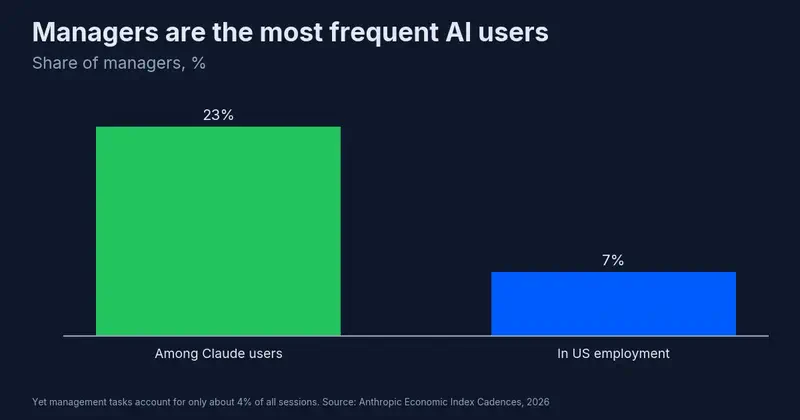
Of all the professions that most frequently open Claude, managers came in first. In Anthropic’s survey, they made up 23% of respondents – while accounting for roughly 7% of U.S. employment. Managers are overrepresented among AI users by a factor of three. Now the second number: management tasks make up just about 4% of all sessions. The people who manage are using AI for everything except managing.
Behind these two numbers lies the most precise description of how managers actually work with AI. And why the fear of “it will take my job” works differently in this profession than you might expect.
On June 26, 2026, Anthropic published a new Economic Index report titled “Cadences”. It continues the Economic Index series, which we have covered before: the Anthropic Economic Index Survey came out in April, and before that – the December study of 1.5 million Claude conversations, which we analyzed in a three-part series. This new edition draws on fresh hourly telemetry plus the first results of that same survey – about 9,700 people whose responses were linked to the actual patterns of their work with the model. The report comes in three parts: when people use AI, what they produce with it, and what they themselves think about it.
I am interested in one thread here – the management thread. Let’s trace it, and the rhythms and numbers will tell us plenty along the way.
Managers use AI for everything except managing
Back to the paradox. Managers are the most active Claude users, yet they barely apply it to management work. So where are those 23% spending their time?
Writing, analysis, and planning. Anthropic classified 93% of all conversations into specific “artifacts” – the thing the person walks away with.
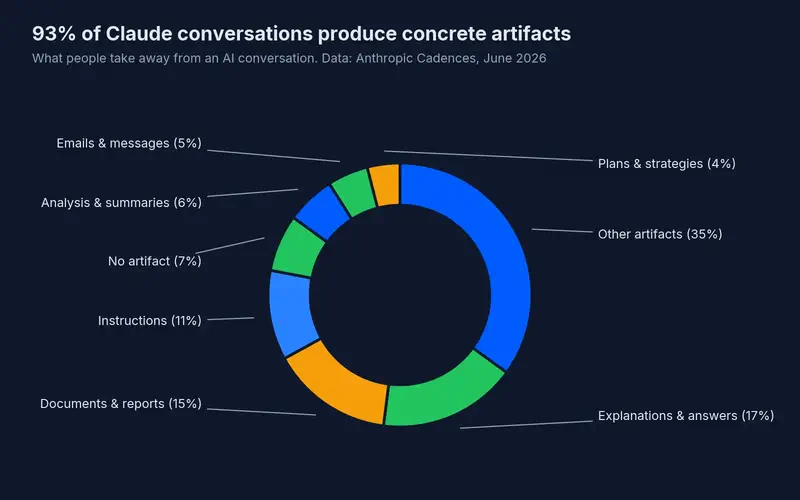
This is exactly the layer of work that wraps around management from every side. Draft a memo, polish a report, pull together arguments for a meeting, sketch out a plan. The manager delegates preparation to AI and keeps the decision for themselves.
And they do it deliberately. In the same survey, when asked what AI cannot do, respondents most often named two things: judgment and people management. The more experienced the respondent, the more confidently they said it. People with 15+ years of experience rate AI’s current capabilities about 10 percentage points lower than newcomers, and they explain it the same way: contextual judgment, situational thinking, building trust, working with people. A precise map of where the boundary runs.
Hence the pattern of use. AI handles what can be formalized; the person holds on to what cannot. The paradox of “I use it more than anyone, but not for managing” is a mature division of labor, not a gap in tool adoption.
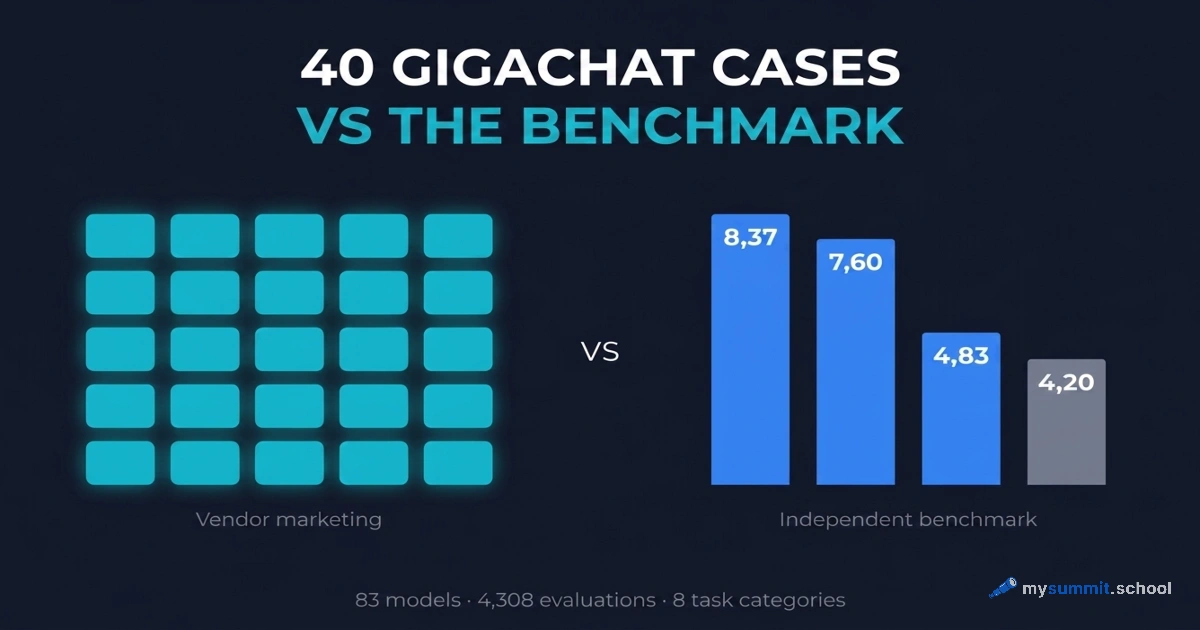
It is worth checking this observation against what managers themselves say they expect from AI: in a set of 40 real responses, the picture is the same – the demand is for removing routine around management, not for replacing the management decision.
Who works at night and why it matters
The “cadences” portion of the report – on rhythms – sounds at first glance like curious trivia, but for a manager there is a working signal buried in it.
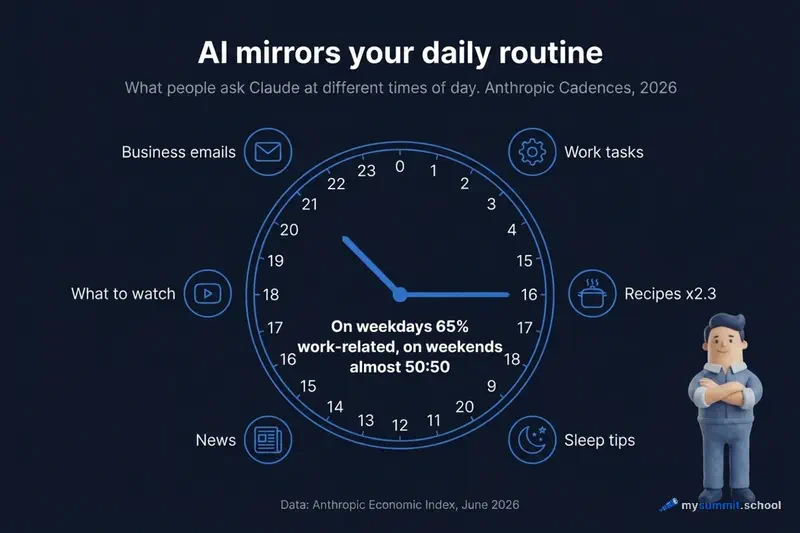
Claude usage mirrors the workweek. On weekdays, personal queries run at about 35%; on weekends that jumps to nearly 50%. Within the day, you can see an entire society’s schedule: news queries spike around 7 AM, business correspondence around 10–11 AM, recipe requests at 6 PM at 2.3x the average, sleep advice in the pre-dawn hours, and “what should I watch” recommendations in the evening. AI has become a mirror of how the human day is organized.
Here is where it gets more interesting. The work that does happen at night and on weekends skews toward higher-paid professions: the top two wage quartiles each gain about 8%, while the lower-middle quartile drops by 11%. The explanation is simple and familiar to any manager: marketers, product managers, and software engineers work outside business hours more than everyone else. And weekends open up space for something new – conversations about “starting my own business” peak on Saturdays and Sundays, while job-search activity drops on those days.
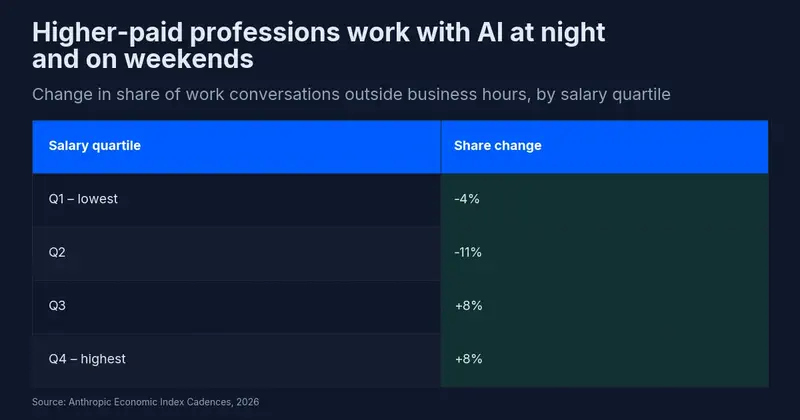
For a manager, this is not a feel-good observation. It is a reminder that the line between work and not-work has blurred for your most valuable people, and AI now records that blur down to the hour. We saw the same dynamic in our analysis of eight months of observations: AI does not save time – it compresses it. And in the piece on project rhythm and 300 hours: the tool changes not just what you do, but when.
Before moving on to the most counterintuitive part of the report, it is worth testing these observations on yourself – not on abstract case studies, but on your own tasks.
Want to see which management tasks AI handles best? 9 real manager tasks in an open module -- try them on your own work. Free.
No payment required • Get notified on launch
The higher the stakes, the more the human invests
The report’s most useful finding breaks a familiar fear. The conventional wisdom goes: the more you hand off to AI, the less you do yourself, and the faster your skills atrophy. The data say the opposite.
Anthropic measured how many tokens go into different tasks and found that cost rises with the value of the work. Professions in the top third by pay consume roughly twice the tokens of the bottom third. Building an application consumes three times the tokens of a median conversation, while a simple explanation takes about a fifth. But the key point is not in the proportions. In expensive, complex conversations, Claude produces more on every turn – and the human engages more actively too: roughly 1.5x more turns, more frequent use of extended thinking. More from AI does not mean less from the person. On the contrary – the more serious the task, the more active both sides become.
The report describes this as augmenting, not displacing. For a manager, this reframes the question entirely. The question is no longer “how much work will I give away” but “how complex a problem can I now afford to take on.” Delegating routine does not free you from thinking – it raises the bar for what is worth thinking about.
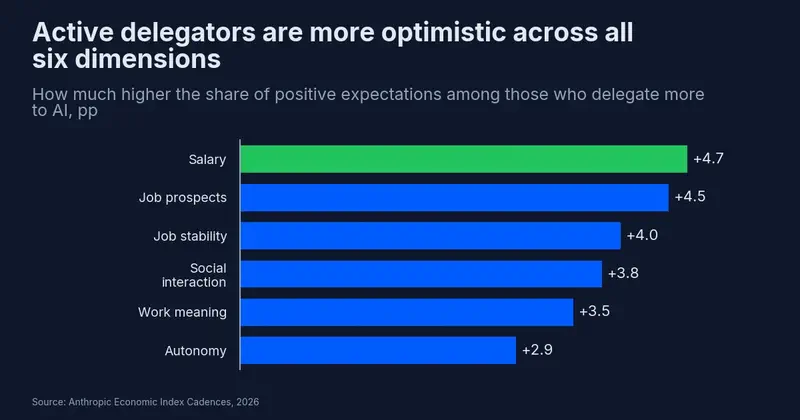
And here is the most important number for us. Those who delegate the most to AI turned out to be more optimistic than everyone else across all six dimensions of work: pay, stability, job prospects, meaning, autonomy, and human interaction. The strongest effects were on pay and employability. The effect holds even when you control for experience. Active delegators do not feel devalued. More than eight in ten say they work faster and have taken on more tasks. Nearly seven in ten report higher quality. More than half say their skills have become more valuable. The people who delegate to AI most readily also say, more than anyone else, that they have learned more during this period.
The report is honest about the caveat: self-assessment cannot rule out skill erosion that the person does not notice in themselves. There is no direct evidence of atrophy, but the data do not guarantee its absence either. The mechanism through which this can happen invisibly is something we covered separately – HBR called it thinkslop: substituting your own thinking with the model’s ready-made answers. This caveat matters also because it aligns with what we analyzed in the piece on Anthropic’s skill formation experiment. There, 52 developers showed that what matters is not the quantity of delegation, but the approach. Putting the two studies together: delegating a lot is not dangerous in itself – what is dangerous is delegating in a way that stops you from encountering difficulty.
13 rounds versus one prompt
Another finding in the report explains why what matters is not which model you use, but how you work with it.
Anthropic compared how much a person invests in the result through regular chat versus Claude Code. The contrast was striking. The median chat conversation that ends with a finished article or post consists of 13 back-and-forth rounds. The median Claude Code session producing the same post is a single human prompt. Thirteen versus one. And the gap persists even when you hold the model constant. It is not about which model is smarter. It is about which product and which delegation mode you have chosen.
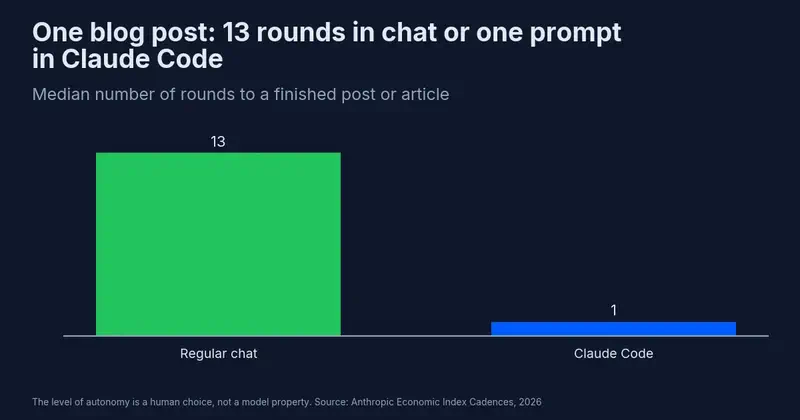
For a manager, this is a practical insight, not a technical detail. The level of autonomy is your decision, not a property of the tool. The same task can be run as a dialogue with twelve refinements or as a single assignment with a final review. The choice depends on how much you need to keep your hands on the wheel and how much you trust the task definition.
There is a related finding worth noting. Anthropic measured the complexity of inputs and outputs on a scale tied to education level – roughly the grade level in the U.S. system: 12 = high school, 16 = bachelor’s, 20 = graduate school. In practical terms, this means: if you set a task at the level of “I can describe what I want but cannot do it myself,” Claude delivers a result one level above. And the gap depends on the task type. It is widest where a person orders a finished product: graphics +2.6 levels, games +1.9, applications +1.7. Where the text goes to a live audience – blogs, articles – there is almost no gap at all.
The takeaway for a manager is concrete. If the task is assembling a report, a mockup, a template – AI will genuinely raise the quality above what you would produce yourself. If the task is writing a post under your own name or an email to your team – AI will output at your level, no higher. It lifts you where you know what you want but do not know how. It does not lift you where your voice is what matters. This is exactly the boundary that an experienced manager senses intuitively.
One prompt or a 13-round dialogue -- that is your choice, not a property of the model. Practice setting AI tasks for consistent results on 9 real manager tasks. Free.
No payment required • Get notified on launch
Who managers actually worry about
The fear of job loss shows up in the report too, and for managers it is structured in a specific way.
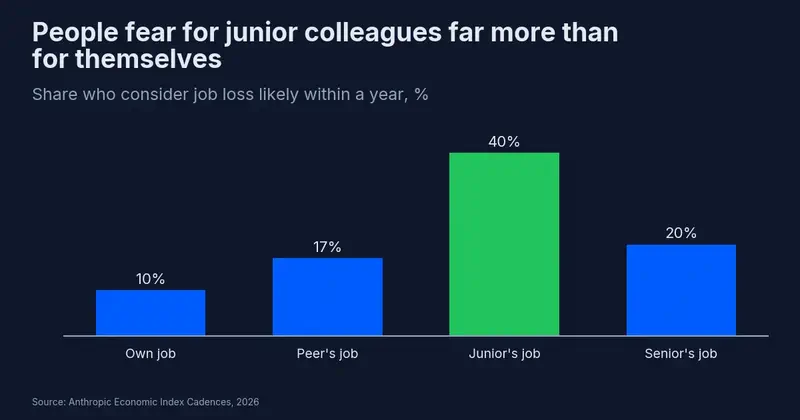
More than a third of respondents believe their responsibilities will change significantly within the next 12 months. But only 10% consider losing their own job likely. When it comes to others, the anxiety is noticeably stronger: over a third estimate the probability that a junior colleague will lose their job at above 60%. The portrait that emerges is a manager who is relatively calm about their own position but worried about their team. A professional reflex: thinking about the people you are responsible for.
There is an uncomfortable detail about gender in the data. Women made up only 12% of the linked sample, and even holding profession constant, they use Claude Code less frequently (by 6.3 points), automate less (by 7.3 points), but spend more active time in chat – working more iteratively and collaboratively. For a manager who distributes access and evaluates who is “more advanced with AI,” this is a signal: different styles of working with the tool are easily misread as different levels of proficiency, when they are simply different strategies. We wrote about why this becomes a problem at the team level in a piece on why employees hide how they use AI.
One last thing worth keeping in mind before you hand your team the mandate to “get good at AI.” In open-ended responses about hopes for the next ten years, people did not primarily choose automation for the sake of doing nothing. About 65% said the most important thing was for work to remain meaningful – for humans and AI to work together. Half wanted routine eliminated. A third mentioned shared prosperity. People do not want AI to do everything for them. They want it to remove the excess and leave the part that gives work its meaning.
Какой вы делегатор?
Anthropic делит пользователей по тому, сколько работы они передают AI. Выберите вариант – покажу, что данные значат именно для вас.
Эпизодический делегатор
В отчёте оптимизм и ощущение роста навыков достаются именно тем, кто реально делегирует, – а не тем, кто присматривается со стороны. Это не призыв «отдать AI всё». Это сигнал, что выигрыш виден только в деле. Возьмите одну задачу, на которой результат заметен за один заход: причесать отчёт, собрать аргументы к встрече, набросать план. Один реальный выигрыш меняет отношение быстрее любой статьи.
Умеренный делегатор
Вы в самой важной зоне. Эксперимент Anthropic по формированию навыков показал: дело не в том, сколько вы делегируете, а в том, как. Опасно делегировать так, чтобы перестать встречаться с трудностью. Пока вы спорите с моделью, проверяете ответы и держите руку на сложных решениях – делегирование работает на вас, а не против. Ваш следующий шаг: расширять не объём, а контроль над качеством того, что отдаёте.
Активный делегатор
По данным отчёта вы в самой оптимистичной группе: активные делегаторы выше оценивают и зарплату, и шансы найти работу, и ценность своих навыков. Но та же оговорка отчёта про невидимую эрозию – про вас в первую очередь. Чем больше вы отдаёте, тем важнее сознательно оставлять за собой суждение там, где решает человек: люди, доверие, спорные решения. Тогда высокая планка делегирования поднимает то, что вы можете взять, а не понижает то, что вы умеете.
What to do with this on Monday
The report is analytical, but several actionable takeaways fall out of it.
The data show exactly where AI strengthens a manager: preparing reports, assembling arguments, polishing documents, drafting emails – everything that wraps around a decision from every side. Judgment itself and working with people stay with you, but the faster you strip away the routine around them, the more time is left for what actually requires your thinking. That is where the most active users spend their time, and that is where the gains are obvious without explanation.
Second – focus on the hesitant, not the refusers. The signal from a related study on dividing your team into thirds converges with this report: optimism and skill growth come to those who actually delegate. One task where the payoff is visible in a single session is the best way to move an occasional user forward.
A separate nuance – working style. An employee who runs a ten-turn dialogue with AI is not necessarily weaker than one who solves it in a single prompt. A more iterative strategy often produces a more refined result. Do not rank people as laggards by their token count.
And the main point: delegation is a lever, not a threat to your skills. The data say active delegators feel growth, not decline. But the report’s careful caveat about invisible erosion means: delegate in a way that keeps you in the loop of understanding. Check the answers, argue with the model, keep your hand on the hard decisions. Then AI raises the bar for what you can take on, rather than lowering the bar for what you can do. This is exactly the logic our course for managers is built on – finding tasks where AI strengthens you, and keeping judgment where the human decides.
Learn to delegate to AI so your skills grow, not atrophy
The Foundation module builds a systematic understanding: how to find tasks where AI genuinely strengthens a manager, frame assignments for consistent results, and keep judgment in your own hands. The management specialization covers rolling out AI in a team separately.

Часто задаваемые вопросы
Why don't managers use AI for management itself?
Does heavy AI delegation actually erode your skills?
Which employees are more optimistic about working with AI?
mysummit.school
Engineering Leader at Microsoft18 years leading engineering teams. Founder of mysummit.school. 700+ graduates at Yandex Practicum and Stratoplan.