Stanford 2025: AI Boosts Productivity by 40% – What the Research Actually Shows
At mysummit.school, we constantly track AI research – not for flashy charts, but to understand how people actually use artificial intelligence. Here are the latest findings from Stanford University and WFH Research, published in November 2025, that are worth discussing.
Spoiler: AI adoption is growing, but not as fast as the media hype suggests. And there are some unexpected insights about who is adopting AI most actively.
The Big Picture: AI Usage Numbers in 2025
The SWAA study (Survey of Working Arrangements and Attitudes) is a large-scale monthly survey running since May 2020. To date, it has collected over 200,000 observations. The latest wave covers October 2025. So what does this research tell us? First – how widely AI is being used.
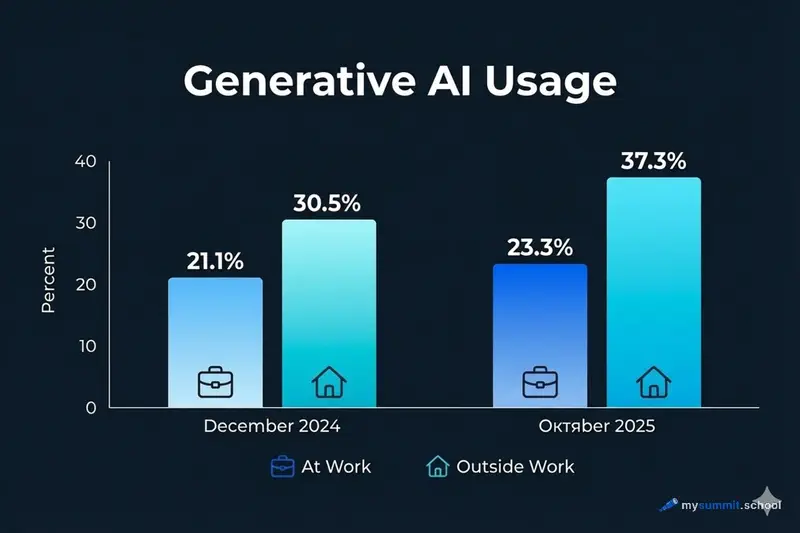
Generative AI Usage: October 2025
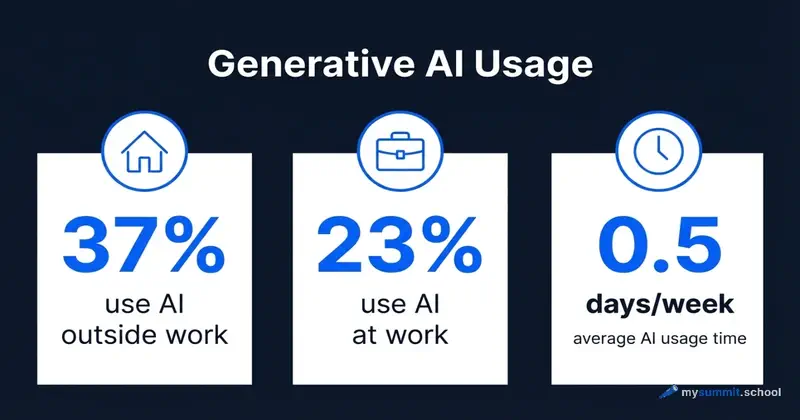
Yes, you read that right: more people use AI for personal tasks than for work. And personal usage is growing nearly 3 times faster (7% vs 2%).
Why Is AI Used More at Home Than at the Office?
This is counterintuitive. You’d think AI offers obvious benefits at work – automating routine tasks, saving time, boosting productivity. But the numbers tell a different story.
Possible reasons:
- Many companies ban or restrict the use of ChatGPT and similar tools due to data leak concerns.
- Employees don’t advertise their AI use – they don’t want to suggest their job could be automated.
- 53% of senior executives already use generative AI, but only 44% of middle managers do. There’s a skills gap.
- At home, you can experiment freely: drafting emails, planning trips, learning languages. At work, the stakes for getting things right are higher.
Remote Workers Adopt Technology Faster
This is where it gets interesting. The study found that work arrangement directly affects AI adoption.
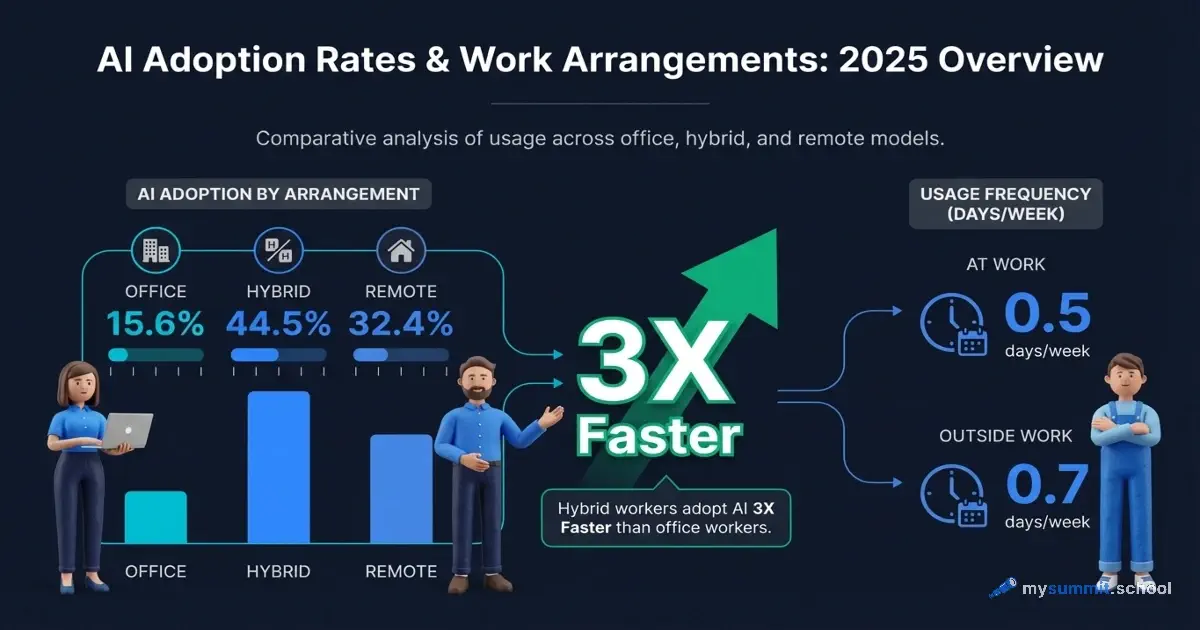
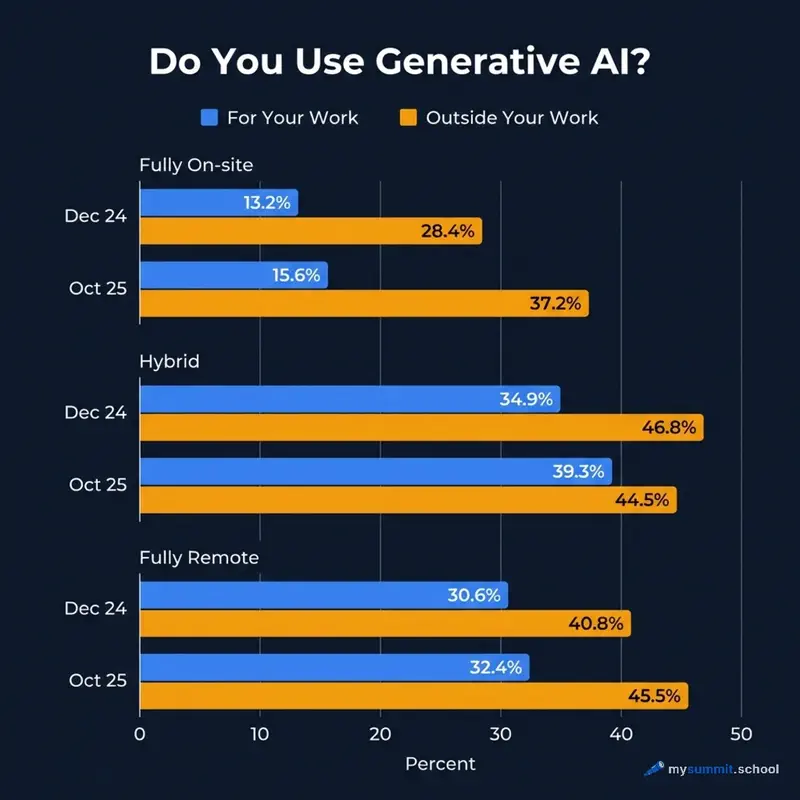
AI Usage by Work Arrangement (October 2025)
| Work Arrangement | AI at Work | AI Outside Work |
|---|---|---|
| Fully on-site | 15.6% | 37.2% |
| Hybrid | 44.5% | 44.5% |
| Fully remote | 32.4% | 45.5% |
Hybrid workers use AI at work nearly 3 times more often than those who are fully on-site.
Why? A few hypotheses:
- Hybrid work = greater autonomy. Less oversight, more freedom to experiment.
- Tech adaptability. People who successfully transitioned to hybrid work are already comfortable picking up new tools.
- Compensating for communication gaps. AI helps fill in the blanks when colleagues aren’t physically around.
Reality Check: People Use AI Just 4 Hours a Week
Now let’s come back down to earth. Yes, 37% say they use AI. But how often?
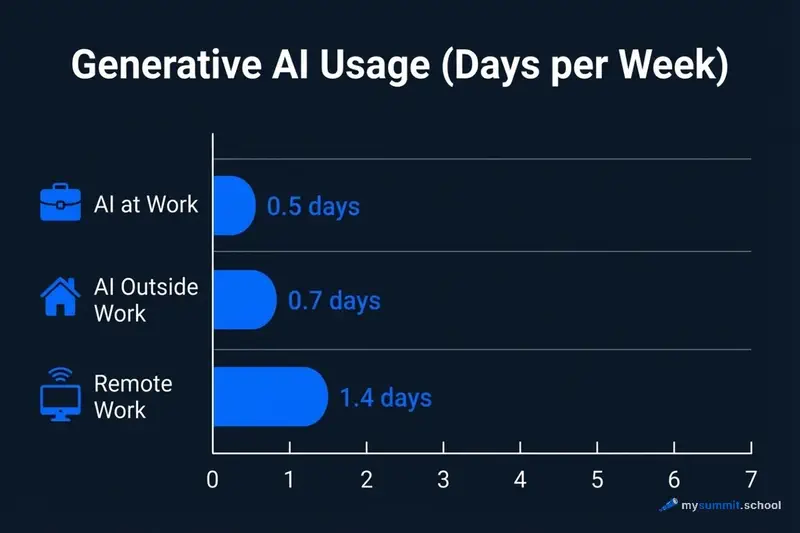
The average respondent uses generative AI:
- At work: 0.5 days per week (up from 0.4 in December 2024)
- Outside work: 0.7 days per week (up from 0.5 in December 2024)
So even those who “use AI” do it roughly once a week. It’s not a constant tool – more of an occasional assistant.
For comparison: remote (or rather, hybrid) work in the US currently averages 1.4 days per week. AI hasn’t come close to that level of integration into daily life yet.
What Does This Mean for Managers?
At mysummit.school, we work with managers who want to bring AI into their practice. Here are the key takeaways from this research:
1. The Gap Between Awareness and Usage Is Enormous
Even a year in, workplace penetration remains low. Almost everyone has heard of ChatGPT. Fewer than a quarter use it regularly. This means the main barrier isn’t access to the technology – it’s understanding how to apply it. The fear of falling behind is just FOMO.
2. Personal Experience Is the Best Teacher
37% use AI outside work, 23% at work. People learn to use AI for personal tasks first, then bring those skills to the workplace. Want your team to use AI? Encourage personal experimentation.
3. Hybrid Work Accelerates AI Adoption
If you lead a hybrid team, you have an advantage. Your people are already used to independence and new tools. Give them AI – they’ll figure it out faster.
4. Half a Day per Week Is Just the Beginning
Yes, the numbers are modest. But 25% growth in 10 months is significant. Those who learn to use AI effectively now will have a real edge in a year or two.
Conclusions
Important note: this study focuses on the US market. The picture in other regions may differ – for example, due to restricted access to certain services.
The Stanford study confirms what we see working with our students:
- AI is not just hype, but it’s no overnight revolution either. Growth is steady but gradual.
- The barrier is skills, not access. People have ChatGPT – they just don’t know what to do with it.
- Hybrid workers lead the adoption curve. If you work in a hybrid setup, you have a natural advantage.
- Personal use paves the way to professional use. People learn to use AI for themselves first.
Our school, mysummit.school, helps managers bridge this gap – from “I’ve heard of ChatGPT” to “I use AI every day for real tasks.” No theory, just hands-on practice.