AI saves your team a day a week. Where does it go?
Two numbers from BCG’s latest report. First: 42% of rank-and-file employees who use AI regularly save at least a full working day every week. Among senior leaders the figure reaches 60%. Second: 66% of those same rank-and-file employees get no instructions at all on what to spend that freed-up time on, and more than half admit they do not redirect it to anything more important.
Between those two numbers sits the most expensive leak in the modern company. A day a week per person appeared, and a day a week per person evaporated. What follows is why that happens, and what a line manager can do about it – the levers sit at exactly that level.
In June 2026 BCG published the fourth edition of its annual study AI at Work: Strategy Matters More Than Tools. It surveyed 11,749 people across 14 markets, split roughly evenly between rank-and-file employees, managers and senior leaders. The title carries the main finding, and I want to pull one thread out of the report: where the saved time goes. That thread is what turns into a practical job for a manager.
The silicon ceiling is gone
A year ago the main problem was access. Senior leaders and advanced specialists used AI while rank-and-file staff sat under a silicon ceiling: no tools, no permission, no examples. That ceiling has been broken.
74% of rank-and-file employees now describe themselves as regular AI users – up 23 percentage points in a year. For comparison, 88% of managers and 93% of senior leaders say the same. The gap between levels has almost closed. Adoption is no longer about whether a person was given a tool; almost everyone has one. We saw the same maturity in our breakdown of Anthropic’s report on managers and AI: senior people have been opening the model every day for a long time.
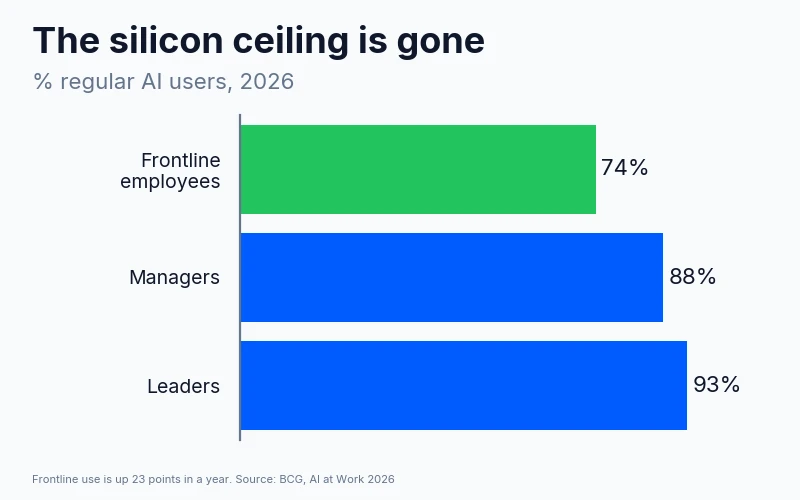
The access gap between levels has almost closed.
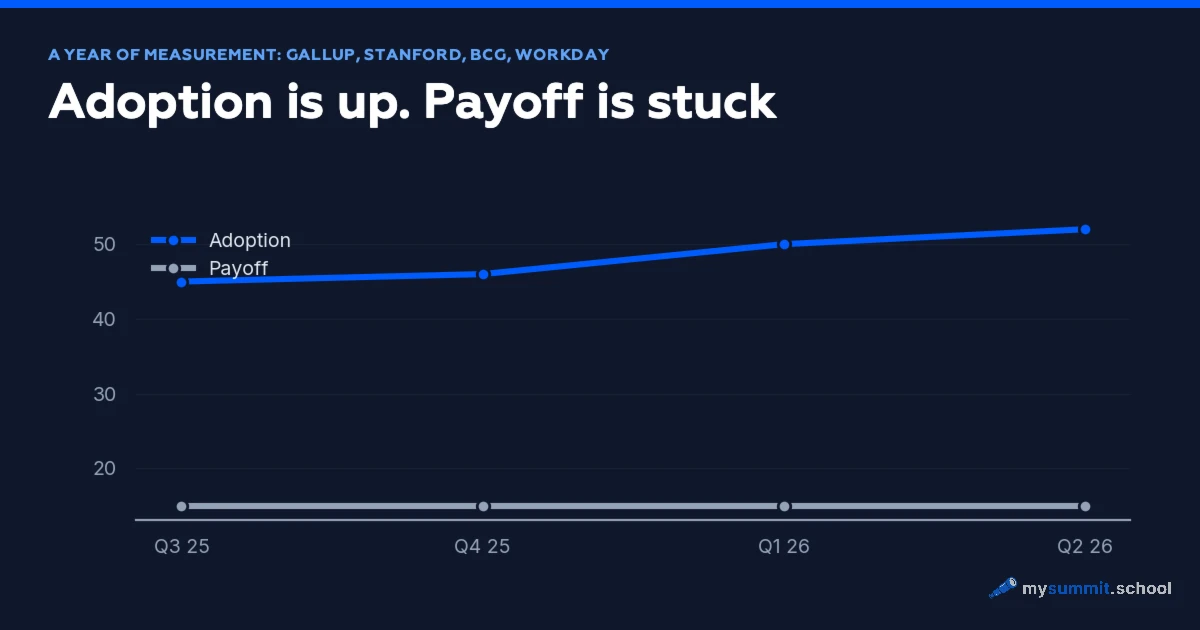
So the bottleneck has moved. It used to be technological: buy licences, open access. Now it is managerial. People use AI every day, save time, and then nothing happens. BCG states it plainly: the real challenge is organisational and managerial. That layer belongs to the line manager, not to the IT department.
Saved time runs through your fingers
Here is the mechanism. An employee uses AI to close something that used to take hours: a first draft of a report, a long email thread, a table turned into findings. An hour is free. What happens next depends on two things – whether the person knows where that hour should go, and whether anyone told them.
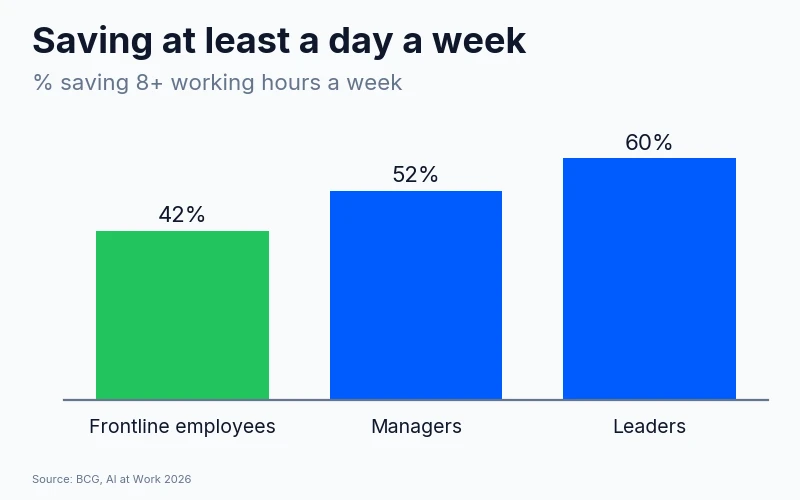
The more senior the level, the more often AI frees up a full day a week.
BCG’s answer is unambiguous: usually nobody told them. 66% of rank-and-file employees say their company gives little or no guidance on where the saved time should go. 58% admit they do not put it into more strategic work. It dissolves – into slightly more of the same, or into an extra round of checking the model’s output.
There is an odd detail here. The top and the bottom of the company see the situation completely differently. Managers and leaders are confident that guidance exists and that the effect is real. Rank-and-file employees feel the opposite. On clarity of guidance, the gap between leaders and front-line staff is 14 percentage points; on redirecting time it is 22. At the top it feels as though direction has been set. At the bottom nobody heard it. This is a common management error: you announced a priority once on an all-hands call and assumed the team had heard it. The data say otherwise.
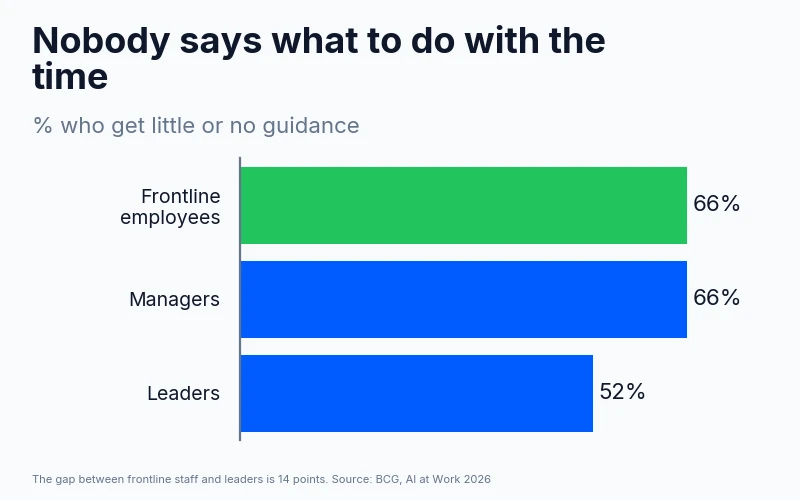
Rank-and-file employees are told least of all where the saved time should go.
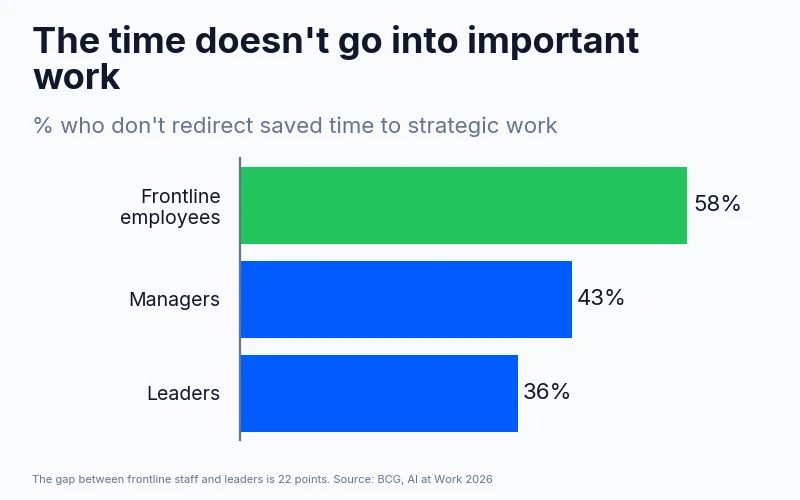
More than half of rank-and-file employees do not convert saved time into important work.
Test it on your own team: aggregate statistics say nothing about the people sitting near you. If your team saves time with AI, do you know where that time goes? Can anyone give a clear answer about what to do with the free hour, other than ‘a bit more of the same’? More often than not the honest answer is no, and that is not the employees’ fault.
Want to see which management tasks actually win you time with AI, and where that time should go? Nine real manager tasks in the open module – try them on your own work. Free.
No payment required • Get notified on launch
Strategy beats tools, and the numbers prove it
The most surprising chart in the report compares what drives results: access to tools, or clarity of strategy. BCG sorted respondents into four groups and looked at who reports a measurable business effect more often.
Weak strategy and weak tool access: 55%. Add tools but leave strategy weak: 60% – a gain of 5 points. Now the reverse: weak tool access with strong strategic clarity: 80% straight away. The distance between ‘we gave them tools’ and ‘we gave them direction’ is 25 percentage points. The combination works best, at 83%. But if you have to decide what to move first, the numbers leave little room: clarity, then licences.
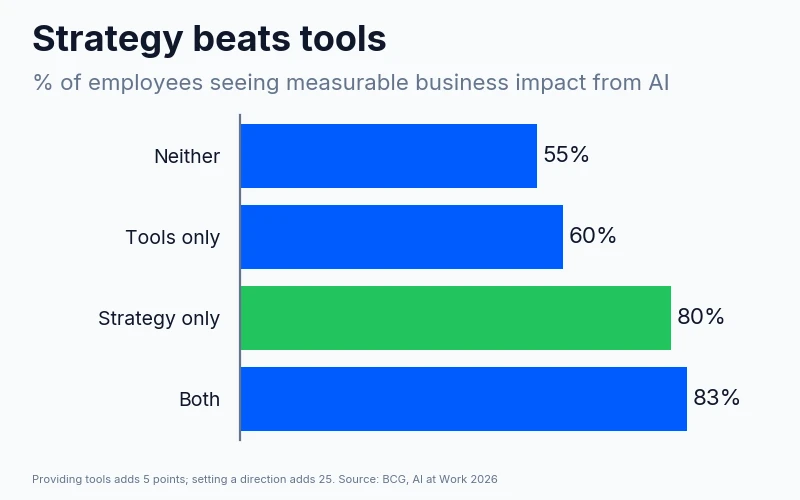
Direction multiplies the effect several times over; access to tools alone does not.
The report cuts the same question a second way, by how companies adopt AI. BCG sorts approaches into three levels. Deploy: hand out tools so everyone works faster (78% of companies). Reshape: redesign end-to-end processes around AI (57%). Invent: build new products and business models (42%, nearly double the share a year earlier). The key finding is that companies reaching Reshape and Invent win on every measure at once. Their employees are markedly more likely to save a day a week and to see a measurable effect – gaps of 22 and 24 points. Trust in leadership communication is 18 points higher too. Handing out tools does not get you there; value appears where the work itself was rethought.
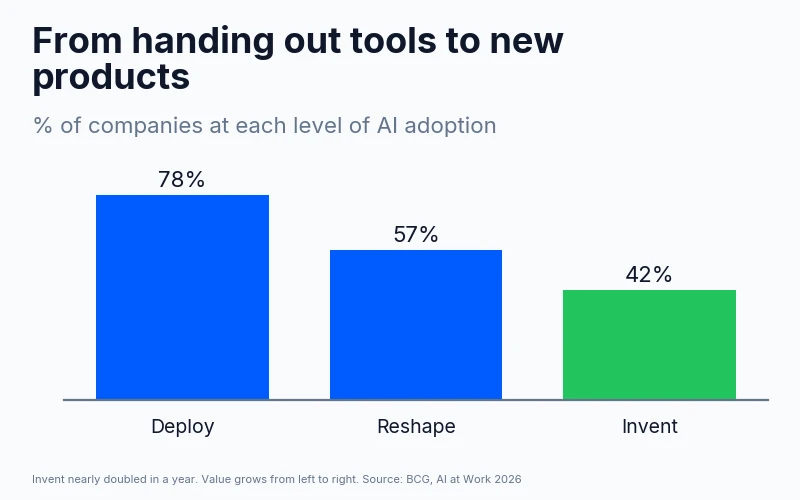
The number of companies reaching the Invent level has almost doubled in a year.
For a manager this is not an abstraction about the CEO’s agenda. You cannot redesign an end-to-end process across a corporation, but you can redesign one workflow inside your team. It starts with a simple question: if we now have a spare day a week, which task will we use it for? The prompt below turns a vague ‘we should use AI’ into a concrete plan for the team. It is filled in with a marketing team example – run it as it stands, then put in your own numbers and priorities.
Note the third item. Strategic clarity lives in a short message that reaches a front-line employee. Forty slides have nothing to do with it. The absence of that message is exactly what produces the 22-point gap between what is heard at the top and at the bottom. How to frame an assignment so that AI delivers a consistent result is covered in detail in how to set tasks with AI.
Direction lives in how you set the task. Practise framing an assignment for AI so the result is consistent, with nine manager tasks. Free.
No payment required • Get notified on launch
The joy paradox: AI makes work nicer and heavier
The report explains why you cannot count on team enthusiasm for long. BCG calls it the paradox of joy.
On one side, 67% of regular users say work has become more enjoyable. On the other, 41% report a higher mental load: checking the model, holding more context in your head, answering for an output a machine generated. Work became more interesting and heavier at the same time.
Then comes the part that matters most to a manager. BCG looked at what feeds that joy in newcomers and in people who have worked with AI for over a year. For newcomers the main driver is cognitive novelty (+43 points to joy): learning a new tool is simply engaging. After a year that driver fades to +21, and something else moves to first place – a clear AI strategy (+30 points). The honeymoon ends on schedule, and curiosity alone will not hold a team’s engagement. What holds it is an understanding of where all this is going and why.
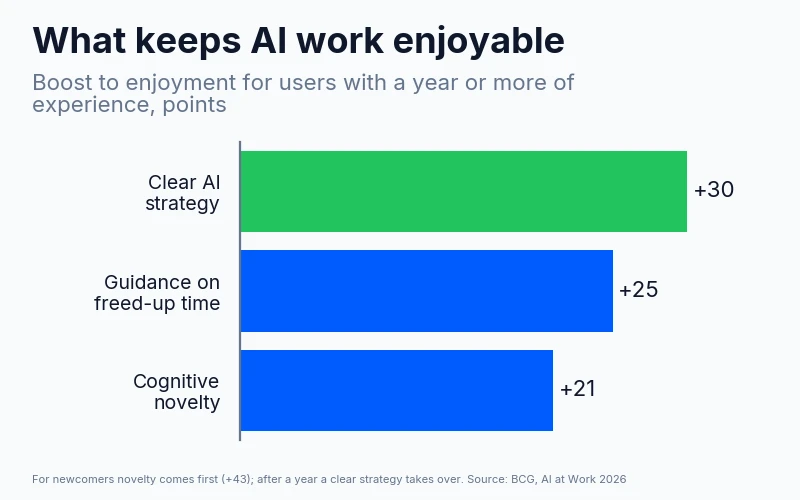
The first thrill of novelty passes; after that, engagement rests on clear strategy.
At this point the report meets what we covered in dividing a team into thirds: durable adoption grows out of people seeing the point, and the first thrill fades quickly. It also meets our note on why employees hide how they use AI – without clear direction, people write the rules themselves, and not always the ones you would choose.
The training gap is telling as well. 88% of respondents think they will need significant reskilling within the next five years. Only 36% feel properly trained. That figure has not moved in a year. Demand for skills is loud and constant; the response still lags.
The agents arrived. The operating model did not.
The last thread worth keeping in mind concerns AI agents. In a year the share of organisations with agents built into their workflows has more than doubled, from 13% to 30%. 61% of respondents think that within three years agents will be able to handle at least half of their work.
And here is the sobering part. 84% have heard of agents, but only 52% understand what one is – and that share fell 15 points over the year. The technology is outrunning comprehension.
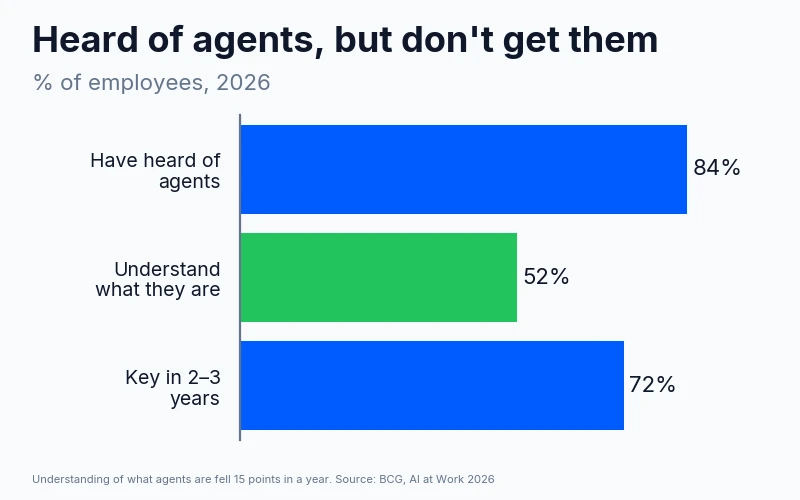
Awareness of agents is rising while understanding falls.
Half of employees also say their company has no clear rules for managing mixed teams of people and agents: who is responsible for what, who checks the output, who answers for a mistake. The operating model cannot keep up with the tool. What agents actually are, and how they differ from an ordinary chat, we covered in a separate piece on how AI agents are put together.
For a manager the point is not to confuse the availability of a technology with the readiness of a process. Nothing in these numbers says you should rush agents into production. We went through why AI pilots die on contact with reality – the disease is the same: the tool arrived, the work around it was never rearranged.
Where to start
The report is analytical, but several things follow from it that you can use immediately.
First, open a conversation about the saved time. Your team is probably already using AI; the question is where the freed hour goes. If nobody can say, you have found the leak. One explicit priority for where that time goes is worth more than five extra licences. The prompt below helps you draft that short message to the team, without the corporate fog. It is filled in with a live example too – swap the context for your own.
Second, change the scoreboard. BCG separately advises leaders to measure the business result of AI. Using the tool guarantees nothing. ‘85% of the team uses AI’ is an adoption metric. Value shows up where the freed time turned into a finished task from your quarterly goals.
Third, repeat the direction more often than feels necessary. The 22-point gap between what is heard at the top and at the bottom closes only through repetition: the priority has to be said in plain language several times. Strategic clarity is a management stance, and one announcement on an all-hands call will not establish it.
Behind all these numbers is a simple test for any manager: if the team already has a spare hour a week, can someone say plainly where it goes? If not, the direction has yet to be set. Our course for managers is built on exactly that logic – find the tasks where AI strengthens the manager, frame them so the result is consistent, and roll this out across a team without losing the point.
Turn saved time into results
The Foundation module builds a systematic understanding: where AI genuinely strengthens a manager, how to frame a task for a consistent result, and how to give a team direction so the time you gain does not dissolve. The management specialisation covers rolling AI out across a team separately.
Часто задаваемые вопросы
How much time do employees actually save with AI?
What matters more for results: access to tools or strategy?
Why does enthusiasm for AI fade over time?

mysummit.school
Engineering Leader at Microsoft18 years leading engineering teams. Founder of mysummit.school. 700+ graduates at Yandex Practicum and Stratoplan.