Bain 2025: 65% of Companies Are Deploying AI – Key Takeaways for Managers

At mysummit.school, we constantly track AI usage research – it matters to us where the reality ends and the hype begins. In our previous article, we broke down Stanford’s data on 37% AI adoption. Now we have two fresh studies with contradictory findings – and that contradiction is, in itself, revealing.
Brookings Institution says: 57% of Americans use AI, but only 19% see a productivity boost.
Bain & Company says: 80% of corporate AI projects exceed expectations.
How is that possible? Let’s dig in.
Two Studies – Two Views of AI
Brookings Institution: The View from Below
The Brookings study (June 2025) surveyed 1,163 ordinary Americans through the representative AmeriSpeak Omnibus panel. 48 demographic criteria, with separate samples for small business (247 respondents) and healthcare (147 respondents).
Focus: how rank-and-file workers and everyday citizens use AI in their daily lives.
Bain & Company: The View from Above
The Bain study (Q3 2025) surveyed corporate executives on organizational AI adoption.
Focus: how businesses systematically deploy AI at the enterprise level.
These are fundamentally different perspectives. And that’s exactly the key to understanding the contradiction.
The Headline Numbers: AI at Home vs AI at Work
The research confirms a trend we saw in the Stanford data: people use AI at home more than at work.
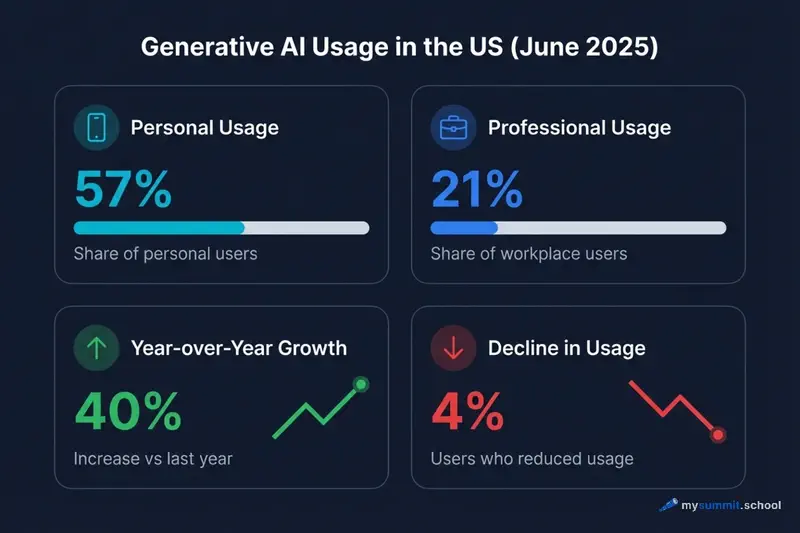
What the Numbers Show
| Metric | Value |
|---|---|
| Personal AI usage | 57% |
| Professional AI usage | 21% |
| Year-over-year growth in usage | 40% |
| Decline in usage | 4% |
Compare with Stanford data (October 2025): 37% personal, 23% professional. The methodology differs, but the trend is the same – AI gets used at home more than at the office.
✅ Takeaway: People learn AI for personal tasks first, then transfer those skills to work. This is a critical insight for anyone looking to roll out AI across a team.
The Productivity Paradox: Many Use It, Few See Results
And here’s where things get genuinely interesting.
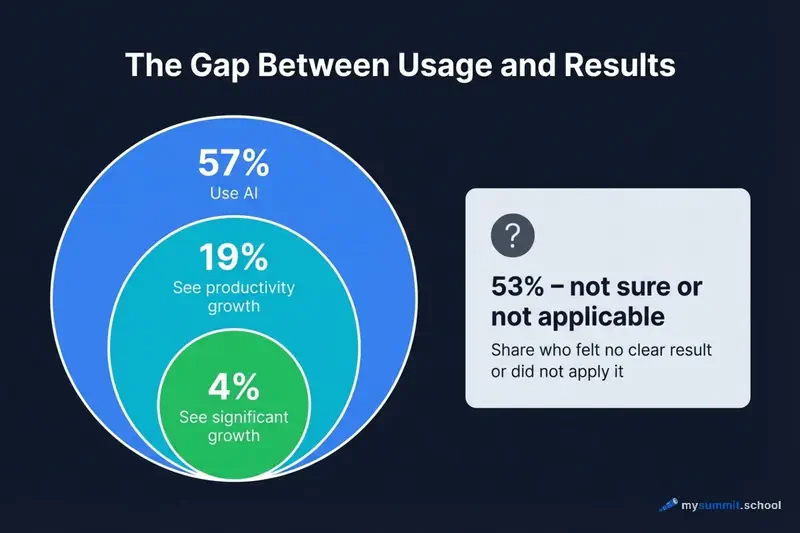
AI’s Impact on Productivity
| Productivity Assessment | % of Respondents |
|---|---|
| Improved | 19% |
| Significantly improved | 4% |
| Not sure / not applicable | 53% |
Only one in five AI users reports a real productivity gain. And just 4% describe significant improvement.
Why? A few hypotheses:
- People don’t know how to use AI properly. They tried writing a prompt once, got a mediocre result, and moved on.
- No systematic approach. AI gets used chaotically, with no integration into actual workflows.
- Inflated expectations. They expected AI to solve all their problems – and were disappointed.
- Wrong tasks. They’re trying to automate things AI isn’t particularly good at yet.
⚠️ Important: This doesn’t mean AI is useless. It means that using AI effectively is a skill – one that needs to be learned.
Demographics: Who Uses AI the Most
The research reveals clear patterns by age, education, and income.
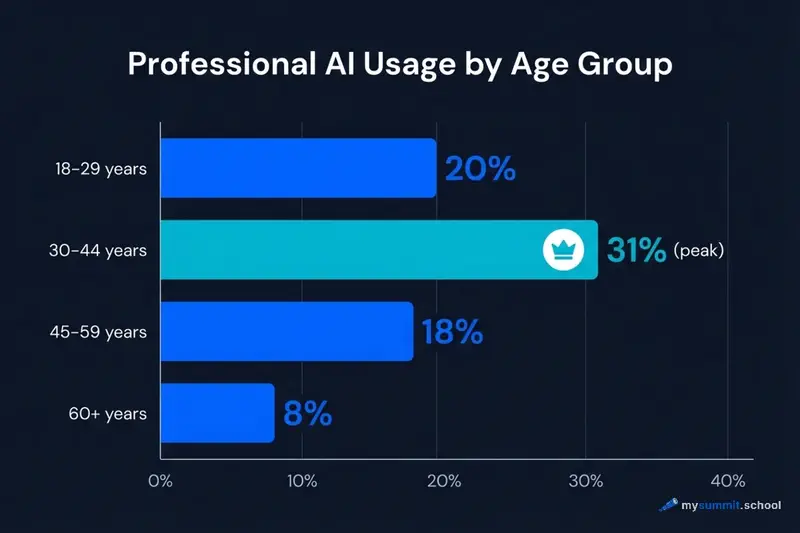
Age: The Peak Is 30–44
| Age Group | AI Usage at Work |
|---|---|
| 18–29 | ~20% |
| 30–44 | 31% (peak) |
| 45–59 | ~18% |
| 60+ | 8% |
Here’s what’s interesting: the youngest cohort (18–29) isn’t leading. 11% of them actually reduced their AI usage over the past year. Perhaps the initial enthusiasm gave way to disillusionment.
But 30–44 is the sweet spot for AI. These are people with enough experience to know which tasks are worth automating, and enough flexibility to pick up new tools.
Education: The Strongest Predictor of Usage
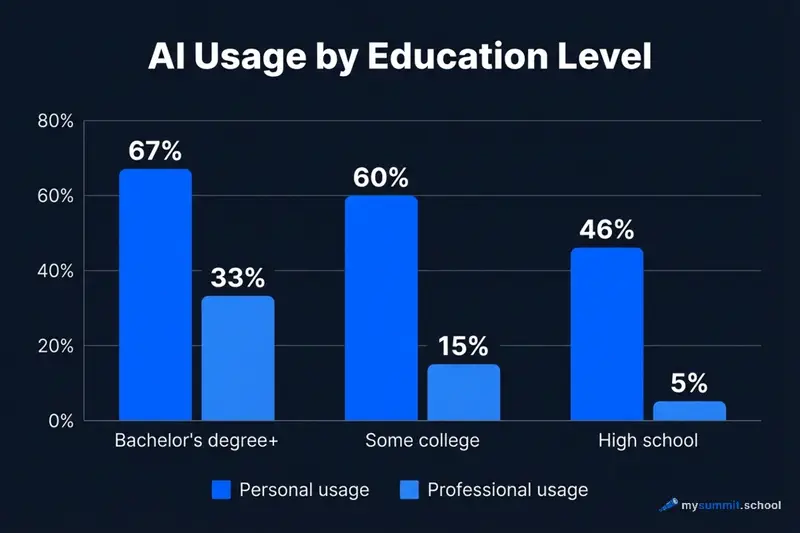
| Education | Personal Usage | Professional |
|---|---|---|
| Bachelor’s degree+ | 67% | 33% |
| Some college | 60% | ~15% |
| High school diploma | 46% | 5% |
The gap is staggering: people with a college degree use AI at work 6.6 times more often than those with only a high school diploma.
Another data point: 20% of college graduates use AI daily. Among those with a high school education – just 8%.
Income: The Correlation Is Obvious
| Income Level | AI Usage at Work |
|---|---|
| Under $30,000 | 9% |
| $100,000+ | 34% |
High earners use AI nearly 4 times more often. This makes sense: they have more tasks that require information analysis and more autonomy in choosing their tools.
What People Actually Do with AI: Top Use Cases
The most popular application is working with documents.
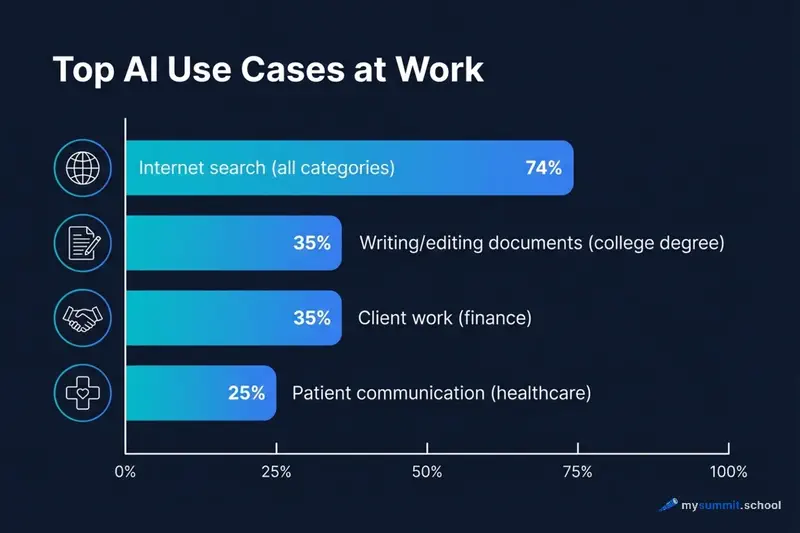
AI Usage at Work by Education
| Task | College Degree | No College Degree |
|---|---|---|
| Writing/editing documents | 35% | 2% |
| Information search | 74% | ~50% |
35% of professionals with a college degree use AI for document work. This includes:
- Writing emails and reports
- Editing and proofreading
- Summarizing long documents
- Creating presentations
Among those without a college degree – just 2%. A gap of 17.5x.
Industry Breakdown: Healthcare and Finance
Brookings separately examined two key industries.
Healthcare: 53% Use AI
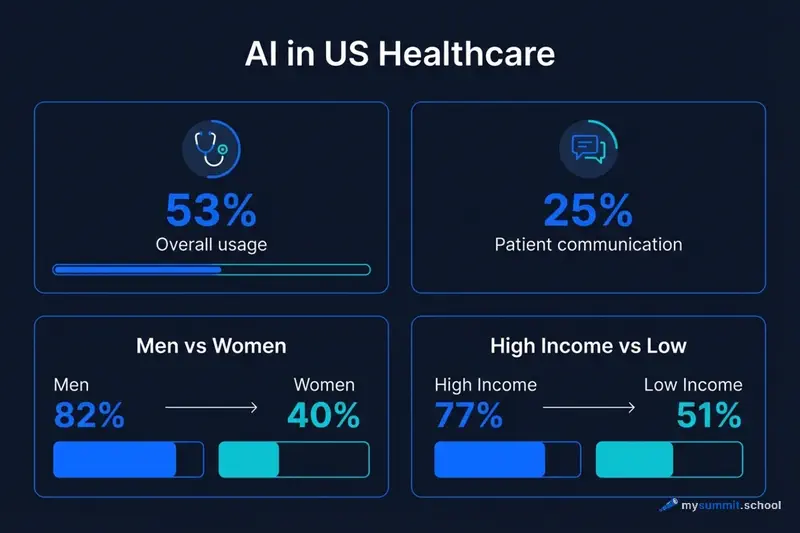
| Metric | Value |
|---|---|
| Overall AI usage | 53% |
| Patient communication | 25% |
| Men | 82% |
| Women | 40% |
The gender gap is striking: men in healthcare use AI twice as often as women. This may be related to role distribution: men more frequently hold administrative positions where AI sees heavier use.
Finance: 62% Use AI
| Metric | Value |
|---|---|
| Overall AI usage | 62% |
| Client-facing work | 35% |
| Ages 30–44 | 89% |
| Men | 79% |
| Women | 39% |
89% of finance professionals aged 30–44 use AI. That’s the highest figure in the entire study. The financial sector leads in adoption.
Company Size Doesn’t Matter
An unexpected finding: small businesses and large corporations adopt AI at the same rate.
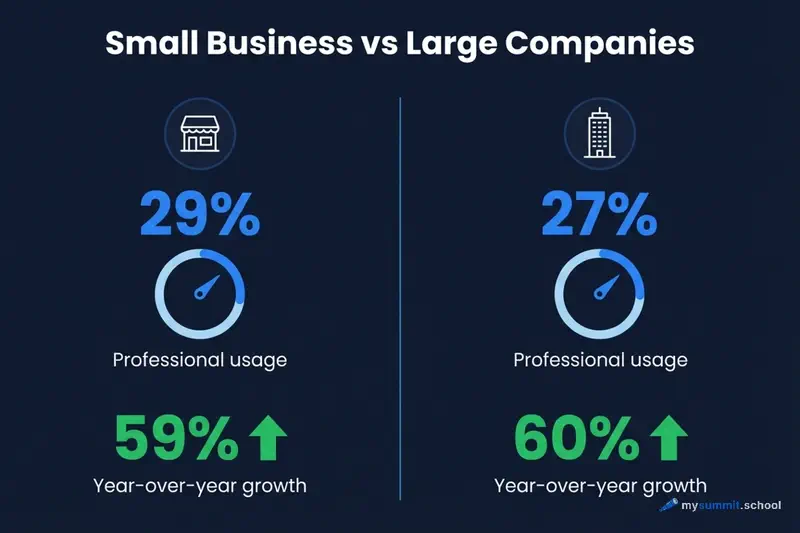
| Metric | Small Business | Large Companies |
|---|---|---|
| Professional usage | 29% | 27% |
| Year-over-year growth | 59% | 60% |
This busts the myth that AI is only for corporations with big budgets. Small businesses adapt just as fast – and sometimes faster, with less bureaucracy slowing down the adoption of new tools.
Skepticism About the Future
Possibly the most concerning signal for the AI industry:
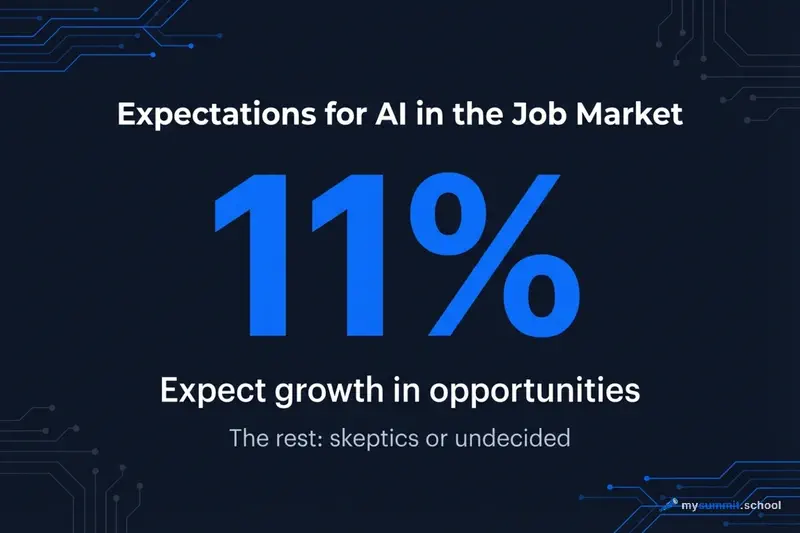
Only 11% of respondents believe AI will expand opportunities in their professional field.
This is a serious signal. People don’t believe in AI’s revolutionary impact on the job market. After two years of hype, we’re entering a period of sober reassessment.
Now the Bain Data: A Very Different Picture
If Brookings paints a picture of disillusionment, the Bain & Company study shows the opposite.
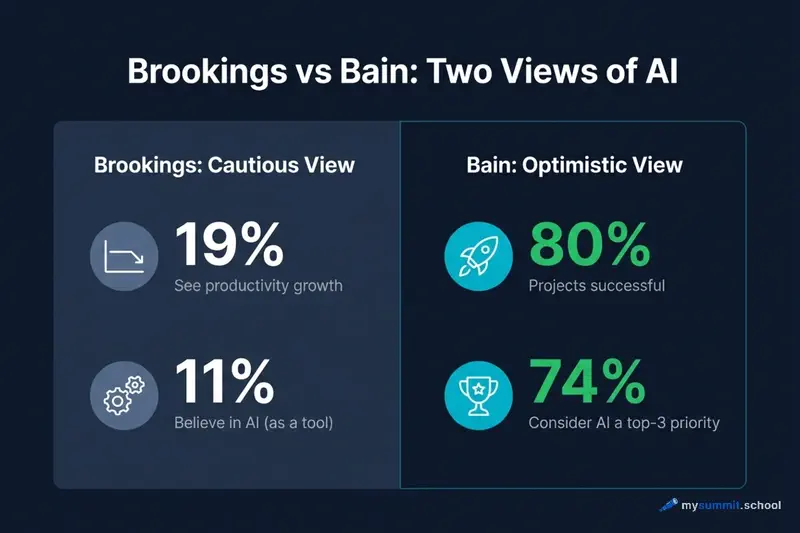
Key Bain Figures (Q3 2025)
| Metric | Value |
|---|---|
| Companies where AI is a top-3 priority | 74% (up from 60% a year ago) |
| AI as the #1 priority | 21% (more than doubled) |
| Companies actively deploying GenAI | 59% |
| Projects that exceeded expectations | 80% |
| Projects with measurable revenue growth/cost reduction | 78% |
80% of AI projects exceed expectations. That’s a radical departure from the 19% at Brookings.
Where AI Works Best (Bain Data)
| Application Area | % Usage | Transition to Production |
|---|---|---|
| Software development | 73% | 40% scaling up |
| Customer service | High growth | 20–33% scaling up |
| Marketing | High growth | 20–33% scaling up |
| Sales | High growth | 20–33% scaling up |
73% of companies use AI in software development, and 40% of pilots have already scaled to production. These are serious numbers.
Bain’s Key Insight: Automation vs Assistant
Bain uncovered a critically important pattern:
Companies using agentic automation (AI performing tasks autonomously) report 2x higher satisfaction and 50% fewer disappointments compared to those using AI merely as an assistant.
This is the key to understanding the gap between the two studies.
The Contradiction Explained: Why the Numbers Diverge
At first glance, Brookings and Bain contradict each other. But look more closely, and they’re telling the same story from different sides.
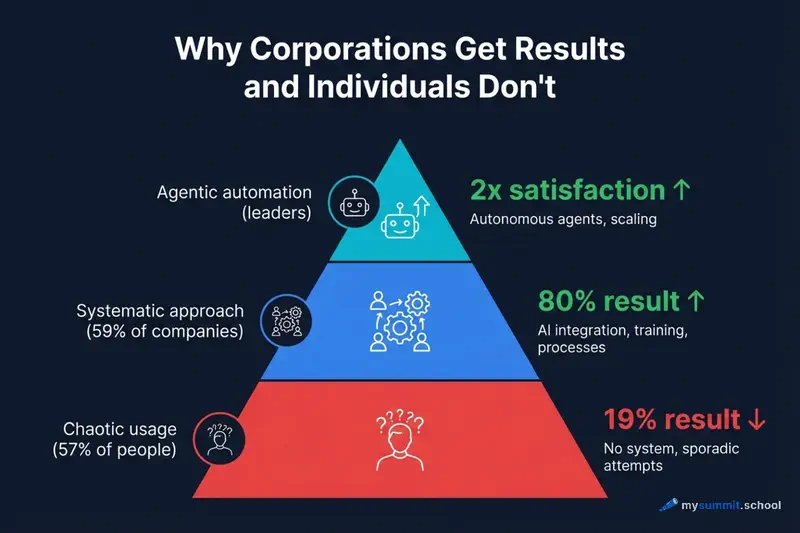
Three Reasons for the Gap
1. Systematic approach vs chaotic experiments
- Brookings (individuals): “Tried ChatGPT a couple of times, wasn’t impressed”
- Bain (companies): Deployment strategy, training, process integration
2. How results are measured
- Brookings: Subjective feeling of “am I more productive?”
- Bain: Concrete metrics – revenue, costs, task completion time
3. Level of automation
- Brookings: AI as “smart search” or a writing assistant
- Bain: AI as an autonomous agent executing entire processes
The Takeaway: It’s Not About the Technology – It’s About the Approach
⚠️ Key Insight: AI delivers when you approach it systematically. 80% of corporate projects succeed precisely because companies invest in training, integration, and measuring outcomes. Meanwhile, 81% of individual users see no payoff because they use AI haphazardly.
This explains why 74% of companies rank AI among their top-3 priorities, while only 11% of rank-and-file employees believe in its impact. Companies are already seeing results – employees aren’t. Not yet.
Why Pilots Don’t Scale
Bain identified an interesting problem even among companies: a third of AI projects get stuck at the pilot stage.
Why Scaling Fails
| Reason | % Dissatisfied |
|---|---|
| “Worked in pilot, didn’t scale” | 33% |
| Development costs exceeded expectations | ~33% |
| Data security concerns | Growing |
Even in systematic corporate deployments, every third project never gets past the experiment stage. This confirms: AI requires not just technology, but implementation skills.
What This Means for Managers
At mysummit.school, we work with managers who want to bring AI into their workflows. Here are the key takeaways from both studies:
1. A Systematic Approach Is the Key to Results
The data is clear: 19% success rate with chaotic usage vs 80% with systematic deployment. A 4x difference.
What to do: don’t just “try ChatGPT” – build a process. Identify tasks, choose tools, measure outcomes.
2. From Assistant to Automation
Bain showed: companies with agentic automation (AI performing tasks autonomously) report 2x higher satisfaction.
What to do: start with simple tasks (writing documents), but plan the transition toward automating entire processes.
3. Ages 30–44 Are the Sweet Spot for AI
Brookings confirms: peak AI usage at work is 31% among the 30–44 age group. These are people with enough experience to understand business processes and enough flexibility for new tools.
What to do: if you’re managing a team, start the rollout with this age group.
4. Data Security Is a Growing Concern
Bain notes: data security concerns are rising, especially among companies in production. This isn’t paranoia – it’s a real barrier.
What to do: train your team on safe AI usage before scaling.
5. Measure Your Results
Brookings asked subjectively: “Do you feel more productive?” Bain measured concretely: revenue, costs, time.
What to do: set metrics before you start deploying. “Saving 5 hours a week on reports” beats “it seems easier now.”
6. Small Businesses Can Compete
Brookings: small businesses (29%) and large companies (27%) adopt AI at the same rate. Less bureaucracy means faster adaptation.
Why the mysummit.school Course Solves This Problem
Both studies point to the same conclusion: the difference between 19% and 80% success is a systematic approach. Our course “Artificial Intelligence for Managers” delivers exactly that.
Practice over theory. Every lesson features real use cases from a manager’s work. Meeting prep, resume analysis, report creation – tasks you do every day.
Focus on measurable results. We don’t teach “how to write a prompt” – we teach “how to save 5 hours a week.” With concrete metrics.
The path from assistant to automation. You start with simple tasks and gradually move toward autonomous AI agents. This is precisely the path that shows 2x satisfaction growth according to Bain.
All the tools. ChatGPT, Claude, YandexGPT, GigaChat, Perplexity – you’ll learn to choose the right tool for each task.
Security. A dedicated module on protecting corporate data – what Bain calls “the growing concern” as companies scale.
Conclusions: What Both Studies Say Together
Brookings and Bain don’t contradict each other – they complete the picture:
AI works – but only with a systematic approach. 19% success with chaotic usage, 80% with deliberate deployment.
The gap between “I use it” and “I get results” is a skills gap. 57% try AI, but most don’t know how to apply it effectively.
Agentic automation is the next level. Companies that move from “AI as assistant” to “AI as autonomous agent” see 2x the payoff.
Data security isn’t paranoia. It’s a real barrier that grows as you scale.
A third of projects stall at the pilot stage. Even a systematic approach doesn’t guarantee success – you need scaling skills.
Employee skepticism vs executive optimism. 11% of employees believe in AI, but 74% of companies rank it in their top-3 priorities. Companies are already seeing results – employees aren’t there yet.
The bottom line: AI is not a magic bullet. It’s a tool that delivers results when used properly. The difference between 19% and 80% success comes down to training, a systematic approach, and measuring outcomes. That’s exactly what we teach at mysummit.school.
Want to Learn AI with Real Results?
At mysummit.school, we’ve designed a free 3-lesson module specifically for managers. No theory – just hands-on practice that delivers results in your first week.
What you’ll get:
- A detailed breakdown of tools with examples for managers
- Ready-made prompts for common tasks
- An understanding of how to choose the right AI for each task
- Skills for using AI safely in a corporate environment
- A path from “trying ChatGPT” to systematic AI usage
Sources: