ChatGPT in 2026: Complete Guide to Models and Features for Managers
ChatGPT, developed by OpenAI, has evolved from a chatbot into a comprehensive AI platform integrated across business and daily life. As of March 2026, the tool continues to evolve rapidly with new models and expanded capabilities. In March, OpenAI raised a record $110 billion in funding from AWS, Nvidia, and SoftBank. ChatGPT’s market share stands at around 45% — down from 69% in 2025 amid growing competition from /blog/en/claude-anthropic-review-2026/ and local solutions.
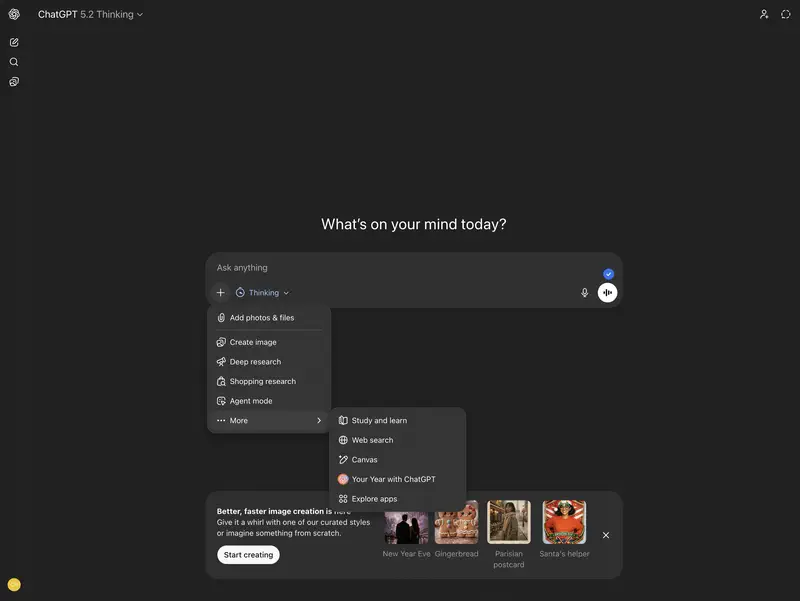
ChatGPT is not just a chatbot — it’s a multi-model platform.
GPT-5.4 (New — March 5, 2026)
GPT-5.4 is OpenAI’s new flagship model combining the best qualities of all predecessors into a unified solution.
- 1 million token context window — OpenAI finally caught up with /blog/en/gemini-google-review-2026/. That’s roughly 2,500 pages of text, allowing you to load an entire book, a mid-sized project codebase, or years of conversation archives.
- Built-in computer control — the model reads screenshots and controls keyboard/mouse. In practice, this means automating routine tasks in any application: filling CRMs, transferring data between systems, testing interfaces.
- Five reasoning levels (none / low / medium / high / xhigh) — you choose the balance between speed and depth. For simple emails — none, for strategic analysis — xhigh.
- 33% fewer factual errors compared to GPT-5.2 and 18% fewer erroneous responses.
- OSWorld-Verified: 75% — exceeds human baseline (72.4%) in operating system tasks.
- Spreadsheet handling: 87.5% — significant improvement from 68.4% in previous models, critical for managers working with Excel and Google Sheets.
For managers: GPT-5.4 is finally a universal tool that doesn’t force you to choose between “fast but shallow” and “smart but slow.” Reasoning levels let you adapt the model to specific tasks on the fly.
Available in ChatGPT as GPT-5.4 Thinking (Plus, Team, Pro) and GPT-5.4 Pro (Pro, Enterprise). API: from $2.50 per 1M input tokens.
GPT-5.3-Codex
GPT-5.3-Codex is a specialized agentic model for automation (February 2026).
- Speed and responsiveness: 25% faster than predecessors — meaning no pauses when generating complex reports or code, critical for live demos and quick edits.
- Autonomous delegation: Optimized for “turnkey” work. You set the task (e.g., “check all project files for errors”), and it independently uses the right tools until completion.
- Self-diagnosis: First model capable of finding and fixing errors in its own logic before delivering answers to users.
GPT-5.3-Codex-Spark (New — March 2026)
GPT-5.3-Codex-Spark is a real-time coding model with ultra-low latency, the first result of OpenAI’s partnership with Cerebras.
- Over 1,000 tokens per second — instant responses when editing code, without pauses or waiting.
- 128K token context window — enough for working with large files and projects.
- Runs on Cerebras Wafer Scale Engine 3 — specialized inference accelerator complementing OpenAI’s GPU infrastructure.
- Minimal edits by default — makes targeted changes without running tests unless requested.
For managers: Codex-Spark accelerates technical teams — developers get instant responses, shortening iteration cycles. If your team uses Codex for automation, Spark makes this process interactive.
Available in research preview for ChatGPT Pro (Codex app, CLI, VS Code).
GPT-5.2
GPT-5.2 is a powerful previous-generation model that remains available and is the default ChatGPT model for most users.
What this means for managers? In Thinking mode, the model shows step-by-step reasoning. You see not just the “final result,” but the logic behind it. This lets you control output quality and use AI for hypothesis testing where error costs are high.
Context window is 400,000 tokens. Thanks to Reasoning Window technology, the model maintains logical coherence even in long conversations.
Important: With GPT-5.4’s release, GPT-5.2 Thinking has been moved to Legacy Models. Complete shutdown of GPT-5.2 Thinking is scheduled for June 5, 2026 — users have three months to migrate.
GPT-5.2 works best with structured prompts (JSON, Markdown, XML). Clear instruction hierarchy improves accuracy of complex commands by 20%.
GPT will execute any prompt. The open module shows exactly where your tasks fail — 9 real tasks, free.
No payment required • Get notified on launch
Retired: Models Removed from ChatGPT
February 13, 2026 — OpenAI conducted a major cleanup: GPT-5 (base), GPT-4o, GPT-4.1, GPT-4.1 mini removed from ChatGPT. Users automatically migrated to GPT-5.2. API access to most models remains, but GPT-5.4 or GPT-5.3 recommended for new projects.
GPT-5.1 removed from ChatGPT March 11, 2026 — GPT-5.1 Instant, GPT-5.1 Thinking and variants discontinued.
GPT-5 was the main workhorse from August 2025 — expert-level knowledge, 400K context, 45% fewer hallucinations. Now replaced by GPT-5.2/5.4.
GPT-4.1 and 4.1 mini — still available via API and Azure. GPT-4.1 with 1M context remains useful for specific technical tasks.
GPT-4o — removed from ChatGPT February 13, 2026 (enterprise access until April 3, 2026). Less than 0.1% of users at removal.
o3 and o3-mini (Deep Reasoning)
o3 models — “heavy artillery” for tasks requiring complex logical inference. With GPT-5.4 and its reasoning levels (xhigh), o3’s role narrows to most extreme tasks.
For managers this means: solving complex logistics problems, identifying hidden patterns in financial data, and step-by-step analysis of crisis situations considering dozens of factors.
Sora 2 (Video)
Sora 2 — text-to-video generation tool. Sora 1 fully disabled March 13, 2026 (all content deleted — export required before that date).
- Physical accuracy: Model no longer “teleports” objects — if a basketball player misses, the ball realistically bounces off the rim. Complex motion support (gymnastics, flips).
- Synchronized sound: Built-in generation of background sounds, speech, and sound effects — separate audio production not needed.
- Cameos (Characters): Insert real people into video after short recording of video and voice in the app. Works for people, animals, and objects.
- Multi-frame consistency: Model maintains world state between frames, enabling coherent narratives.
- iOS Sora app: New social platform — creation, remixing others’ generations, content feed, Characters feature.
For business: Create ad creatives in minutes, prepare training videos for employees and product presentations without video production.
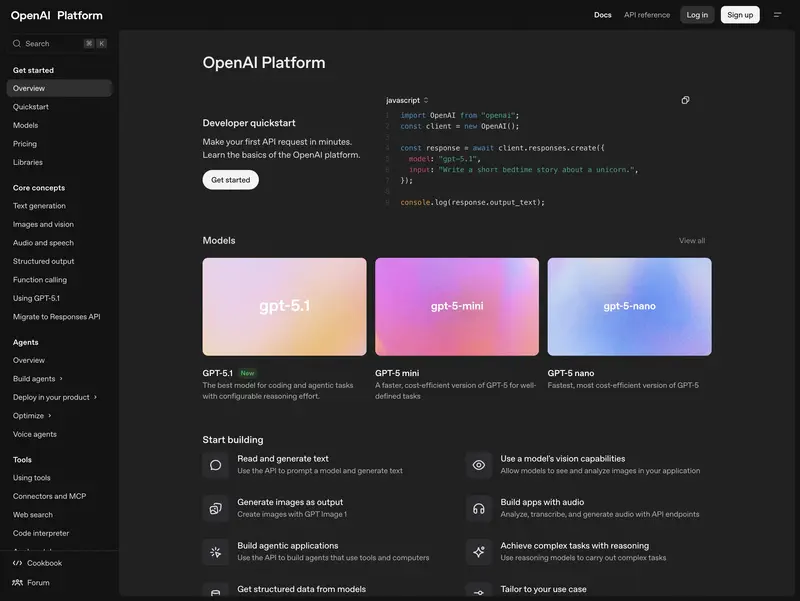
OpenAI Frontier (New — February 5, 2026)
Frontier — enterprise platform for creating, deploying, and managing AI agents. OpenAI positions it as “hiring AI employees”: agents get their own identity, permissions, and constraints.
- Shared business context: Frontier connects to CRM, data warehouses, ticket systems, and internal apps, creating unified context for agents.
- Agent memory: AI employees accumulate experience from past interactions, improving quality over time.
- Flexible deployment: On-premises, cloud, or OpenAI servers.
- Security: Each agent has its own identity, explicit permissions, and guardrails for regulated industries.
Early customers include HP, Intuit, Oracle, State Farm, Uber, Cisco, and T-Mobile.
For managers: Frontier lets you “hire” AI assistants for routine tasks: filling reports, processing tickets, monitoring metrics. The platform is managed like an employee team, not an IT project.
Agents look impressive in demos. In the open module — 9 manager tasks where AI silently fails. Test in practice.
No payment required • Get notified on launch
Results in Our Benchmark
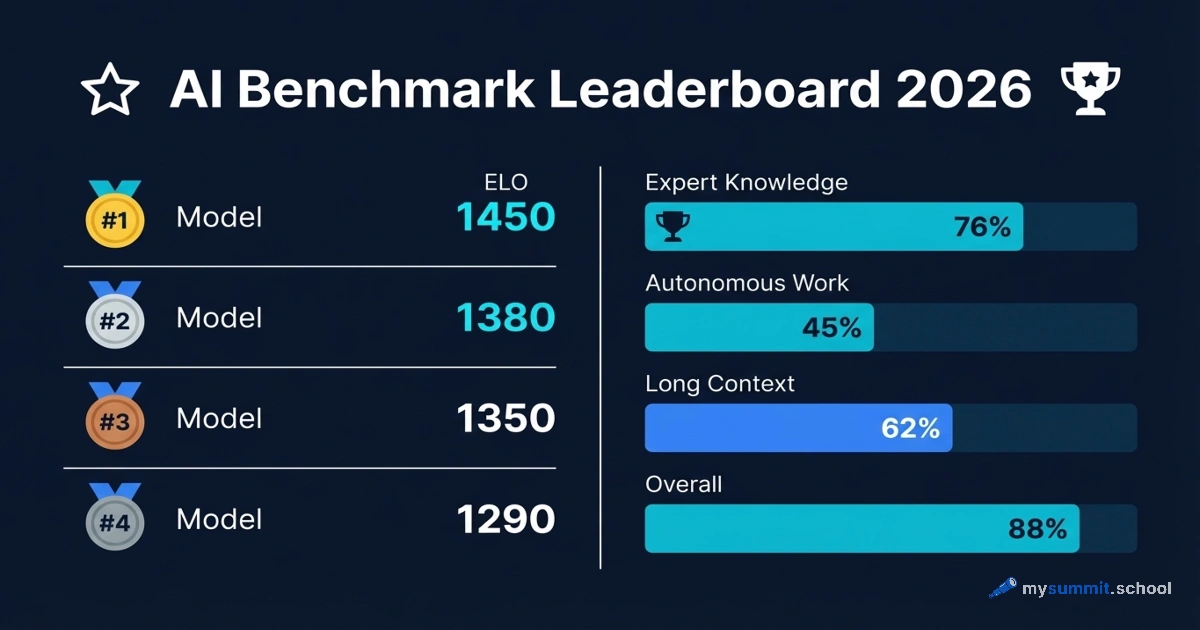
We tested six OpenAI models in our benchmark across eight categories of manager tasks — communication, planning, team management, problem-solving, information retrieval, learning and development, regional specifics, decision analysis. Results are telling.
GPT-5.4 — undisputed benchmark leader. Consistently high results across nearly all categories: communication, planning, team management, problem-solving — all in the elite group. Only noticeable weakness — regional specifics: model confuses Kazakh holidays and avoids specific tax calculations. One of the strongest models in the entire test.
GPT-5.2 Pro — close to the flagship. Best result among all models in “information retrieval” category. Strong positions in communication and team management.
GPT-5 Mini — benchmark’s biggest surprise. Free model showed best result among all tested models in “communication” category. You don’t need to pay premium for quality business communication — GPT-5 Mini on the free tier outperforms $200/month flagships. However, noticeably weaker in learning and development, as well as regional specifics.
GPT-5.2 — solid all-rounder. Best among OpenAI models in regional awareness, strong positions in team management.
GPT-5.4 Mini — holds confidently in upper tier, even results without failures.
GPT-4o — radically inferior to entire GPT-5.x lineup. Model ended up in benchmark’s lower group, and the gap between generations is huge. If you’re still using GPT-4o via API — switching to any GPT-5 model will provide a qualitative leap.
Competition from Chinese models. While OpenAI dominates Western markets, Chinese AI labs have produced remarkably competitive alternatives. Kimi K2.5 performs at the level of top Western models and leads in information search capabilities. MiniMax M2.7 delivers exceptional team management skills, accessible at chat.minimax.io. GLM-5 offers strong performance at competitive pricing through chat.z.ai. MiMo V2 Omni from Xiaomi demonstrates top-tier team management and learning capabilities, available at mimo.xiaomi.com. These models are increasingly viable alternatives worth exploring alongside ChatGPT.
What to Keep in Mind
- Hallucination levels continue to decrease: GPT-5.4 shows 33% fewer factual errors than GPT-5.2. Huge progress compared to early models.
- Despite improvements, hallucinations still possible, especially in specialized areas.
- Responses can sound templated. Use structured prompts for better results with new models.
- There are limits on message counts and other technical constraints.
How Different ChatGPT Models Handle Manager Tasks
Document work. GPT-5-mini excels at generating standard emails and reports. GPT-5.4 with 1M context and improved spreadsheet handling (87.5%) — best choice for analyzing large documents and creating strategically important materials.
HR management. GPT-5-mini helps with initial screening. GPT-5.4 with computer use can automate routine in HR systems. GPT-5.2 remains a good choice for complex HR situations and onboarding program development.
Project management and automation. GPT-5.4 with computer use — new standard for automation in any application. GPT-5.3-Codex — ideal for automating technical routine, while Codex-Spark accelerates developer iterations in real-time. OpenAI Frontier — for large-scale AI agent deployment in enterprise environments.
Strategic planning. GPT-5.4 in xhigh mode — new gold standard for C-level tasks. o3 model specializes in root cause identification and complex mathematics.
Learn to work with ChatGPT for real manager tasks
ChatGPT is a powerful ecosystem, but without a structured approach, 80% of capabilities remain unused. In the course, we break down how to craft prompts for document analysis and report automation — even if you're just starting.
Continue learning
Open the textbook and pick up where you left off
Quick Reference
- GPT-5.4: flagship — 1M context, computer use, 5 reasoning levels, 33% more accurate than GPT-5.2.
- GPT-5.3-Codex: autonomous agents for development, 25% faster, self-debugging.
- Codex-Spark: real-time coding, 1000+ tokens/s, 128K context, Cerebras partnership.
- GPT-5.2: default ChatGPT model, Reasoning Window (Thinking ends June 5, 2026).
- GPT-5 / 5.1: removed from ChatGPT (February–March 2026), still available via API.
- o3 / o3-mini: mathematics, logic, deep reasoning.
- Sora 2 / Pro: video content with physical accuracy, iOS app, Sora 1 disabled.
- Frontier: enterprise AI agent platform (HP, Oracle, Uber, etc.).
- GPT-4o / 4.1 (Retired): removed from ChatGPT, partially available via API.
ChatGPT Pricing (March 2026)
- ChatGPT Free — $0/month: access to GPT-5-mini, o3-mini (reasoning). Basic functionality, message limits, basic memory.
- ChatGPT Go — $8/month (New): GPT-5.2 Instant, 10x more messages/files/images than Free. Expanded memory. Available in 170+ countries.
- ChatGPT Plus — $20/month: access to GPT-5.4 Thinking, GPT-5.2, o3, Codex. DALL-E 4 image generation, Sora 2 video (limited).
- ChatGPT Creator — $50/month: all Plus features + Sora 2 Pro (2,500 credits), priority access to new media models.
- ChatGPT Pro — $200/month: unlimited access to GPT-5.4 Pro, GPT-5.3-Codex, Codex-Spark, GPT-5.2 and o3, maximum speed, 10,000 Sora 2 Pro credits.
- ChatGPT Team — $25/user/month (annual) or $30 (monthly): 100 messages/3 hours, shared GPTs, data not used for training.
- ChatGPT Enterprise: enterprise-grade security, GPT-5.4 Pro, unlimited GPT-5.3 and 5.2, Sora 2 Pro API access, OpenAI Frontier platform.