What Is AI in Simple Terms: A Manager's Guide for 2026
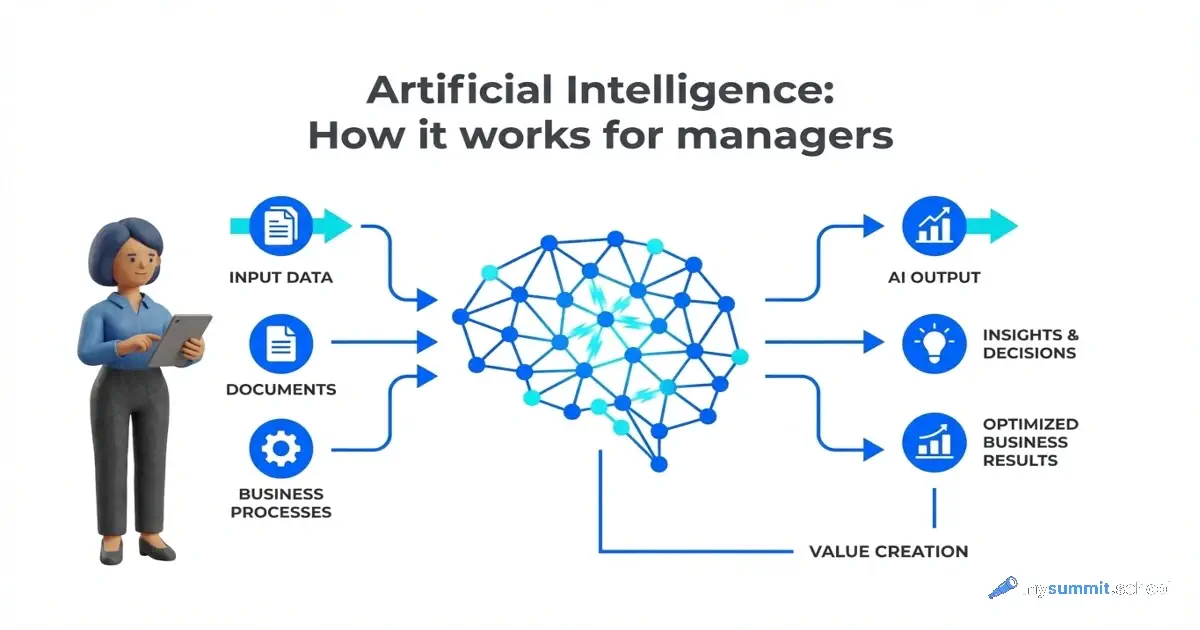
Thousands of managers google “what is AI in simple terms” every day – not because they aren’t smart enough, but because textbook explanations are useless for making real decisions. The problem isn’t the complexity of the topic. The problem is that most explanations were written by engineers for engineers.
Let’s cut through the jargon and formulas – and focus on what a manager actually needs to know.
Artificial intelligence (AI) is a program that learns from examples and draws conclusions that resemble human reasoning. Not because it “thinks,” but because it recognises patterns in enormous volumes of data and applies them to new situations. The one thing that matters for managers: AI is a tool that can process information faster and cheaper than a human. Everything else is implementation detail.
How AI Actually Works: An Analogy
Forget the robots from science fiction. Real AI works differently.
Picture a new hire you’ve given 10,000 examples of strong and weak CVs, labelled “hire / reject.” After a year, they’d learn to screen candidates. They don’t understand the meaning of the words – they’ve memorised which combinations of signals correlate with which outcome.
That’s exactly how AI works:
- Training – the system is fed an enormous number of examples (billions of texts, images, data points)
- Pattern recognition – the algorithm finds statistical relationships: “after word X, word Y frequently follows,” “this photo has the features of a cat”
- Application – when a new query arrives, the system predicts the answer based on what it has seen before
No understanding, no consciousness, no emotions. Just very sophisticated statistics. Understanding this is what lets you accurately assess both the capabilities and the limitations of AI.
Neural Network, AI, ChatGPT: Sorting Out the Confusion
These terms get used interchangeably, even though they’re not the same thing:
| Term | What it is |
|---|---|
| Artificial Intelligence (AI) | The umbrella term for all systems that mimic intelligent behaviour |
| Neural network | One type of AI, inspired by the structure of the brain. Currently the dominant approach |
| Large Language Model (LLM) | A type of neural network trained on text. The foundation of ChatGPT, Claude, Gemini |
| Generative AI (GenAI) | AI that creates new content: text, images, code, audio |
| ChatGPT | A specific product from OpenAI, built on an LLM |
The simple logic: neural network is a subset of AI. ChatGPT is a specific product running on a neural network. Generative AI is a category of tasks that some neural networks solve.
When a colleague says “let’s implement a neural network” – they almost certainly mean one of the generative AI systems like ChatGPT or Claude. To understand how these systems are objectively evaluated and compared, it’s worth getting familiar with how LLM benchmarks work.
The Two Types of AI That Matter for Managers
Narrow AI solves one specific task better than a human. Examples already in your life:
- Spam filters in email
- Recommendations on Netflix and YouTube
- Face recognition on your phone’s lock screen
- Voice input (Siri, Google Assistant)
- Credit scoring at banks
You’ve been using narrow AI for years – you just never called it that.
Generative AI (GenAI) creates new content on demand in plain language. This is what triggered the revolution from 2022 onwards:
- ChatGPT, Claude, Gemini – text generation, document analysis, question answering
- Regional AI tools – for working with sensitive data under local compliance requirements
- Midjourney, Stable Diffusion – image generation
- Suno, ElevenLabs – audio generation
GenAI tools are the ones showing up in every strategy deck and boardroom discussion right now. If you want to compare them against specific criteria, a full comparison of nine tools in 2026 will help you make an informed choice.
How AI Predicts the Next Word: A Clear Picture
The most common misconception is that ChatGPT “understands” meaning and “thinks through” its answer. In reality, the underlying task is far simpler – and more elegant: predict which token (a word or part of a word) should come next.
You can trace this mechanic from a 19th-century mathematics dispute, through nuclear weapons and Google’s algorithm, all the way to modern LLMs. The Veritasium video below tells the story in that exact order. The section on predictive text starts at 25:25, but the full journey from Markov chains matters for understanding the context.
The same principle in English
Take the word “Good”. In a large English text corpus it appears most often in three stable combinations:
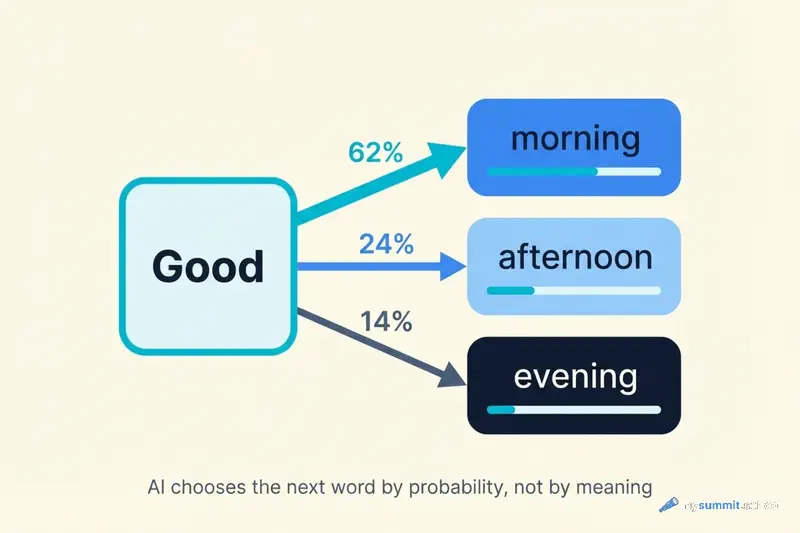
When ChatGPT receives the start of a phrase “Good…”, it doesn’t “think” about which word is correct. It simply knows from training that after “Good” the word “morning” appears in 62% of cases – and picks the most probable option.
This is why the most frequent two-word sequence in English is “of the” (as part of “of the world”, “of the year”, “of the time”). The model has seen it trillions of times and knows: after “of” the probability of “the” is very high. This isn’t understanding – it’s memorised co-occurrence frequency.
The key point for managers: what looks like “intelligence” is probability transitions between tokens, scaled to hundreds of billions of parameters. That’s also why hallucinations happen: the model doesn’t know what’s true, only what’s statistically probable.
What AI Can Actually Do Right Now
For a manager, the relevant question isn’t technical – it’s practical: what can I hand off to AI today?
Working with text:
- Write, edit, rephrase any document
- Summarise long reports, correspondence, meetings (from a transcript)
- Translate into any language while preserving style
- Draft versions of emails, presentations, briefs
Data analysis:
- Find patterns in large spreadsheets
- Compile a summary report from scattered data sources
- Answer questions about an uploaded document (“find all mentions of risks”)
Generating ideas:
- Suggest solutions for a described problem
- Play devil’s advocate and critique your plan
- Sketch out a structure for a strategy or project
Automation:
- Write code for simple tasks (Excel formulas, Python scripts)
- Fill in templated documents from data
- Classify incoming requests
9 diagnostic lessons: try applying AI to real tasks – and find out which mistakes most managers make. No registration required.
No payment required • Get notified on launch
What AI Can’t Do – and Why That Matters
Understanding the limitations saves you from expensive mistakes.
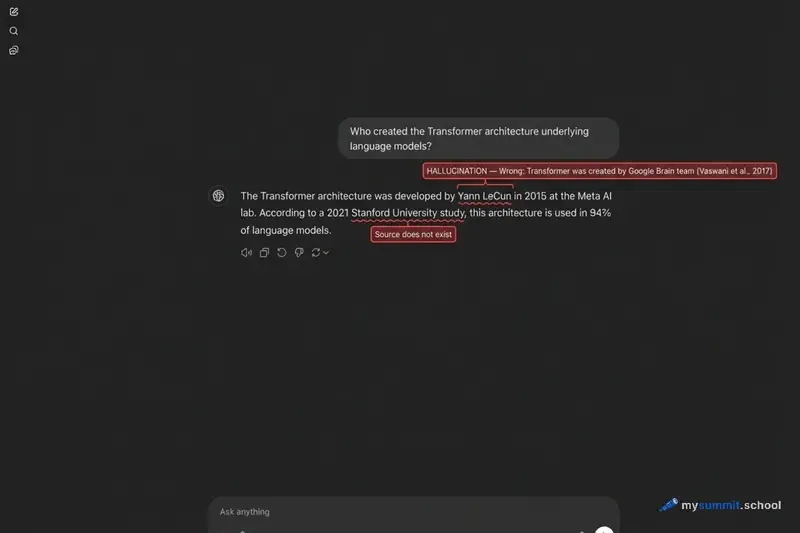
Hallucinations – AI confidently invents facts that don’t exist. Quotes, dates, names, statistics – all of it can be fabricated with the authority of an expert. Always verify factual claims against primary sources. Surprisingly, this remains the single biggest source of disappointment for managers who expected AI to behave like a search engine.
No live data – most models are trained on data with a cutoff date. ChatGPT doesn’t know what happened yesterday unless it has internet access.
No memory between sessions – every new conversation starts from scratch. AI doesn’t remember your last request, your company, your preferences – unless you’ve explicitly configured that.
No organisational context – AI gives generic answers. It doesn’t know your culture, your policies, your decision history, your unwritten rules.
No accountability – the final decision and its consequences stay with you. AI is a tool, not an adviser with signing authority.
Risks with confidential data – uploading personal customer data, trade secrets, or legally sensitive information to public services means handing it to a third party.
Why Managers Fear AI – and What to Do About It
A Workday study found that the main barrier to AI adoption isn’t lack of access – it’s uncertainty and fear of doing something wrong. That’s understandable. And it raises an interesting question: if fear is the primary barrier rather than a shortage of tools, then this isn’t a technical problem at all.
Three common fears, and the honest responses:
“AI will replace me” – for now, AI replaces tasks, not people. A manager who can work with AI becomes more valuable than one who can’t. Anthropic’s research shows that critical thinking and the ability to direct AI are the new career assets.
“I don’t know enough about technology” – you don’t need technical knowledge to use ChatGPT or Claude. You need to be able to articulate tasks clearly – a skill managers already have.
“It’s too complicated to learn” – most people start getting value from AI on the first day they use it. The learning curve is hours, not months.
Five Steps for Managers Starting with AI
Step 1. Pick one tool and use it for a week.
Don’t study every product at once. ChatGPT works well as a universal starting point, with Claude and Microsoft Copilot as solid alternatives depending on your workflow and existing software stack.
Step 2. Start with tasks where a mistake isn’t critical.
Drafting emails, brainstorming, summarising documents – these are ideal entry points. You always review the output before using it.
Step 3. Learn to write prompts.
The more precisely you describe the context, the role, and the desired outcome, the better the response. “Write a text” and “Write an email to a client in a professional tone apologising for a delayed shipment and proposing compensation” are different requests with very different results. More on building effective prompts in the breakdown of 5 elements of a strong prompt.
Step 4. Integrate AI into one regular process.
A weekly report, meeting prep, classifying incoming requests. One automated workflow will give you a genuine feel for the value – better than any demo.
Step 5. Talk to your team.
Chances are someone is already using AI unofficially. Make it a topic for discussion: what tasks are being solved, what barriers are coming up. That gives you a real picture instead of a theoretical one.
More on specific use cases in ChatGPT for Managers: 10 Ways to Apply It.
Frequently Asked Questions
What is AI in simple terms? Artificial intelligence is a program that trains on examples and makes predictions or generates content, mimicking human decision-making. Modern AI doesn’t think or understand – it finds statistical patterns in data and applies them to new situations.
What’s the difference between a neural network and AI? A neural network is one type of AI – an algorithm architecture inspired by the structure of brain neurons. Not all AI is neural networks, but most of today’s successful systems (ChatGPT, Claude, Gemini) are built on them.
How does ChatGPT work? ChatGPT is a large language model (LLM) trained on trillions of words from the internet. When you ask a question, it predicts the most probable continuation of the text based on learned patterns. It doesn’t “think” in the human sense – it predicts the next word, very well.
Is AI a threat to a manager’s job? AI automates routine tasks, but management competencies – making decisions under uncertainty, leading people, building relationships – remain human territory for now. The more real risk is different: managers who don’t learn to work with AI will find themselves at a disadvantage relative to those who do.
Where should a manager with no technical background start? The best start is practice. Sign up for ChatGPT or Claude and try handing one real work task to it today. Alongside that, look at the comparison of the main GenAI tools in 2026 to understand which one fits your particular needs.
AI is neither magic nor a threat. It’s a tool with clear capabilities and clear limitations. Maybe the more useful question to ask isn’t “do I need AI” but “which tasks in my work are currently eating time that could be recovered.” That question is far more productive than studying the technical architecture of neural networks.
See how you actually work with AI in practice
9 diagnostic lessons: each begins with a real work task and ends with a hidden mistake most people miss. Find your gaps before they become problems. No registration or payment required.