Claude by Anthropic in 2026: Complete Guide to Models, Artifacts, Cowork and Applications for Managers

In early 2026, Anthropic introduced flagship Claude 4.6 models, solidifying the company’s leadership in deep data analysis and agentic automation. Claude Opus 4.6 was released on February 5, 2026, and Sonnet 4.6 on February 17 — models with an unprecedented context window of 1 million tokens.
This update transforms AI from a chatbot into a full-fledged “digital employee” capable of holding entire libraries of documentation in memory and working autonomously on complex projects. Against the backdrop of declining ChatGPT market share, Claude demonstrates explosive engagement growth: average user session duration has risen to 30+ minutes.
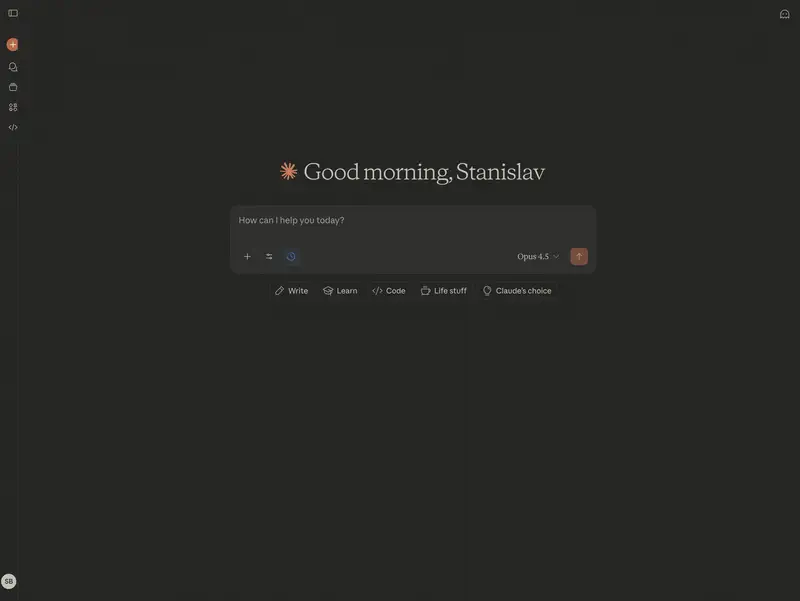
What Makes Claude Special?
Claude provides two operating modes:
Instant Responses — for quick queries when you need an answer in seconds.
Extended Thinking — the model “thinks” from several seconds to several minutes, showing users its reasoning chain. This ensures complete transparency in decision-making. Opus 4.5 added support for parallel computing for complex tasks.
Live Data Connectors in Artifacts — users can connect Claude to real-time data sources: Google Sheets, Salesforce, SQL databases. This enables generating reports and dashboards based on the freshest data.
Like ChatGPT, Claude offers multimodality and data processing:
- Processing up to 5 images at once in the web interface and up to 100 via API
- Support for various document formats (DOCX, CSV, PDF, EPUB, etc.) with a 30MB limit per file
- Context window of 1,000,000 tokens — allows loading entire codebases or hundreds of PDF files
- Transcription and analysis of handwritten notes, graphs, and technical diagrams
- Extended Conversation — long chats no longer hit token limits thanks to automatic summarization
Project-based chat organization — a unique capability where Claude was a pioneer. Each project has shared context that every chat can use.
Claude Models (February 2026)
Claude Opus 4.6
Claude Opus 4.6 — the most powerful model in the lineup, state-of-the-art in programming and agentic planning.
- Record context: 1,000,000 tokens (in beta mode) — the model can “read” and hold in memory entire company documentation or a year of email archives.
- Autonomous agents: Opus 4.6 can work independently for hours on large tasks (full data migration, project audit) without losing the thread of reasoning.
- Complex logical planning: the best tool for “unraveling” conflicting business scenarios, finding hidden risks in contracts, and strategic planning.
- Virtual employee (Cowork): ability to delegate folder access on your computer for independent file creation and editing.
Price: $5 per million input tokens, $25 per million output tokens (for context up to 200K).
Opus 4.6 is the most manipulation-resistant model released by Anthropic. It’s significantly harder to deceive with prompt injection attacks compared to competing models.
Claude Sonnet 4.6
Claude Sonnet 4.6 — the “workhorse” of the new generation. In many office tasks and tests, it outperforms Opus 4.6 thanks to higher speed and updated knowledge base. Can work continuously for up to 30 hours, supporting complex autonomous development cycles.
Price: $3 per million input tokens, $15 per million output tokens, supporting up to 128K tokens on output.
Claude Opus 4.5 and Sonnet 4.5 (Legacy)
The 4.5 series models have been moved to “Legacy” status. They remain available to support stable integrations, but migration to the 4.6 series is recommended for new projects.
Claude Haiku 4.5
Claude Haiku 4.5 — a fast and economical model, remains the default model for free users. Price: $1 per million input tokens, $5 per million output tokens.
Ideal for: chatbots and customer support, processing large volumes of documents, programming assistance, multi-agent systems.
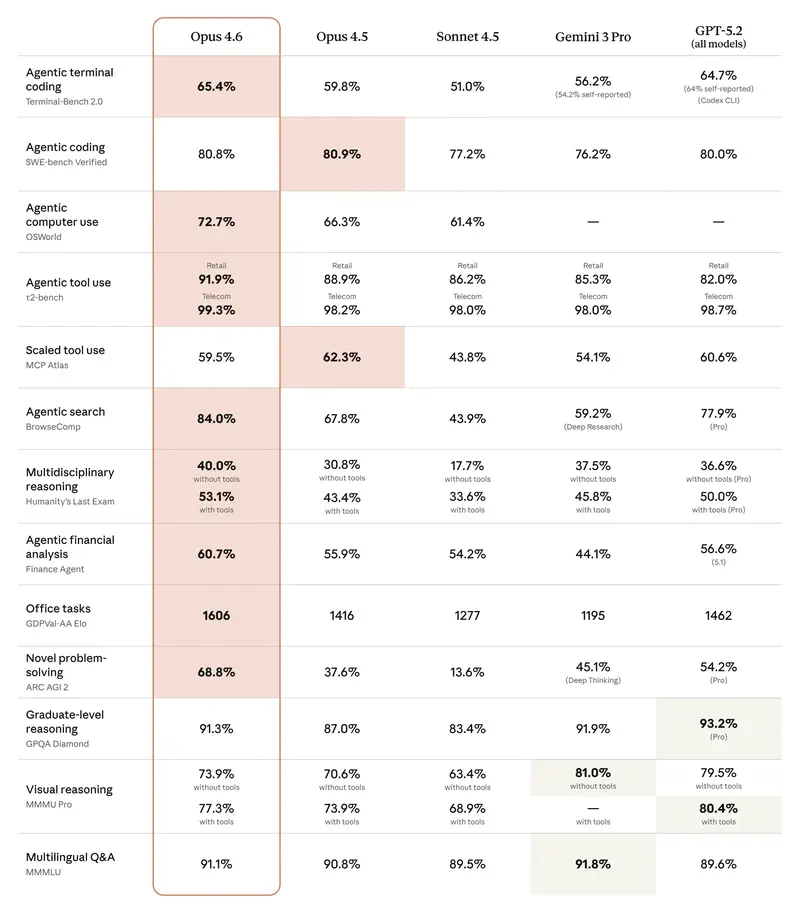
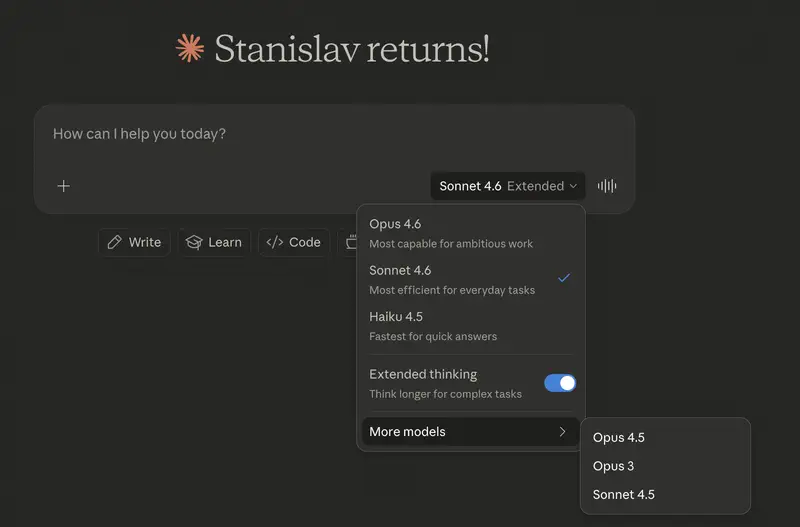
Quick Model Selection Guide
- Opus 4.6: top model for programming, ultra-long contexts (1M), and complex planning.
- Sonnet 4.6: optimal choice for most tasks, high speed and excellent price/quality balance.
- Opus 4.5: legacy flagship for supporting old integrations.
- Haiku 4.5: instant responses, classification, and simple chatbot work.
Communication Styles
Claude offers several preset writing styles that you can select in the interface to adapt responses to specific needs.
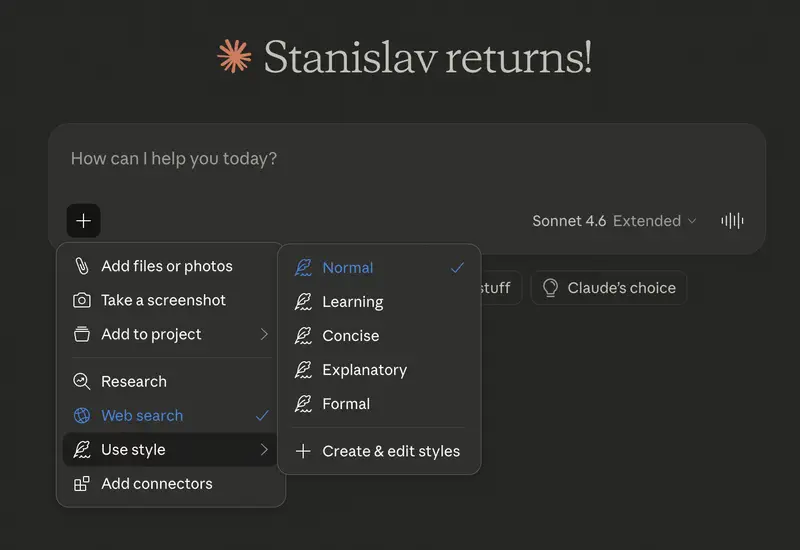
Normal — standard balanced style for most tasks. Suitable for data analysis, presentation preparation, and team communication.
Concise — brief style when time is critical and only key conclusions are needed. Ideal for executive briefings, emergency decisions, summarizing lengthy reports.
Explanatory — detailed explanatory style. Suitable for training employees on complex processes, explaining strategic decisions, preparing detailed instructions.
Formal — official business style. For letters to partners and investors, board reports, contracts, and regulatory documentation.
Custom style creation functions are also available for company-specific needs — for example, corporate communication style with company-specific vocabulary.
Artifacts: Interactive Content Creation
Artifacts — a unique Claude feature that automatically creates interactive documents, code, and visual content in a separate window to the right of the chat.
The artifacts library shows the enormous capabilities of this tool.
Usage Examples for Managers
- Interactive KPI dashboard — ask to create a dashboard with metrics: revenue, deals, average check, conversion.
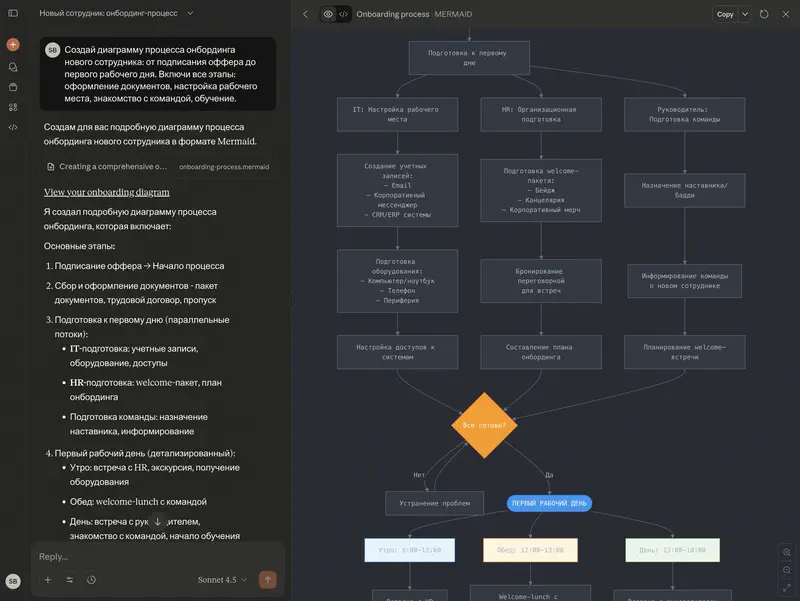
- Process diagram — ask to create a flowchart of new employee onboarding.
- Interactive chart — upload sales data and get a chart with trends.
- ROI calculator — a working calculator for calculating marketing campaign ROI.
Claude Code: Agent for Working with Code
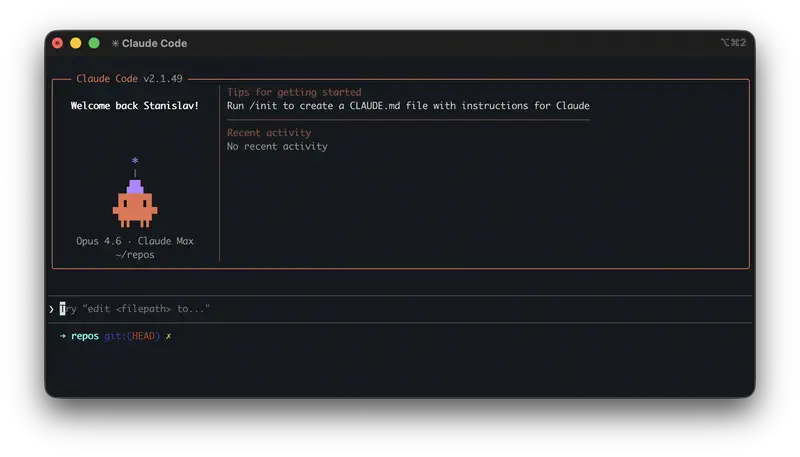
Claude Code — an agentic command-line tool (CLI) that works directly inside a project repository.
- Technical control and audit — analyzing project compliance with security standards.
- Automatic documentation — updating README and API docs when code changes.
- Accelerating Time-to-Market — automating routine tasks: refactoring, bug fixing, writing tests.
- Progress transparency — summary of changes for any period.
Claude Desktop: Desktop Application
Claude Desktop — application for macOS and Windows for quick access to Claude without a browser.
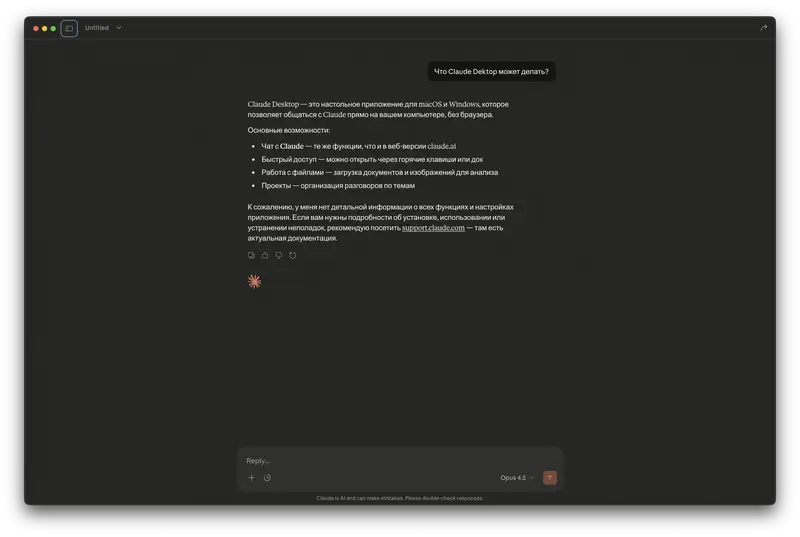
- File creation and editing — tables, documents, presentations, PDFs right in the application.
- Image work — screenshot capture and drag-and-drop files.
- Skills — instruction sets for consistent task execution.
Claude Cowork: AI Assistant for File Work
Cowork — a feature that transforms Claude into a virtual employee capable of independently working with files on your computer.
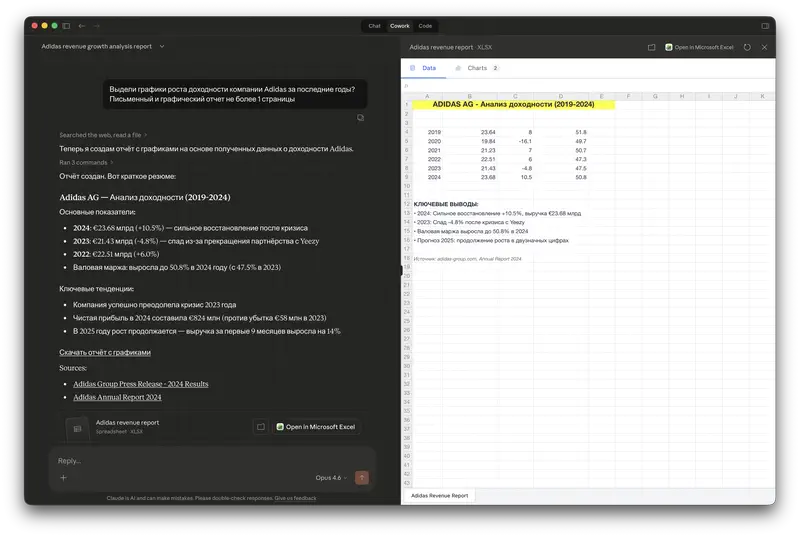
You provide access to a folder. AI reads, edits, and creates files directly, breaks tasks into subtasks, and executes them in parallel.
For managers: Cowork processes complex tasks without timeouts. You can assign analysis of dozens of documents or creation of a series of reports — and get a ready result.
Claude for Excel and PowerPoint
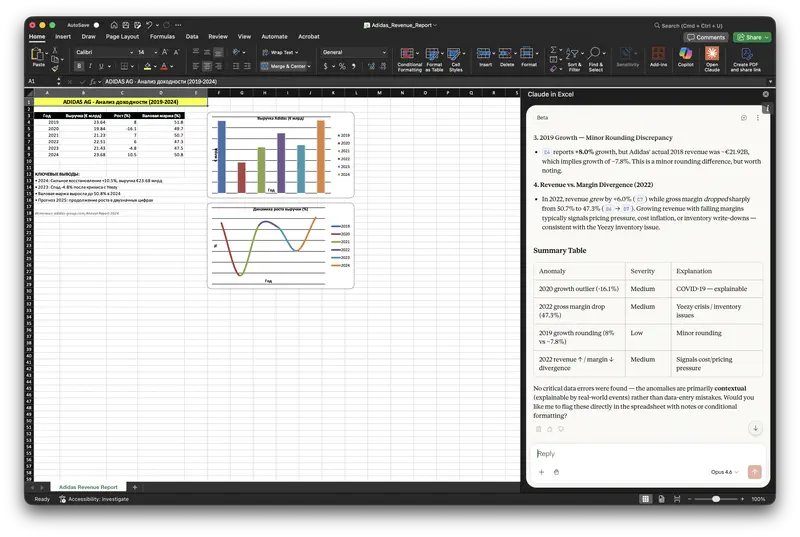
In February 2026, extensions for Excel and PowerPoint were presented. Available on Pro and Max plans.
Claude Pricing (February 2026)
Claude Free – $0/month: default Haiku 4.5, also Sonnet 4.6 with limits (~15-20 messages per day).
Claude Pro – $20/month: 5x more usage, all models (including Opus 4.6), Projects, memory between sessions, Thinking mode.
Claude Team – $25-30/user/month: everything from Pro + collaboration, data not used for training, minimum 5 users.
Claude Max – $100-200/month: 5-20x more limits, Cowork, priority access to 1M context window.
Claude Enterprise – from $60/user/month: enterprise security (SOC 2, GDPR, HIPAA), unlimited usage, SSO, 100+ users.
Practical Applications for Managers
Claude can process up to 1,000,000 tokens — the size of several dozen books or a huge email archive.
- Team status report analysis — upload 10-15 reports, get a summary in minutes
- Meeting photo processing — photograph the whiteboard, get a task plan
- 1-on-1 preparation — analysis of correspondence and notes with an employee
- Email chain analysis — key decisions and next steps
- Executive summary — 20-page report into 2-minute presentation
- Conflict resolution — analysis from different sides, mediation formulations
- Competitor materials — comparison table with conclusions
- Sprint planning — from chaotic list to prioritized backlog
Results in Our Benchmark
We tested five Claude models in our independent benchmark across eight management task categories — from analysis and planning to communication and team management. Results confirm Claude’s reputation as an analytical leader, but with nuances.
Claude Sonnet 4.5 and Opus 4.5 — in the elite group. Sonnet 4.5 showed the best result among all models in three categories: analysis and decision-making, planning, problem-solving. Opus 4.5 — best in learning and development. General pattern: where other models give an answer, Claude builds a decision-making system — matrices, condition trees, review thresholds.
Claude Sonnet 4.6 — also in the elite group. Best result among all models in learning and development, as well as in team management. Very strong communication performance.
Claude Haiku 4.5 — amazing result for a free model. In the problem-solving category, competes with top paid models. Strong positions in learning, development, and planning. Weak spot — information search and regional awareness.
Claude Sonnet 4.0 — significantly weaker than 4.5/4.6 generation models. The generational difference is critical: acceptable results in analysis, but noticeable lag in information search and communication.
Weak spot of the entire lineup — information search: Claude is not connected to the internet and relies only on training data.
Competition from Chinese models. While Claude leads in analytical depth, Chinese AI developers have produced competitive alternatives worth considering. Kimi K2.5 performs at the level of top Western models and actually surpasses Claude in information search, making it a strong alternative for research-heavy workflows. MiniMax M2.7 delivers excellent team management capabilities, available at chat.minimax.io. GLM-5 shows particular strength in team management and offers direct access at chat.z.ai. MiMo V2 Omni from Xiaomi demonstrates exceptional learning and team management performance, accessible at mimo.xiaomi.com. These models often provide direct access without the usage restrictions common with Claude.