DeepSeek in 2026: The Budget Flagship That Rivals the Best AI Models
AI models in this article
DeepSeek is a Chinese AI startup that has become one of the industry’s leading players in just two years. In April 2026 DeepSeek released V4 – a generation of models that competes with GPT-5.4 and Claude Opus 4.6 on quality while costing 10–50 times less.
For a manager, DeepSeek is primarily about price. Quality is on par with the best Western models, yet API costs are a fraction of the competition. DeepSeek particularly excels at analytics, logical reasoning, and programming. All models are open source under the MIT licence – you can download and deploy them on your own infrastructure with no restrictions.
What Makes DeepSeek Special?
DeepSeek is built on the principle of “smart” efficiency. Rather than summoning every expert to every meeting, the system instantly calls only the 2–3 specialists needed for a specific question (Mixture-of-Experts architecture).
- Cheaper to run than competitors – uses 2–4x fewer computational resources thanks to hybrid attention and KV-cache compression.
- Handles massive documents – a context window of 1,000,000 tokens (~750,000 words, roughly 2,500 pages of text).
- Thinks step by step – three reasoning modes: quick answer, deep analysis, and maximum reasoning.
Core DeepSeek Models (April 2026)
DeepSeek-V4-Pro

The flagship model. 1.6 trillion parameters, of which 49 billion are active per token. A general-purpose assistant: writing, analysis, coding, data work. Comparable in quality to GPT-5.4 and Claude Opus 4.6 – the gap is estimated at 3–6 months.
- Context: 1,000,000 tokens (input) / up to 384,000 tokens (output)
- Three reasoning modes: Non-Thinking (quick answers), Think High (deep analysis), Think Max (maximum reasoning with self-verification)
- Codeforces rating: 3,206 – International Grandmaster level
DeepSeek-V4-Flash
The fast and cheap model. 284 billion parameters, 13 billion active. Quality close to Pro on standard tasks – at 12x lower cost.
- Same 1,000,000-token context
- Same three reasoning modes
- Ideal for high-throughput tasks: chatbots, document processing, bulk requests
Multimodality: Janus-Pro and Image Recognition
DeepSeek-V4 is a text model. For image work there are separate solutions:
- Janus-Pro-7B – image generation and recognition. Scores 80% on GenEval (DALL-E 3 – 67%). Limitation: low resolution at 384x384 px.
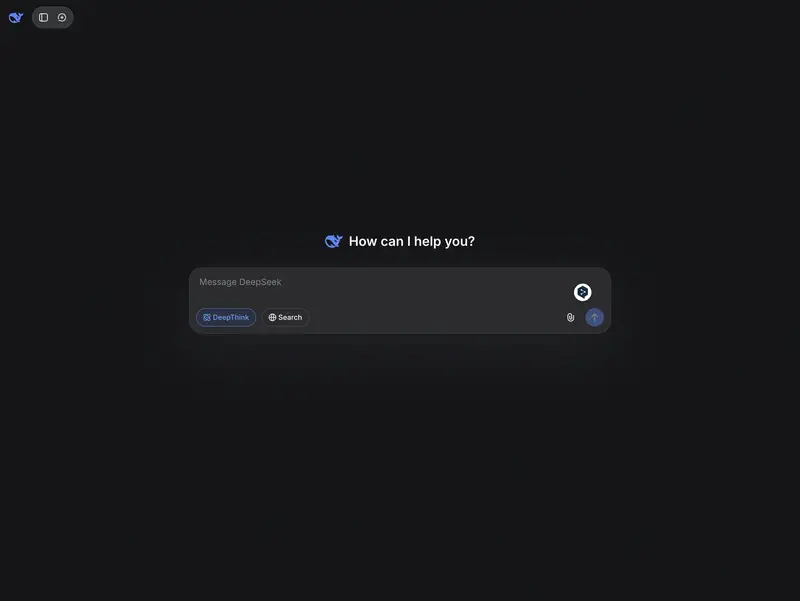
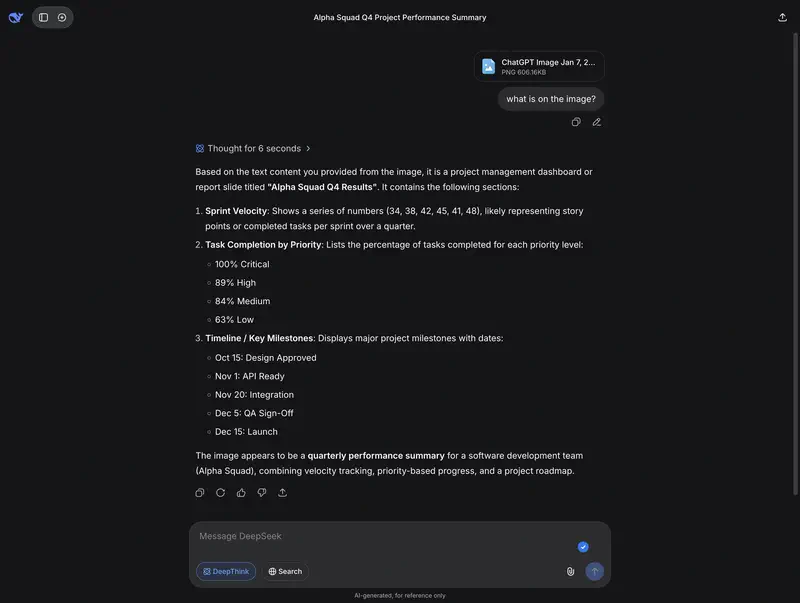
- Image Recognition Mode (beta since April 2026) – image analysis in DeepSeek chat. Recognises diagrams, tables, screenshots.
DeepSeek is free and powerful. Our open module reveals where managers go wrong with any AI model – 9 real-world tasks.
No payment required • Get notified on launch
Comparison With Competitors
Chinese Models
DeepSeek V4 leads on price-to-quality ratio, but it is not the only strong player from China:
| Model | Company | Context | Strength | Price (output/1M) |
|---|---|---|---|---|
| DeepSeek V4-Pro | DeepSeek | 1M | Code, reasoning, price | $0.87 |
| DeepSeek V4-Flash | DeepSeek | 1M | Speed, batch tasks | $0.18 |
| Kimi K2.6 | Moonshot AI | 256K | Agentic tasks, up to 300 sub-agents | $4.00 |
| GLM-5.1 | Zhipu AI | 203K | Reasoning accuracy | ~$2.00 |
| Qwen 3.6 Plus | Alibaba | 1M | Broad task coverage | ~$1.50 |
| MiniMax M2.7 | MiniMax | 128K | Self-improving model | ~$1.20 |
The 75% discount became permanent in June 2026 – $0.87 for output is now the standard price.
Kimi K2.6 is DeepSeek’s main Chinese competitor. It leads in agentic tasks (SWE-Bench Pro: 58.6% vs DeepSeek V4-Pro’s 55.4%) and can run up to 300 sub-agents in parallel for complex tasks like multi-hour codebase refactoring. But it costs 5–14x more than DeepSeek.
Comparison With Western Models
| Model | Price (input/output per 1M) | Quality (BenchLM, 0–100) | Context |
|---|---|---|---|
| Gemini 3.1 Pro | ~$3.50 / $10.50 | 93 | 1–2M |
| GPT-5.5 | $5.00 / $25–30 | 92 | 1M |
| Claude Opus 4.7 | $5.00 / $25.00 | 88 | 200K |
| DeepSeek V4-Pro (Max) | $0.435 / $0.87 | 87 | 1M |
| DeepSeek V4-Flash | $0.09 / $0.18 | 77 | 1M |
DeepSeek V4-Pro scores 87 out of 100 on BenchLM – just 1 point below Claude Opus 4.7. Yet it costs 29x less. (A separate MySummit benchmark on management tasks uses a 1–10 scale – results in the update section below.)
Where DeepSeek V4 Outperforms
- Programming: LiveCodeBench 93.5% – above Gemini 3.1 Pro (91.7%) and Claude Opus 4.6 (88.8%)
- Information retrieval: BrowseComp 83.4% – above Claude Opus 4.7 (79.3%)
- Long context at a reasonable price: 1M tokens at $0.09 input (Gemini 2.0 Flash is cheaper but capped at 8K output)
Where DeepSeek V4 Falls Short
- Complex agentic tasks: Terminal-Bench 67.9% vs 82.7% for GPT-5.5
- Multi-step code work: SWE-Bench Pro 55.4% vs 64.3% for Claude Opus 4.7
- Multimodality: no built-in image analysis (Claude, GPT, Gemini all have it)
- Communication: according to our data, one of the weakest results among top models on feedback formulation tasks
Learn to use DeepSeek for analytics and decision validation
DeepSeek V4 with Think Max mode is a powerful tool for identifying risks in business plans and financial modelling. Our course shows how to use free AI for serious analysis – even if it does not replace your primary tool.
Continue learning
Open the textbook and pick up where you left off
Practical Applications for Managers
- “Translating” technical jargon into plain language – summarising a complex technical report into a concise executive memo.
- Stress-testing decision logic (Think Max) – upload a business plan and ask the model to find weak spots. Maximum reasoning mode surfaces non-obvious risks.
- Data analysis – describe in plain words what you want to learn from an Excel spreadsheet, and DeepSeek will write the formulas or a script.
- Working with large documents – upload a policy document or annual report (up to ~2,500 pages) and ask questions about it. The 1M-token context fits entire codebases or corporate knowledge bases.
- Accelerating IT team work – writing code, code review, testing, and documentation. Codeforces rating at International Grandmaster level.
Try It Yourself: Analysing a Risky Decision
Below is a management case with hidden problems. Click “Execute” and compare how the old model (V3.2) and the new one (V4-Flash) handle risk identification. Pay attention to the depth of reasoning and specificity of recommendations.
What to look for in the responses:
- V4-Flash with thinking mode builds an analysis chain and more often spots non-obvious connections (lease expiry + redundancies = reputational risk; a 2-location pilot is not representative of 40)
- V3.2 gives more surface-level answers, often misses links between risks
- Kimi K2.5 typically structures the response in more detail but can be verbose
Benchmarks compared. 9 practical management tasks will show where your approach breaks down – free.
No payment required • Get notified on launch
Update: Benchmark Results and DeepSeek on Yandex Cloud (July 2026)
In our management task benchmark (42 models, 80 scenarios), DeepSeek V4 confirms its status as the market’s pricing anomaly.
DeepSeek V4 Pro
$0.43/$0.87 per 1M tokens (input/output). For $0.87 on output tokens, DeepSeek delivers quality that its neighbours charge $9 (Gemini 3.1 Pro) and $4.50 (GPT-5.4 Mini) for.
Best for: process-implementation plans, scripting difficult team conversations, high-volume routine correspondence.
Not for: ROI and financial models (systematic calculation errors), legal reasoning, SaaS pricing analysis.
DeepSeek V4 Flash
$0.09/$0.18 per 1M tokens. Ranks above Gemini 3.1 Pro while costing 130x less ($0.09 vs $12/M). An ideal workhorse for text and planning tasks.
Best for: weekly reports, feedback classification, quarterly plans and risk matrices.
Not for: budgets and financial models, international law and GDPR, automation code.
DeepSeek on Yandex Cloud – Is It Worth It?
Yandex offers DeepSeek V4 Flash through its own API. The same model, but the numbers differ dramatically:
| Parameter | DeepSeek direct | Yandex Cloud | Difference |
|---|---|---|---|
| Input price/1M | $0.09 | $3.00 | ×33 |
| Output price/1M | $0.18 | $5.00 | ×28 |
| Benchmark result | Slightly higher | Slightly lower | – |
What you’re paying for: direct access from Russia without a VPN, an SLA from Yandex, data storage inside Russia, and the same 1M-token context window. Verdict: worthwhile for teams already on Yandex Cloud automating tasks without a dedicated AI budget. But if a VPN isn’t a problem, standard DeepSeek is slightly better and 27x cheaper.
Previous Generations
DeepSeek V3.2 (tested earlier) – a solid upper-middle tier performer. Particularly strong in planning and problem-solving. A notable gap: communication, one of the weakest results among all tested models.
DeepSeek R1 – a comparable overall level. Its strengths are information retrieval and analytics, where step-by-step reasoning gives it a clear edge.
Detailed category breakdown in our article on the best AI models for managers.
Limitations and Risks
- Limited multimodality – the core V4 model is text-only. Image analysis is in beta, generation is via a separate Janus-Pro at low resolution (384x384). Competitors (Claude, GPT, Gemini) have multimodality built in.
- Content safety – safety filters are weaker than those in ChatGPT and Claude. The model is easier to “convince” to generate unwanted content.
- Data privacy – the company is based in China. The solution: download the model (MIT licence) and run it locally – 7B and 14B DeepSeek distillates run on a regular laptop.
- Fewer ready-made integrations – no official plugins for CRM or ERP systems. However, DeepSeek supports both the OpenAI and Anthropic API formats, so most tools work via an adapter.
- API stability – during peak hours there can be delays and failures. For production systems, consider proxy providers (DeepInfra, Together.ai, OpenRouter).
- Chinese-language priority – quality in Russian remains strong. According to our data, DeepSeek V3.2 outperforms every Russian model (including Alice AI and GigaChat) even on tasks with Russia-specific context.
Pricing and Availability
| Model | Cost (per 1M tokens) | For comparison |
|---|---|---|
| DeepSeek V4-Flash | $0.09 input / $0.18 output | GPT-5.5: $5 / $25–30 |
| DeepSeek V4-Pro | $0.435 input / $0.87 output | Claude Opus 4.7: $5 / $25 |
- Free access – you can use chat.deepseek.com for free, including Deep Think mode.
- Open source (MIT) – all models are available for download, commercial use, and modification with no restrictions.
- Cache savings – repeated requests are 10x cheaper ($0.014/1M for Flash).
- 75% discount on V4-Pro, originally announced as temporary, became permanent in June 2026. The $0.435/$0.87 pricing is now standard.
- Peak hours – since mid-July 2026, DeepSeek introduced peak/off-peak pricing: prices can run above standard during high-load hours.
Fact: DeepSeek V4-Flash costs 97% less than GPT-5.5 at comparable quality on standard tasks. For a startup processing 100M tokens per month, switching from Claude Opus to DeepSeek V4-Flash saves ~$2,400 monthly.
What Changed From V3 to V4
| Parameter | DeepSeek V3.2 | DeepSeek V4-Pro |
|---|---|---|
| Context | 128K tokens | 1,000,000 tokens |
| Parameters | 671B (37B active) | 1.6T (49B active) |
| Reasoning modes | Separate R1 model | Built-in (3 modes) |
| Licence | Custom open | MIT |
| Max output | ~8K | 384K tokens |
| API compatibility | OpenAI format | OpenAI + Anthropic |
| Chips | Nvidia H800 | Nvidia + Huawei Ascend |
Migrating From Older Versions
The legacy identifiers deepseek-chat and deepseek-reasoner now redirect to V4-Flash and will be deprecated on 24 July 2026. If you use the API, update to deepseek/deepseek-v4-flash or deepseek/deepseek-v4-pro.
Useful Links
- DeepSeek official website
- DeepSeek Chat – free web interface
- API documentation and pricing
- Models on Hugging Face
- V4 announcement (technical report)
This article is part of the “GenAI Tools Review 2026” series. All tools are covered with hands-on exercises in the mysummit.school course.

Stanislav Belyaev
Engineering Leader at Microsoft18 years leading engineering teams. Founder of mysummit.school. 700+ graduates at Yandex Practicum and Stratoplan.