45% of Americans Use AI Annually: Gallup 2025 Data and What Changed in a Year

Gallup – one of the oldest polling organizations in the US – has released fresh data on how Americans used artificial intelligence in 2025. We’ve already covered Stanford (37% personal use), Brookings (57% use AI, but only 19% see results), and Wharton (82% of executives use it weekly). Now we have Gallup’s numbers – and they point to an important trend: usage is growing, but more slowly than the hype suggests.
Headline: 45% of Americans use AI at least once a year (+5 pp year over year), 23% use it weekly (+4 pp), 10% daily (+2 pp). The growth is real, but gradual. And most people still don’t know how to apply the technology to their own work.
About the study: Gallup’s methodology
Who ran it: Gallup – one of the largest research firms, operating since 1935
When: Data collected in May 2025
Scale: Representative sample of US adults
Method: Phone and online interviews
Focus: Not just “do you use it,” but how often, for what, in which industries, and does your organization know about it.
This is the fourth major study we’ve examined, and together they paint a complete picture of AI usage in 2025.
The key numbers: growth is real, but gradual
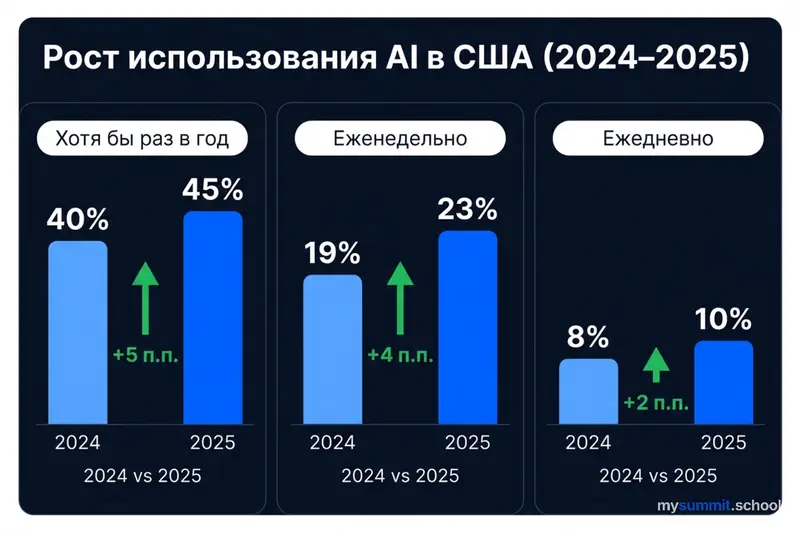
AI usage frequency: 2024–2025 dynamics
| Metric | 2024 | 2025 | Change |
|---|---|---|---|
| At least once a year | 40% | 45% | +5 pp |
| Weekly | 19% | 23% | +4 pp |
| Daily | 8% | 10% | +2 pp |
45% of Americans now use AI at least once a year. A year ago it was 40%. A gain of 5 percentage points – 12.5% in relative terms. Sounds decent, but let’s compare it to the media hype.
Context: what the numbers actually mean
Weekly use – 23%. That’s below what Stanford reported for workplace use (23%), but roughly matches. Gallup asked about all use – at home and at work. Stanford split the two.
Daily use – only 10%. For comparison, Wharton showed that 46% of top executives use AI daily. The gap is enormous: executives use the technology 4.6x more actively than the average American.
Takeaway: AI hasn’t become a mass-market tool yet. Growth is steady (+12.5% over the year), but most of the population is still experimenting occasionally rather than integrating AI into a daily routine.
Awareness of AI use in the organization: only 37%
Gallup asked an interesting question the other studies didn’t: “Do you know whether your organization has deployed or uses AI?”
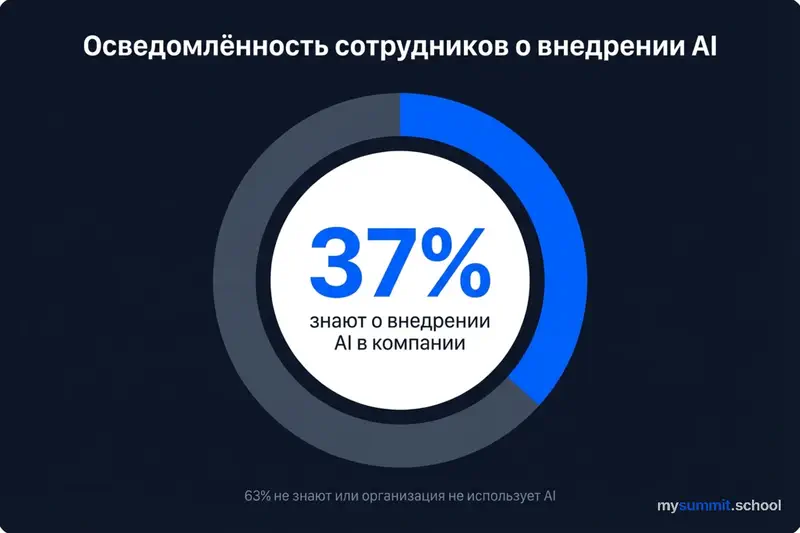
Only 37% of employees know their organization has deployed AI. And that’s despite Wharton showing that 74% of companies rank AI in their top 3 priorities and 61% have appointed a Chief AI Officer.
Why the gap?
1. Corporate deployment vs. visibility for rank-and-file employees:
- A company bought Microsoft Copilot for 4,000 employees at $1.4M a year
- But 63% of employees either didn’t notice or didn’t realize it was AI
- Actual users – 47 people. More than once – 12.
2. AI “under the hood”:
- A bank uses AI for credit scoring
- But the teller at the branch has no idea
3. No internal communication:
- Top management rolls out an AI strategy
- But never tells the team what’s happening
Important: 74% of companies call AI a priority, but only 37% of employees know about it. That’s a massive communication gap, and it’s slowing adoption.
Industry breakdown: tech and finance lead (as always)
Gallup broke down AI use by industry, and the results line up perfectly with what Wharton found.
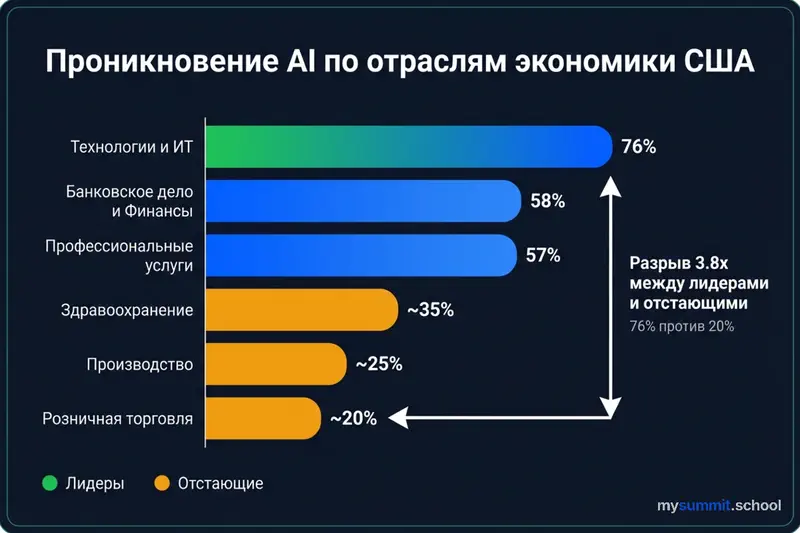
AI use by industry
| Industry | AI usage |
|---|---|
| Technology/IT | 76% |
| Banking/Finance | 58% |
| Professional Services | 57% |
| Healthcare | ~35% |
| Manufacturing | ~25% |
| Retail | ~20% |
Tech leads by a huge margin – 76%. That means three out of four employees at tech companies use AI. In finance – more than half (58%).
Manufacturing (25%) and retail (20%), meanwhile, lag by a factor of 3–4x. The reasons are the same ones we unpacked in our Wharton piece:
Manufacturing and retail lag not because they’re “behind,” but because of the nature of the work:
Physical world: GenAI is good at text, code, images. But manufacturing is robots, machines, warehouses. AI in that context requires computer vision, equipment control, and integration with legacy systems.
Complex integration: In finance, AI can process a loan application autonomously. In manufacturing, you need to integrate AI with equipment, ERP, and supply chains.
ROI is harder to measure: In tech, “AI wrote 500 lines of code” is an obvious metric. In retail logistics, “AI optimized delivery” spreads the savings out over time.
Takeaway: Gallup confirms the Wharton trend: GenAI first transforms industries where the main work is information processing. Manufacturing and the physical world follow, but they need more complex solutions than just ChatGPT.
What people use AI for: top applications
Gallup asked what tasks people use AI for. The results show clear priorities.
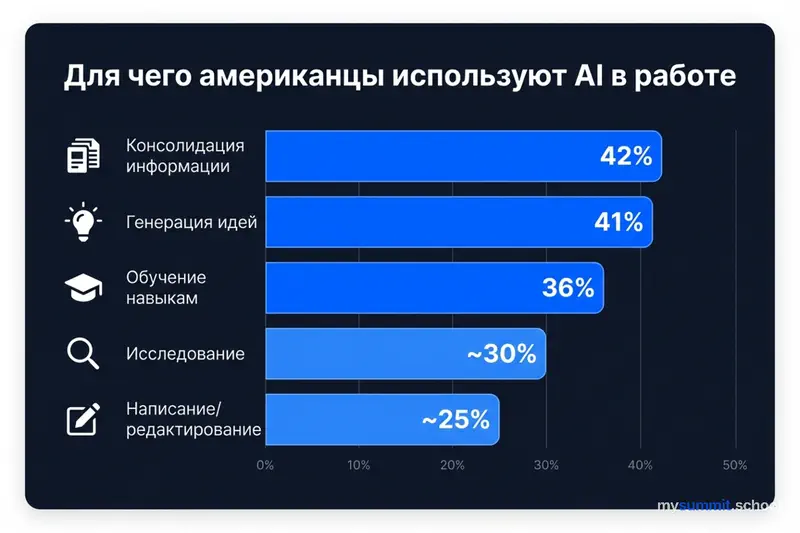
Top AI use cases at work
| Task | % of users |
|---|---|
| Consolidating information | 42% |
| Generating ideas | 41% |
| Learning new skills | 36% |
| Research | ~30% |
| Writing and editing | ~25% |
What does this mean?
1. Consolidating information – 42%
The most popular use – pulling data together from multiple sources. That means:
- Summarizing long documents and reports
- Extracting key points from many sources
- Aggregating information for decision-making
Example: “Read these three reports and pull out the main points in 5 bullets.”
2. Generating ideas – 41%
Second most popular – using AI as a brainstorming co-author. That includes:
- Generating options for projects
- Creating alternative product names
- Process optimization suggestions
Example: “Suggest 10 ideas for boosting customer engagement.”
3. Learning new skills – 36%
A third of users treat AI as a personal tutor:
- Explaining complex concepts in plain language
- Helping pick up new tools and technologies
- Answering questions 24/7
Example: “Explain SQL to me like I’m 12.”
Why isn’t writing and editing in the top three?
Interestingly, writing and editing ranks only fifth (~25%). That contradicts the popular belief that “everyone uses ChatGPT to write.”
Possible reasons:
Quality of generated text: AI produces mediocre drafts that need heavy editing. For many people, it’s easier to just write it themselves.
Task specifics: Writing requires creativity and audience awareness. AI is good at templates, not unique content.
Ethical concerns: Some people worry that using AI to write is “cheating” or “plagiarism.”
Takeaway: AI is used more often as a helper for processing information (42%) than as a content creator (25%). This confirms the trend: people trust AI to analyze data, but keep creative work for themselves.
Comparing four studies: the full 2025 picture
Now that we have data from Stanford, Brookings, Wharton, and Gallup, we can put them side by side.
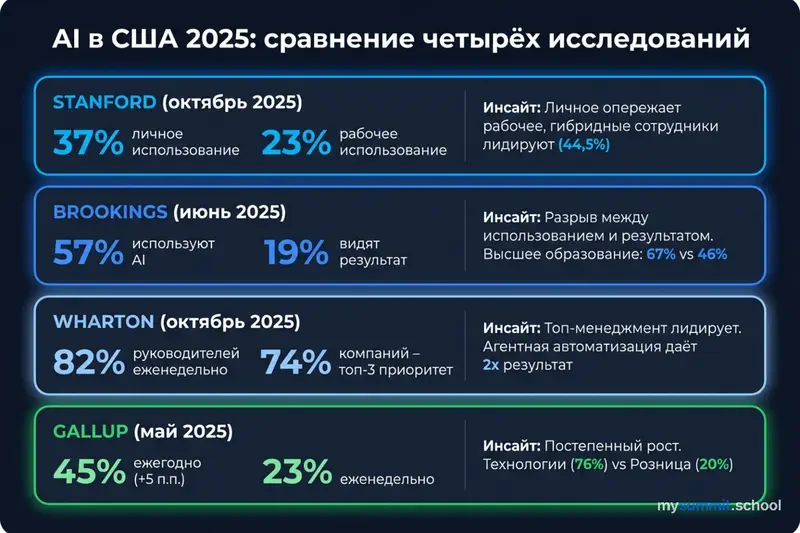
Four studies – one story
| Study | Key numbers | Main insight |
|---|---|---|
| Stanford (October 2025) | 37% personal use 23% at work | Personal use is ahead of work use Hybrid employees lead (44.5%) |
| Brookings (June 2025) | 57% use AI 19% see results | Gap between use and results College degree: 67% vs. 46% without |
| Wharton (October 2025) | 82% of executives weekly 74% of companies – top 3 priority | Top management leads Agentic automation delivers 2x results |
| Gallup (May 2025) | 45% yearly (+5 pp) 23% weekly 37% know about corporate AI | Gradual growth Tech (76%) vs. Retail (20%) |
What do we see overall?
1. The gap between top management and regular employees is enormous:
- Wharton: 82% of executives use AI weekly
- Gallup: 23% of all employees use it weekly
A difference of 3.6x. That explains why companies call AI a success (74% rank it in their top 3 priorities) while employees don’t see the change (37% know about the rollout).
2. Usage is growing, but few see results:
- Brookings: 57% try it, but only 19% see productivity gains
- Wharton: 80% of corporate projects are successful
Why the gap? As we explored in the Brookings piece, it comes down to a systematic approach. Companies invest in training, integration, and ROI measurement. Individual employees just “try ChatGPT” without a strategy.
3. Education and income are the main predictors of use:
- Brookings: College-educated – 67% use AI, non-college – 46%
- Brookings: Income $100k+ – 34% use it at work, income <$30k – 9%
This isn’t just statistics. It’s a social divide: AI reinforces the advantages of those who already have education and high income.
4. Personal use runs ahead of workplace use:
- Stanford: 37% personal vs. 23% at work
- Gallup: Top uses – consolidating information (42%), generating ideas (41%), learning skills (36%)
People learn to use AI for themselves, and only then carry the skills over to work.
Main takeaway from all four studies: AI works when people approach it systematically. 19% of individuals see results from chaotic use, but 80% of companies succeed with deliberate deployment. The difference comes down to training, strategy, and ROI measurement.
What this means for managers: practical takeaways
At mysummit.school we work with managers who want to bring AI into their day-to-day. Here’s what all four studies say, together:
1. Don’t wait for AI to become “convenient”
Gallup: 45% use it at least once a year, +12.5% growth year over year. This is a gradual trend, not an overnight revolution.
What to do: Start now, even if the tools are imperfect. Those who learn today will be the leaders 2–3 years from now.
2. Personal use is the path to workplace use
Stanford: 37% personal, 23% at work. People experiment at home first.
What to do: Encourage your team to use AI for personal tasks (trip planning, learning). The skills will transfer to work automatically.
3. Education and skills are the main barriers, not access
Brookings: 67% with college degrees vs. 46% without – it’s a skills gap.
What to do: Invest in training, not just access to tools. ChatGPT is free, but without skills people give up after a week.
4. Top management has to use AI themselves
Wharton: 82% of executives use it weekly. That’s not a coincidence – it’s culture.
What to do: If you’re a leader, start with your own tasks: meeting prep, report analysis, strategy. Be the role model.
5. Only 37% know about corporate AI – that’s a communication problem
Gallup: 74% of companies are rolling out AI (per Wharton), but only 37% of employees know about it.
What to do: Tell your team what’s happening. “We’ve rolled out Microsoft Copilot – here’s how you can use it.” Without communication, deployment will fail.
6. A systematic approach yields 80% success; chaos yields 19%
Brookings: 19% of individuals see results. Wharton: 80% of companies succeed.
What to do: Don’t just say “try ChatGPT.” Build a process: define tasks, pick tools, train the team, measure ROI.
7. Agentic automation is the next level
Wharton: Companies using automation (AI performing tasks autonomously) get 2x the return of those using AI as an assistant.
What to do: Start with an assistant (ChatGPT for drafts), but plan the transition to end-to-end process automation.
Why the mysummit.school course prepares you for real deployment
The four studies make one thing clear: the difference between 19% and 80% success comes down to a systematic approach and training.
In our “AI for Managers” course:
Practice instead of theory. Every lesson is built around real tasks: meeting prep, resume analysis, report writing. The things you do every day.
From assistant to automation. You start with simple tasks (ChatGPT for emails) and gradually move toward autonomous processes. That’s the same path Wharton found delivers a 2x boost in satisfaction.
Focus on measurable ROI. We teach not “how to write a prompt” but “how to cut 5 hours of busywork a week” with concrete metrics. Just like the 72% of companies in the Wharton data who track ROI.
All the tools. ChatGPT, Claude, YandexGPT, GigaChat, Perplexity – you’ll learn to pick the right tool for each task.
Security from day one. A separate module on protecting corporate data – the same scaling barrier Wharton calls “a growing concern.”
Conclusions: AI is growing gradually, but the gap between leaders and laggards is widening
Gallup confirms the overall picture we saw in Stanford, Brookings, and Wharton:
AI usage is growing gradually. 45% yearly (+12.5% YoY), 23% weekly (+21%), 10% daily (+25%). Steady growth, not explosive.
Top management leads by a huge margin. 82% of executives weekly (Wharton) vs. 23% of all employees (Gallup). A 3.6x gap.
Tech and finance are pulling ahead. 76% in tech, 58% in finance vs. 20% in retail. A 3.8x gap, and growing.
Usage ≠ results. 57% try it (Brookings), but only 19% see productivity gains. Companies with a systematic approach hit 80% success (Wharton).
Only 37% know about corporate AI. Even though 74% of companies rank AI in their top 3 priorities. That’s a communication breakdown.
Education and income are the main predictors. College education: 67% use AI vs. 46% without. Income $100k+: 34% vs. $30k: 9%. AI is widening the social divide.
Personal use runs ahead of workplace use. People learn on themselves first, then carry it over to work. This is the key adoption pattern.
The main takeaway: AI is no longer hype, but it’s not mainstream either. We’re at the point where early adopters gain a huge advantage, while most people still don’t know how to apply the technology. Whoever learns to use AI systematically now will have an edge 2–3 years from now, when the technology becomes a baseline skill.
Want to move from 19% to 80%?
At mysummit.school we’ve built an open module specifically for managers. No theory – just practice that delivers results in the first week.
What you’ll get:
- A detailed walkthrough of tools with examples for managers
- Ready-made prompts for typical tasks (consolidating information, generating ideas, learning – the top 3 uses per Gallup)
- The path from assistant to automation (how to get the 2x satisfaction boost)
- Skills for safe AI use in a corporate environment
- Understanding of how to measure ROI (like the 72% who track metrics)
Turn AI from a toy into a work tool
Foundation module on prompt engineering and critical thinking plus specialisations for managers. The path from occasional assistant to measurable ROI – like the 72% who already track metrics.
Sources:

Stanislav Belyaev
Engineering Leader at Microsoft18 years leading engineering teams. Founder of mysummit.school. 700+ graduates at Yandex Practicum and Stratoplan.