GigaChat at Work: Getting the Most Out of Russia's Sovereign AI
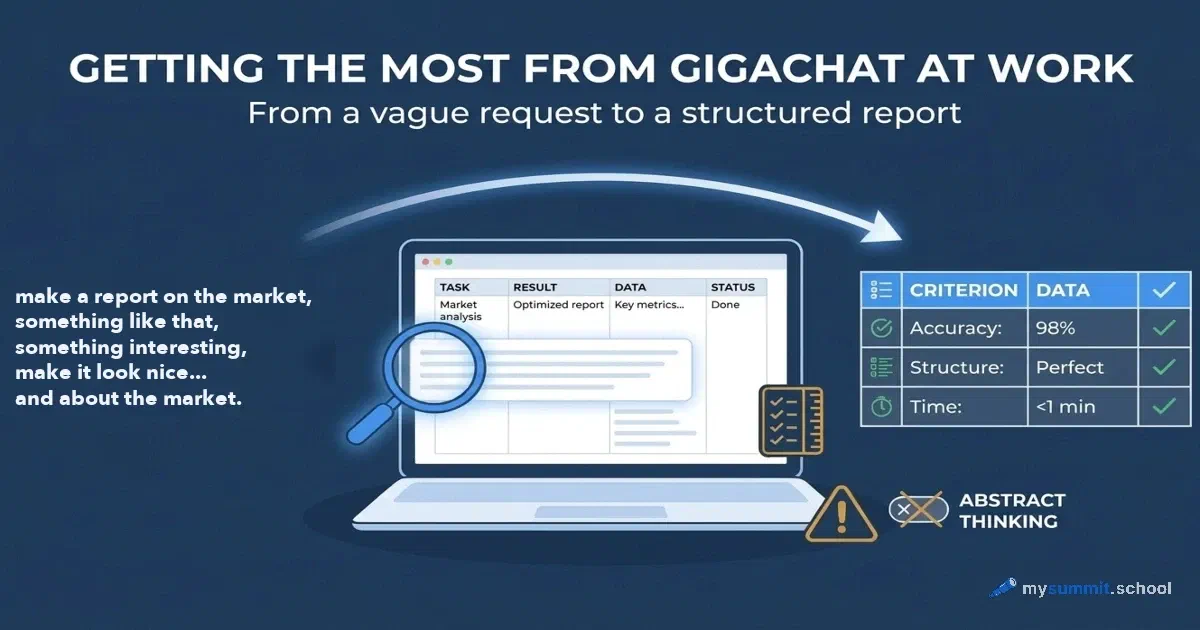
AI models in this article
GigaChat is the large language model built by Sber, Russia’s largest bank. Outside Russia almost nobody uses it. Inside, it is often the only option: banks, state agencies, defense contractors and big industrial groups run it on their own servers because Russian data-localization rules and sanctions keep ChatGPT, Claude and Gemini off the table. If you work with a Russian team, a Russian subsidiary or a client in a regulated Russian industry, this is the tool on their desk.
This guide was written for those daily users, and it reads that way: the examples are Russian contracts, Russian laws, Russian prices. For anyone else it is a useful case study in a broader problem – how to get decent work out of a “sovereign” or on-premise model that trails the frontier, because policy rather than quality decided you would use it.
Search for “GigaChat” in Russian and you get two kinds of content: promotional reviews from Sber’s partners and dismissive teardowns from ChatGPT users. Neither helps when you need to write a prompt right now and get a usable first draft of a document.
So this is a practical guide. What to do to get 20–30% better output from GigaChat. What to avoid so you don’t make it worse. And where the line is beyond which no prompt will save you and you need a different tool.
Where GigaChat earns its place
Before the techniques, an honest map of its strengths. There are three areas where GigaChat performs as well as or better than the competition.
On-premise deployment: the main advantage
GigaChat is the only Russian LLM with full on-premise deployment. According to Sber, 65% of corporate GigaChat Enterprise contracts are delivered on-premise or in a private cloud.
SIBUR, the petrochemicals group, already runs GigaChat for diagnostic AI assistants (an engineer describes equipment symptoms, the system suggests repair hypotheses) and for a procurement optimizer. Steelmaker Severstal has scaled AI to a thousand employees a day and more than 60 solutions over eight years.
For banks, defense companies and government contractors this is decisive: data never leaves the perimeter, the model complies with 152-FZ (Russia’s personal data law), and there is an audit trail that meets Bank of Russia requirements. ChatGPT, Claude and DeepSeek offer nothing comparable inside Russia. If your organization cannot send requests to foreign clouds, there is no choice to make, and this section is for you.
Formal business correspondence
GigaChat was trained on a corpus of Russian government and corporate documents, and it shows in formal writing: registration numbers, reference lines, the right level of formality in salutations, the layout of document details as Russia’s GOST standards prescribe them. ChatGPT and DeepSeek trip over these elements more often – they shuffle the order of the details block or slip into an informal register in official letters.
A caveat: this is an observation from practice, not the result of systematic testing. In our benchmark GigaChat scores poorly on “communication” and “regional awareness” – but the benchmark measures the analytical quality of answers, not how accurately a document is formatted. If you prepare official letters to Russian authorities, try GigaChat and compare it with your usual tool on a real template.
Legal documents: trust the form, check the substance
In 2025 GigaChat clearly beat ChatGPT 4 at identifying Russian regulations. In 2026 that gap closed: DeepSeek V4 Flash caught up and in places beats GigaChat on citing specific articles correctly (detailed tests in the “Where prompting stops helping” section below). GigaChat still formats legal documents better – details, registration numbers, formal salutations. But article numbers and the logic of conclusions need checking, whichever model you use.
How to prompt GigaChat: what actually works
If you move prompts from ChatGPT to GigaChat unchanged, you will get worse results than you could. The models were trained on different corpora and calibrated differently. Our prompt-technique experiment across 1,717 runs showed that the right prompt improves GigaChat’s answers by 20–30%.
One trap deserves its own warning: patched prompts. The typical story goes like this. A prompt worked on GigaChat Pro, so you added a caveat – “always cite your source”. Then another – “don’t make up facts”. Then another – “answer strictly from the document”. Each patch fixed a specific problem, but together they conflict: the model tries to cite a source and not invent anything at the same time, and ends up either inventing the citation or refusing to answer. When Sber updates the model (and GigaChat gets updated without notice), the old workarounds start getting in the way. Before adding new instructions, check that they don’t duplicate or contradict the ones already there.
Below are specific techniques, tested against data. One note before you start: GigaChat is tuned primarily for Russian, and all our measurements were made with Russian prompts. The translated prompts below run on the same models, so you can compare them yourself, but expect GigaChat to be weaker in English than in Russian.
Commands instead of polite questions
GigaChat learned from Russian government and corporate documents, where the directive style is the norm. Prompts in the imperative mood get more concrete answers.
This tip is rooted in Russian grammar. A Russian user would naturally write «Можно ли подготовить анализ…?» (“Would it be possible to prepare an analysis…?”). The version that works better uses bare imperatives: «подготовь» (“prepare”), «укажи» (“specify”), «сформируй» (“compile”). In English the closest equivalent is the difference between “Could you maybe…?” and “Prepare…”, and the principle carries over to most models, but the effect we measured is for Russian.
Try it on a live example – both prompts run on the same GigaChat, but the first is written the way people usually write to ChatGPT, and the second is adapted:
The naive prompt gives GigaChat an excuse to answer “yes, I can” and produce a general overview that mentions GDPR (which does not apply to a Russian service). The structured prompt gets a concrete table with law numbers and measures. The difference is entirely in how the request is phrased.
Role framing: matters more than in ChatGPT
In ChatGPT a system role helps, but the body of the prompt often outweighs it. In GigaChat organizational context carries more weight.
Weak: “Check this contract for compliance with 44-FZ.”
Stronger: “As chief counsel for a public-sector customer, review the draft contract for compliance with 44-FZ on the public procurement system. The customer is a state-funded institution, the initial maximum contract price is under 3 million rubles, and the purchase is from a single supplier. Flag the clauses that need changes and propose wording.”
(44-FZ is Russia’s federal law on public procurement – the rough equivalent of EU public procurement rules.) The second version sets the legal position, the procedural context and the concrete deliverable, and GigaChat makes better use of that structure than of a short request.
A three-part structure for complex tasks
For legal and compliance requests, a three-block formula works: (1) role and goal with references to the regulations, (2) contextual constraints, (3) the required output format.
Example: “[1] As in-house counsel at a Russian manufacturing company, carry out a legal review of a draft supply agreement for compliance with the Civil Code of the Russian Federation (chapters 30 and 25) and arbitration court practice. [2] The supplier is a sole trader, the buyer is a limited liability company, the contract value is 1.5 million rubles, delivery is in three stages, prepayment is 50%. [3] Output: a list of risks by contract section, recommended wording changes, and the clauses that match arbitration court practice.”
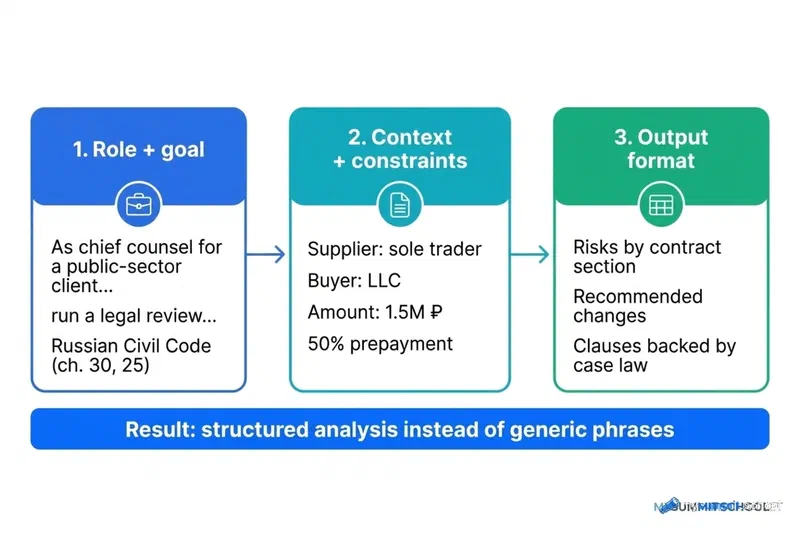
This structure reduces the share of shallow answers – GigaChat’s main weakness according to our benchmark.
If you work through the API, add a stop sequence (stop) with the closing tag of your format to the call parameters – for example </answer> or </result>. The model will stop generating exactly where you need it to, without tacking on an “afterword” that breaks your parsing. It costs nothing: the prompt stays the same and no extra tokens are spent.
Ask for counterarguments
On tasks in regulatory grey zones GigaChat tends to give confident but not always accurate answers. A technique that works: before the final verdict, ask for arguments on both sides.
“List three arguments that this activity requires a license and three arguments that it does not. Then give your overall assessment and say which facts would be decisive.”
This forces the model to consider alternative readings before it takes a position, and hallucinations on regulatory questions become less frequent.
Behind this technique sits a more general principle: whenever you constrain the model, spell out both sides of the trade-off.
Weak: “Be specific. Don’t give vague wording. Back every statement with a reference to a regulation.”
Stronger: “Be specific, but if you’re unsure a reference is accurate, say so plainly. A wrong citation of a legal article is more dangerous than an honest ’needs checking against the original source’.”
The first version pushes GigaChat toward confident but unverified claims – the model will fill every point with a reference, even one it “remembers” inaccurately. The second gives the model room to behave correctly in both directions. Our experiment confirmed this with data: an aggressive tone in the prompt completely suppressed GigaChat’s admissions of uncertainty – the model stopped hedging, but did not get more accurate. Factual accuracy actually slipped from 71% to 70%.
Context limit: 25,000 tokens
GigaChat 2 Max has a 32,000-token context window; competitors start at 128,000 and go higher. For reliable results, keep requests under 25,000 tokens – above that, quality degrades.
One trick only makes sense in Russian, where laws carry very long official titles. Write «ФЗ-44» (“Law 44-FZ”) instead of the full «Федеральный закон от 05.04.2013 № 44-ФЗ „О контрактной системе в сфере закупок товаров, работ, услуг для обеспечения государственных и муниципальных нужд"» (“Federal Law No. 44-FZ of 5 April 2013 On the Contract System in the Procurement of Goods, Works and Services for State and Municipal Needs”). Across a long document, the token savings add up. The same habit – short, consistent names for things you reference often – is worth adopting in any language.
For prompting in general, see our articles on the basic structure of a prompt and common prompting myths (in Russian).
Prompt techniques are the minimum that works without extra spending. But to apply them sensibly you need to know when GigaChat produces a decent result and when it is confidently wrong without you noticing. That is the line we test next, on real tasks.
The prompt techniques in this article squeeze 20–30% more out of GigaChat. Checking the answer is the same skill for any model – GigaChat, DeepSeek or Claude. In the free module of our course you practise it on 9 management tasks and learn to tell a good result from a hallucination.
No payment required • Get notified on launch
Where prompting stops helping
Prompts reorganize what the model already knows – they do not create knowledge that isn’t in the weights. Our Make Weak Model Great Again experiment showed this with data: if GigaChat never “saw” a regulation during training, no prompt along the lines of “you are an experienced Russian labor-law attorney” will make it quote the code correctly.
To see where that line runs, we put GigaChat and DeepSeek V4 Flash through two real tasks. We ran them in Russian; the English versions below let you reproduce them.
Test 1: a management crisis
What to watch for: GigaChat via the API produces a structured but generic plan – every action is assigned to “the project manager”, the metrics are things like “positive feedback”, and there is no day-by-day prioritization. DeepSeek V4 Flash separates symptoms from root causes, spreads ownership across specific roles and warns you about what not to do.
GigaChat Ultra in the web interface does noticeably better – it assigns roles and adds eNPS and meeting protocols. But Ultra is only available on the web, not via the API. And in reasoning mode Ultra made a factual error: it suggested “arranging a knowledge transfer from the departed developers” – even though the task says they left for a competitor a month ago. More on why reasoning mode hurts below.
Test 2: Russian regulation (152-FZ)
152-FZ is Russia’s personal data law, roughly the local counterpart of GDPR. This is home turf for GigaChat.
This is a task where GigaChat should be in its element. Check three things: (1) which model correctly separates special categories (Art. 10) from biometrics (Art. 11), (2) which notices that the portal goes beyond the employment relationship, so notifying Roskomnadzor, the Russian data protection regulator, is mandatory, (3) which one doesn’t mix up article numbers.
In our tests the API version of GigaChat confused Art. 9 (consent) with Art. 10 (special categories). DeepSeek V4 Flash named all applicable articles correctly, separated the data categories and gave the fine amounts under the Russian Code of Administrative Offenses. GigaChat Ultra in standard mode did better – it named Art. 10 and Art. 11 correctly – but Ultra is only available in the web interface, not via the API.
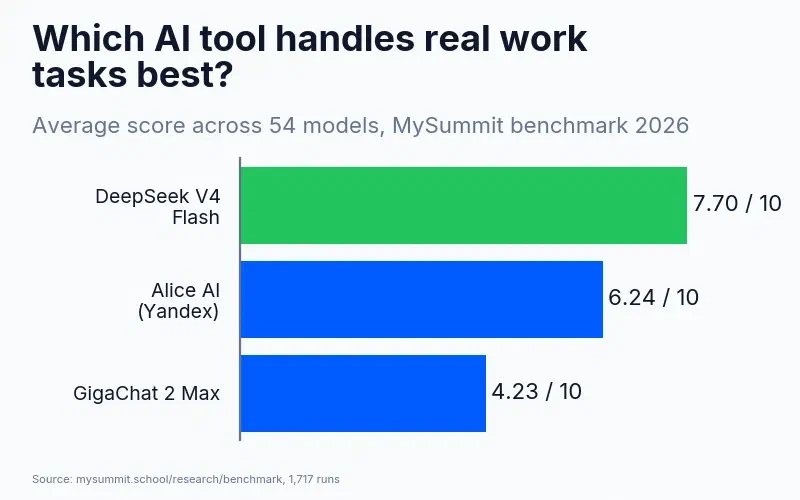

The honest conclusion: GigaChat’s edge on legal tasks was real in 2025, against ChatGPT 4. In 2026 DeepSeek V4 Flash closed that gap. GigaChat is still better at the form of documents (details, registration numbers, formal style), but on substance – citation accuracy and the logic of conclusions – the difference is gone.
The reasoning-mode trap
A separate warning: don’t use GigaChat’s reasoning mode for tasks that need precise citations.
We ran the same legal task on GigaChat Ultra in both modes. In standard mode the model correctly named Art. 10 and Art. 11. In reasoning mode it cited Art. 8 (publicly available sources – irrelevant to the task) and skipped Art. 11 entirely. The reasoning looked logical, but it led to the wrong citations.
This matches Wei et al. (Google Brain, 2022) and our own data from the MWMGA experiment: in smaller models, chain-of-thought provokes confident but wrong reasoning. The model generates five steps that look logical and arrives at a false conclusion. For the same reason, don’t ask GigaChat to “improve its answer” – research (Zhang et al., ACL 2024) showed that small models can’t detect their own errors and, instead of critiquing, simply rephrase the same answer.
The practical rule: set the right structure in the first request (the three-part formula above). Don’t iterate, don’t switch on reasoning – it won’t get better.
These tests show one specific thing: the difference between a good and a bad result is not the choice of model, it’s the ability to check the answer. GigaChat cited Art. 9 instead of Art. 10, and if you don’t know that special categories live in Art. 10, you’ll take the error for the truth. That is exactly what our course teaches: telling a reliable answer from a confident hallucination.
GigaChat mixed up Art. 9 and Art. 10. Would you have noticed? The free module of our course has 9 tasks where you learn to check AI answers on real management situations.
No payment required • Get notified on launch
When to switch to another tool
Our MWMGA experiment showed that picking the right model for the task gives a bigger gain than polishing prompts for the wrong one. Loyalty to a tool is an expensive habit.
Even if GigaChat is your main tool, some tasks are worth sending elsewhere:
| Task | Can GigaChat handle it? | Alternative |
|---|---|---|
| Formal correspondence to Russian standards | Try it – in our experience, better on form | Compare with DeepSeek on your template |
| First draft of a legal document | Form yes, substance – check it | DeepSeek V4 Flash to cross-check citations |
| Analysis, planning, complex reasoning | Weak – low in the benchmark | DeepSeek / Claude / ChatGPT |
| Long documents (>25K tokens) | No – quality degrades | Claude / Gemini (128K+ context) |
| Code generation | Weak – 25–35% worse | DeepSeek |
| International regulation | No – accuracy drops to 65% | ChatGPT / Claude |
| Creative tasks | Weak – 40% lower on novelty | ChatGPT |
DeepSeek V4 Flash works in Russia without a VPN, costs about 25 rubles per million tokens and in our benchmark is well ahead of GigaChat. Alice AI from Yandex also scores higher. For a comparison of Russian alternatives, see our YandexGPT review and the full tool comparison.
If you work in a closed environment and switching is impossible, that’s not a dead end, it’s your working conditions. Here is what an effective process looks like: a bank lawyer receives a draft contract, runs it through GigaChat with the three-part formula (role + constraints + format) and gets a structured first-pass analysis in three minutes instead of an hour. Then they check the article numbers against the original source, which takes another ten minutes. Net result: a task that used to take an hour and a half is done in fifteen minutes, and the lawyer knows exactly which parts of the answer are reliable and which need manual checking.
The key skill here is telling the reliable part of an answer from a hallucination. Prompts organize what the model already knows – they don’t create knowledge.
What it costs in practice
The honest picture from our own usage: we bought a 6-million-token package for 3,450 rubles. Over a month we made about 900 requests – and used less than a fifth of the package. The effective price per token came out 5.6 times higher than the list price.
That is how prepaid packages work: without a steady high volume, you overpay. Since 2026 unused tokens roll over for 90 days, which softens the blow a little.
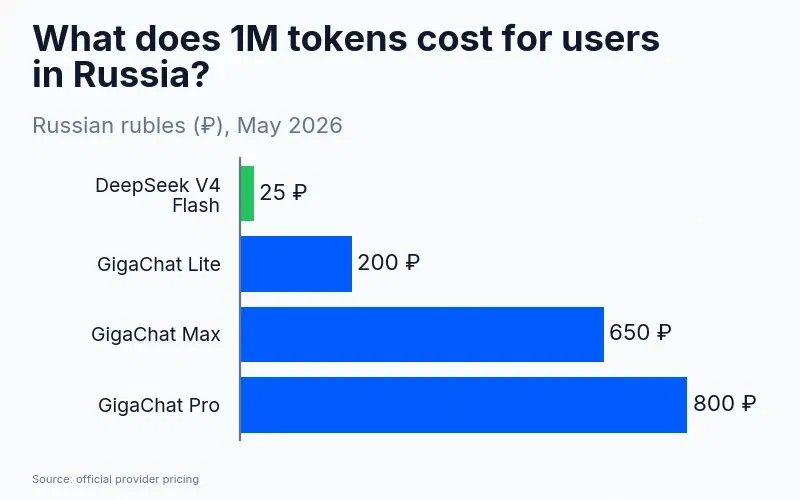
By tier: Lite (~200 rubles per million tokens) covers about 90% of routine tasks – drafts, summaries, simple letters. Pro (~800 rubles) is the best fit for regulatory work. Max (~650 rubles) is positioned as the flagship, but our benchmark showed a weak result – there is no point paying for Max on tasks where GigaChat isn’t strong to begin with.
For comparison: DeepSeek V4 Flash costs 25 rubles per million tokens and delivers much higher quality. More in our DeepSeek review and our comparison of AI tools for managers in Russia.
If you use GigaChat through the web interface rather than the API, the GigaChat Plus subscription costs 399 rubles a month and includes access to Ultra. For most of the tasks in this article, that’s enough. A prepaid API package makes sense with a predictable high volume – say, a ten-person legal department analyzing contracts every day. For occasional use, paying for a package up front is a poor deal.
Cheat sheet: rules for working with GigaChat
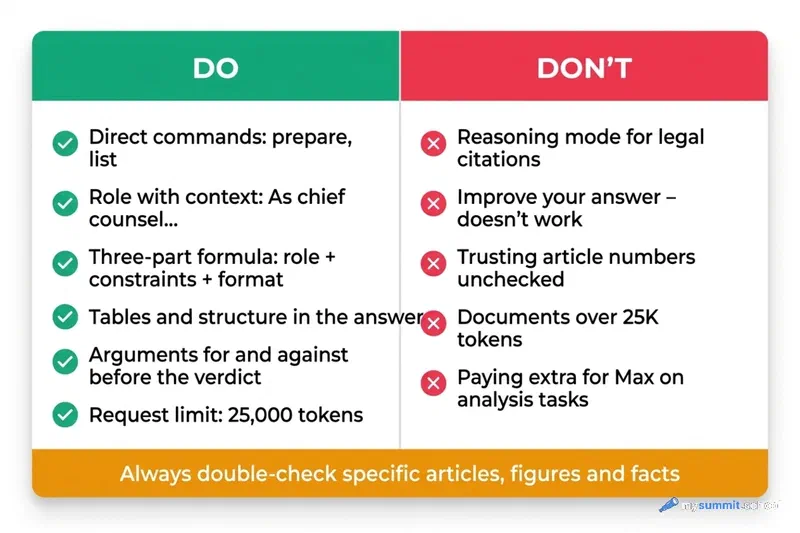
Do:
- Write in the imperative: in Russian «подготовь», «укажи», «сформируй» (“prepare”, “specify”, “compile”)
- Give a role with context: “As chief counsel for a public-sector customer…”
- Use the three-part formula: role + constraints + format
- Ask for tables and structure in the output format
- Ask for arguments for and against before the verdict
- Spell out both sides of the trade-off: not just “be specific” but also “if you’re unsure, say so plainly”
- Keep requests under 25,000 tokens
- Check the prompt for conflicting instructions before adding new ones
Don’t:
- Don’t turn on reasoning mode for tasks that cite regulations
- Don’t ask it to “improve” its answer or “find the weak spots” in it
- Don’t rely on article numbers without double-checking
- Don’t use GigaChat for documents longer than 25K tokens
- Don’t overpay for Max on analysis and planning tasks
- Don’t pressure the model with an aggressive tone – it will sound more confident, not more accurate
Double-check every time GigaChat names specific articles, figures or facts. The model sounds equally confident whether it is right or wrong.
The prompt is written. Is the answer right?
The core skill in working with AI is checking the result. In the foundation module of our course you practise critical thinking with AI on real management tasks: how to tell deep analysis from shallow, when to trust citations and when to double-check. Start with the free diagnostic module: 9 lessons, no sign-up required.


Stanislav Belyaev
Engineering Leader at Microsoft18 years leading engineering teams. Founder of mysummit.school. 700+ graduates at Yandex Practicum and Stratoplan.