GigaChat in 2026: Honest Review – Is It Worth Using for Work?

AI models in this article
GigaChat is the generative AI model from Sber – Russia’s largest bank, which has spent the last decade turning itself into a technology group. It was built for Russian speakers from the ground up: trained on Russian data, with a solid grasp of the cultural context, slang and everyday realities behind the language. And inside Russia it works without a VPN – which matters there, because ChatGPT, Claude and Gemini don’t officially serve Russian users.
For a manager in Russia, that means a model that handles local specifics – from business etiquette to the finer points of Russian law – better than its foreign rivals. Sber shipped GigaChat 2.0, a generation with multimodal features, in 2025. In March 2026 it released GigaChat Ultra with a reasoning mode, and in summer 2026 GigaChat 3.5 Ultra took over the top of the lineup. That model is the main focus here.
Update: GigaChat 3.5 Ultra and Benchmark Results (July 2026)
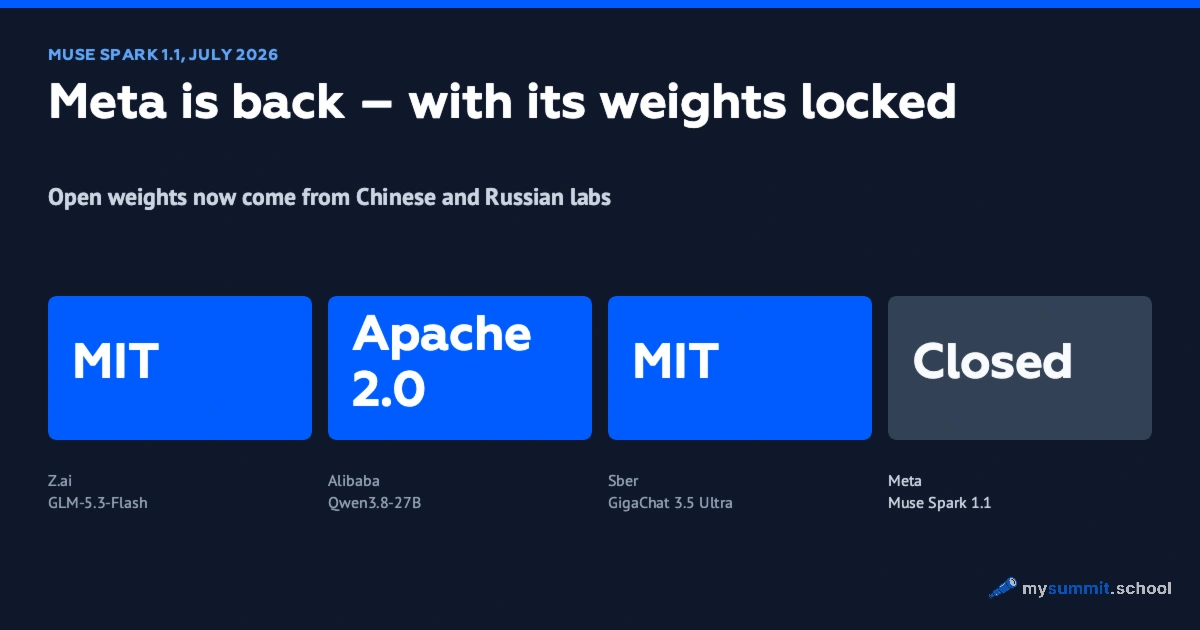
Sber released GigaChat 3.5 Ultra, a mixture-of-experts (MoE) model with 432 billion parameters. The weights are open on HuggingFace and GitVerse (a Russian code-hosting platform) under the MIT License. It is almost half the size of the previous flagship, uses fewer resources and generates long text up to 4 times faster. The context window is 262K tokens, against 128,000 for the 2.0 lineup.
Getting access is simpler than with Sber’s earlier releases. It’s free in the GigaChat assistant: the web chat (giga.chat), the mobile apps and the Telegram bot. API access goes through Cloud.ru Foundation Models, a Russian cloud platform: model ID cloudru/ai-sage/GigaChat3.5-432B-A28B, 262K context, priced at $1.07 per 1M input tokens and $3.21 per 1M output tokens (96.22₽ and 288.6₽ on the platform itself). At the time of checking, the model isn’t in Sber’s own API at developers.sber.ru, so Cloud.ru is the only integration route. Both prompts on this page call exactly that ID, so you can test the model right here in the article – no sign-up, no keys.

We tested it in the MySummit benchmark. Here’s where every GigaChat model landed:
| Model | Cost per 1M tokens | Ranking position |
|---|---|---|
| GigaChat 3.5 Ultra | $1.07/$3.21 | Best in the lineup, lower half |
| GigaChat Ultra | $10/$10 | Near the very bottom |
| GigaChat 2 Max | $7.22/$7.22 | Last place |
On price, 3.5 Ultra undercuts the Western flagships: Claude Sonnet 4.6 costs $3/$15 per 1M tokens. The Chinese models that are available in Russia go the other way – they’re cheaper than GigaChat and rank higher.
The benchmark judges recommend it for emails to senior leadership, meeting minutes, strategic analysis of alternatives, and any case where you need direct access from inside Russia. They advise against it for financial calculations, references to employment law and team-management tasks – the mistakes there are the dangerous kind.
For comparison: Gemma 4 31B delivers comparable results at roughly an eighth of the price. DeepSeek V4 Flash is an order of magnitude cheaper and scores noticeably higher. GigaChat’s one real advantage is guaranteed data storage inside Russia.
There is progress: the jump in scores from GigaChat 2 Max to 3.5 Ultra is clear. But the leaders (Claude Opus 4.6, Xiaomi’s MiMo v2.5 Pro) are still a long way ahead.

Full access to GigaChat (model selection, every feature) requires a SberID account and a Russian phone number. Basic features work on the website without registration, and through bots on Telegram and VK (Russia’s largest social network).
Try It Yourself: GigaChat vs DeepSeek vs Qwen
Before we get into models and pricing, run a prompt right here and compare three models: GigaChat 3.5 Ultra (Sber, via Cloud.ru), DeepSeek V4-Pro and Qwen3.8-Max (Alibaba). All three in the widget are current flagships, including the Sber model described above.
Example 1. Internal communication – hybrid work announcement
The task tests three things at once: fluency, a feel for business etiquette, and the ability to sound like a person rather than a policy memo. In the Russian edition of this article the prompt is in Russian, and there GigaChat plays at home – Russian business vocabulary and cultural context. In English it plays away: its training data is mostly Russian, and that tends to show in tone and phrasing. DeepSeek and Qwen are on neutral ground with English. Further down there’s a second prompt, an analytical one, where the balance shifts.
GigaChat Models
GigaChat 3.5 Ultra (July 2026)
The current flagship. A 432-billion-parameter MoE architecture, trained in FP8, with online reinforcement learning (online RL) and MTP-accelerated generation (multi-token prediction). The weights are open – HuggingFace and GitVerse, MIT License – so you can deploy the model inside your own infrastructure.
Architecturally, 3.5 Ultra is built on a Russian-developed linear attention technique: Sber describes it as accumulating context gradually instead of re-reading the text from the start. That has two practical consequences. The model is almost half the size of the previous flagship and uses fewer resources, and it generates long text up to 4 times faster. The context window is 262K, twice that of the 2.0 lineup.
According to Sber, development involved around 1,500 experiments, and the training data leans heavily on filtered, human-written text.
Access: free in the GigaChat assistant (web chat, mobile apps, Telegram bot) and via API through Cloud.ru Foundation Models – ID cloudru/ai-sage/GigaChat3.5-432B-A28B, $1.07/$3.21 per 1M tokens. At the time of checking, the model isn’t available in Sber’s cloud API (developers.sber.ru).
In our benchmark it posts the best result of any GigaChat model while sitting in the lower half of the overall ranking. It is surprisingly strong at strategic analysis – the best result among Russian models in that category. Its weakest category is team management. On price it’s cheaper than the Western flagships and more expensive than the Chinese models available in Russia, which rank higher.
GigaChat Ultra (March 2026)
In March 2026, Sber unveiled GigaChat Ultra – the flagship of that generation, with two modes:
- GigaChat Ultra – standard mode. Structures answers well, with tables and concrete recommendations, but regularly gets data wrong. The model shows its chain of reasoning before answering. In our test across 32 management scenarios, the reasoning mode made results worse: it helped on multi-factor tasks (stakeholder analysis, negotiation prep) but hurt wherever precise data and calculations were needed. The detailed breakdown with data is in a separate article.
GigaChat Ultra is free at giga.chat, in the mobile apps and through the Telegram bot. At the time of that review, the API wasn’t available yet. Since 3.5 Ultra came out, it has dropped to the very bottom of the ranking.
The GigaChat 2.0 Lineup
The previous generation, which Sber still serves through its own API. These are the models behind most corporate case studies – and behind our own spending figures below.
- GigaChat 2 Lite – for quick everyday tasks: answering questions, drafting emails, simple summaries. Fast and as cheap as it gets. A good fit for chatbots and high-volume request processing.
- GigaChat 2 Pro – the balance of speed and quality. Handles summarizing, rewriting, editing and creative work well (marketing copy, social media content). Better at following complex instructions.
- GigaChat 2 Max – the heavy model for complex professional work: analytics, large documents (up to 200 pages at once), in-depth data analysis. Context window: 128,000 tokens.
GigaChat Models Ranked in Our Benchmark
In our benchmark we tested every available GigaChat model on 80 real management tasks (47 models in the ranking). Every GigaChat model is in the bottom half, though 3.5 Ultra has closed some of the gap.
3.5 Ultra has an uneven profile: some categories at solid mid-table level, others near the end of the list. Since the move to Cloud.ru, price is no longer an argument against it – it’s below the Western flagships. The open question is its place in the ranking.
GigaChat Ultra – the former flagship, now near the very bottom of the ranking. At $10/$10 per 1M tokens, it loses to models that cost a fraction of that: Gemini Flash Lite ($0.15/M) and Alice AI ($0.8/M), Yandex’s model.
GigaChat Ultra Thinking – the variant with reasoning mode – scored slightly below standard Ultra. Paradoxically, communication is one of its worst categories, while for Ultra without thinking it’s the best one. Learning and development is very weak.
GigaChat 2 Max – last place. Alice AI costs 9 times less and scores noticeably higher.
Regional expertise is a paradox of its own. On its “home turf” (Russian legislation, Kazakhstan’s tax rules), GigaChat Ultra Thinking was flagged as a source of potential hallucinations: it mixed up Kazakh government agencies and quoted wrong tax rates. The Chinese model Kimi K2.6 handles similar scenarios far better.
Claude Sonnet 4.6, meanwhile, costs more than GigaChat 3.5 Ultra and scores noticeably higher. Where the comparison really goes against GigaChat is wherever Chinese models are available: they’re cheaper and rank higher.
GigaChat’s Multimodal Features
The list below describes what the GigaChat assistant can do – the web chat, mobile apps and Telegram bot. The source doesn’t say which features come from the 3.5 Ultra model and which are carried over from the 2.0 lineup. What we know for sure: 3.5 Ultra has a 262K context against 128,000 tokens for 2.0, and it generates long text up to 4 times faster – on document-heavy work, that’s where you feel the difference. The 200-page limit per document is stated for version 2 Max.
- Documents – upload a report, contract or internal policy (up to 200 pages in the Max version) and ask questions about it. The model finds the relevant clause, writes a summary or compares two documents.
- Audio – upload a meeting or interview recording (up to 1 hour); GigaChat transcribes it, pulls out the key points and drafts the minutes. No need to convert it to text first.
- Video – send a video link; the model describes the content and answers questions about it.
- Images – generates illustrations from a description (via the built-in Kandinsky, Sber’s image model) and analyzes uploaded images: charts, diagrams, photos of documents.
- Music – creates background tracks up to 3 minutes long for presentations or videos.
- Web search – finds current information and links to sources, like Perplexity.
- Voice calls – you can call GigaChat and talk a task through: the model answers in real time, handles interruptions and keeps a transcript of the conversation.
- Deep Research – the model runs a multi-step investigation of a complex question on its own, pulling from several sources and producing a structured answer with citations.
- Reasoning mode – breaks complex tasks into steps and shows its chain of reasoning, the way an expert would work through a problem. Useful for checking the logic behind an answer.
- Russian legislation – GigaChat finds its way around Russian laws, GOST standards (Russia’s national technical standards) and regulations better than its competitors.
The feature list answers most “what can the tool do” questions. The second question is how accurate it is on a specific request. In our benchmark, the model is reliable on business correspondence and document formatting, and makes mistakes on financial calculations and employment-law references. Where GigaChat delivers a dependable result also depends on how you phrase the request.
GigaChat understands Russian better than its competitors – but answer quality depends on the prompt. The free module has 9 tasks that show the difference between a good request and a bad one.
No payment required • Get notified on launch


Choosing between GigaChat, ChatGPT and DeepSeek is half the job. The other half is learning to get the result you need from the model. Free module: 9 management tasks with the mistakes broken down.
No payment required • Get notified on launch
GigaChat Pricing and Costs
GigaChat – free or paid?
Basic access is free. The web interface at giga.chat works once you sign in with SberID – no subscription and no daily message cap. GigaChat is also free on Telegram, VK and the MAX messenger.
For the API (automation, product integration), Sber gives 1,000,000 free tokens a year – enough for several months of active use by one person. That’s Sber’s own API at developers.sber.ru, which runs the 2.0 models; at the time of checking, 3.5 Ultra isn’t there. It’s available through Cloud.ru Foundation Models at $1.07/$3.21 per 1M tokens – standard API access, no packages, no prepayment.
GigaChat API Pricing (current for 2026)
Sber updated its pricing in February 2026. Prices in Russia are quoted in rubles; for orientation, Cloud.ru’s rates above put 100₽ at about $1.11. Here’s how GigaChat compares to its nearest competitors – models that also work from Russia without a VPN:
| Model | Cost per 1M tokens | Quality tier |
|---|---|---|
| GigaChat 3.5 Ultra (Cloud.ru) | 96.22₽ input / 288.6₽ output | Best result in the lineup |
| GigaChat 2 Lite | 65₽ | Simple requests, drafts |
| GigaChat 2 Pro | 500₽ | Mid-level writing and analysis |
| GigaChat 2 Max | 650₽ | Complex analytics |
| DeepSeek V4 Flash | ~8₽ | Strong and very cheap (benchmark) |
| Qwen 3.6 Plus | ~30₽ | Upper part of the ranking |
| ChatGPT (GPT-4o) | ~750₽ | Top tier |
| Claude Sonnet | ~900₽ | Top tier |
DeepSeek V4 Flash comes out roughly 12 times cheaper on input tokens and 18 times cheaper on output, with a higher benchmark score. If working without a VPN is your main criterion, DeepSeek, Qwen and MiMo all work directly from Russia and cost less.
What GigaChat Costs in Practice: Our Experience
We use the GigaChat API on the MySummit.school learning platform – students run prompts straight from the articles and compare answers across models. Here are the real numbers for February–May 2026:
- 928 API requests (mostly GigaChat Max)
- 976,000 tokens used (~1,000 tokens per request)
- 3,450₽ spent – two 3-million-token packages (Max + Pro)
- Of the 6 million tokens bought, less than 1 million had been used at the time of publication – the rest is still being drawn down
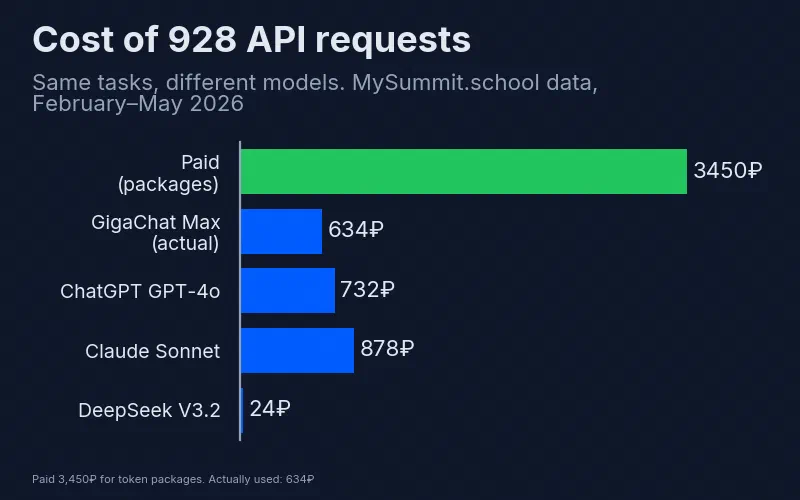
An average GigaChat Max request costs 0.68₽. The same 928 requests through DeepSeek would have cost 24₽ instead of 634₽ – more than an order of magnitude less, even though DeepSeek scores far higher in our benchmark.
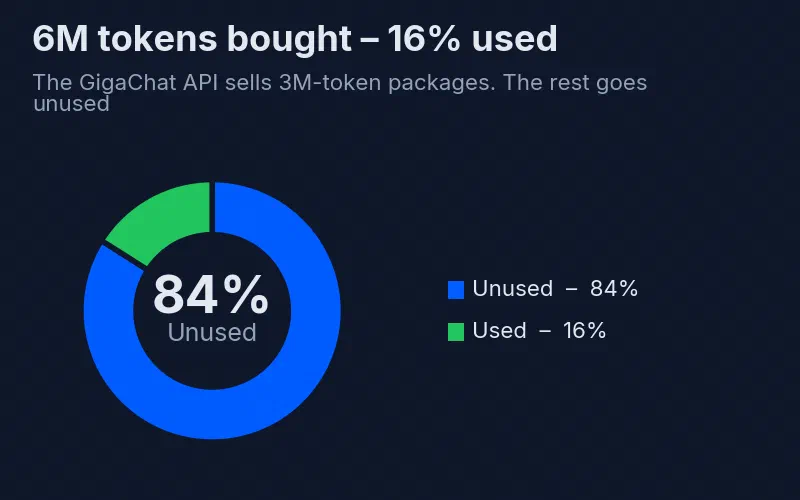
The real trap is the package model. The GigaChat API sells tokens in 3-million packages, starting at 1,500–1,950₽. Even with active use through a learning platform and hundreds of requests, we’ve used only 16% of what we bought. Competitors (DeepSeek, Qwen, OpenAI) bill pay-as-you-go – exactly what you use. Cloud.ru works the same way for 3.5 Ultra: per-token billing, no mandatory package.
Practical Uses for Managers
- Documents and reports – summarizing long documents, comparing contract versions, preparing briefs for leadership. GigaChat handles Russian business vocabulary better than foreign alternatives.
- Law and regulation – questions about Russian laws, GOST standards and regulations. The model was trained on Russian legal data.
- Marketing and content – copy for Russian audiences, social media posts, marketing materials that get the local context and tone right.
- Meetings – upload a meeting recording (up to 1 hour) and get a transcript with key points and a list of decisions.
- Presentations – GigaChat can generate a presentation from a text description.
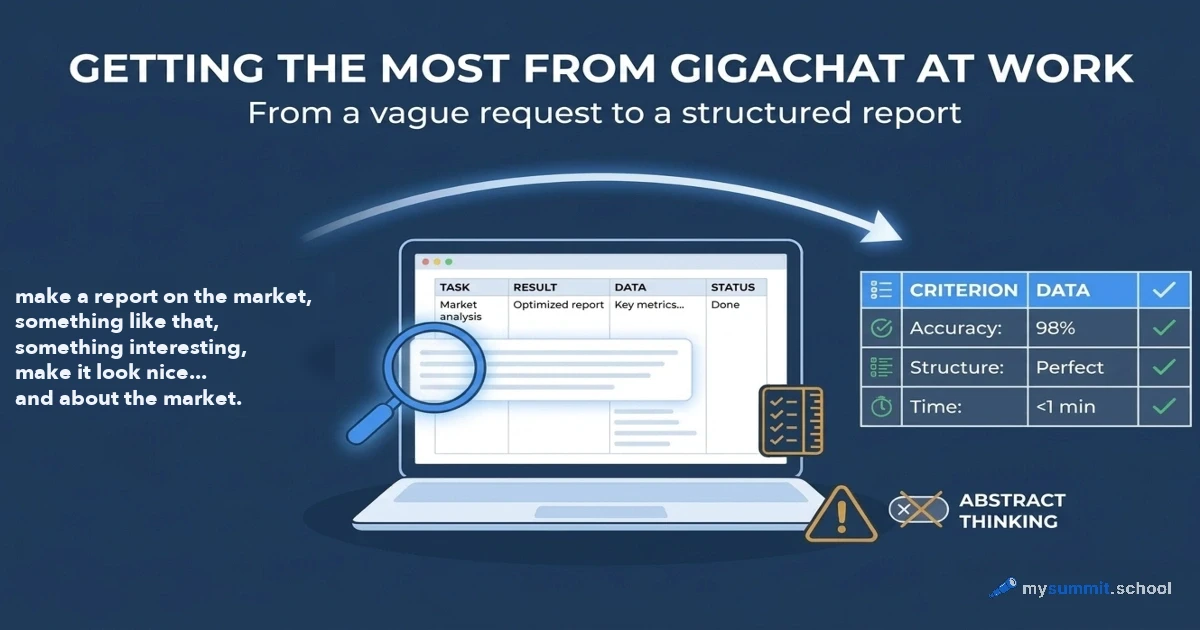
If you already have GigaChat and want to get the most out of it, see our separate breakdown of the prompt techniques that add 20–30% in quality, and the pitfalls of reasoning mode: GigaChat for work – how to get the most out of what you have.
Example 2. Russian regulatory context – compliance and risk
The second prompt is analytical. It tests the area where GigaChat ought to have an edge: knowledge of Russian regulation – specifically 152-FZ, Russia’s personal data law (roughly its counterpart to GDPR), enforced by the regulator Roskomnadzor. Same lineup as before: GigaChat 3.5 Ultra via Cloud.ru against DeepSeek V4-Pro and Qwen3.8-Max.
Watch two things: how well the model knows the Russian-specific terminology (152-FZ, Roskomnadzor, consent to processing) and how tightly it sticks to every requirement in the prompt – 6–8 items, explanations, 2 problem areas. That’s the difference between a polished-looking answer and a working tool for a manager.
Limitations and an Honest Comparison
In our benchmark, GigaChat 3.5 Ultra is the best result in the lineup but sits in the lower half of the ranking. The gap to the leaders is still wide: Kimi K2.6, DeepSeek V4 Pro and MiMo v2.5 Pro are all available from Russia and considerably stronger.
In practice, this means:
- For analytics and complex reasoning – ChatGPT, Claude, Kimi and DeepSeek are considerably stronger
- For Russian-language writing, legislation and business correspondence – GigaChat 3.5 Ultra is competitive, though Yandex’s Alice AI LLM v3 is improving too
- For multilingual work – ChatGPT and Claude are more consistent at holding the response language with mixed-language prompts
- Reasoning mode (Thinking) – makes results worse in five of eight task categories. Detailed breakdown with data and links to academic research
The context window of the GigaChat 2.0 lineup is 128,000 tokens (comparable to GPT-4o and Claude Sonnet); 3.5 Ultra has 262K.
And GigaChat’s API pricing is still high next to Russian and Chinese models. DeepSeek V4 Flash comes out roughly 12–18 times cheaper with a much higher benchmark score.
GigaChat’s Advantages
- Best understanding of Russian – trained on Russian-language data, it gets business slang, cultural context and local realities
- Russian legislation – finds its way around laws, GOST standards and regulations better than foreign alternatives
- All in one – text, images, audio, video, music, presentations, web search
- Open weights for 3.5 Ultra – MIT License, so you can deploy it in your own infrastructure and not depend on an external API being available
- Availability – free web interface, Telegram bot, MAX messenger; API access to 3.5 Ultra via Cloud.ru; a free annual token allowance on Sber’s own API
- Sber ecosystem – built into Sber’s ATMs and SberBoom smart speakers
- Data stays in Russia – data stored in Russia, compliant with 152-FZ. This matters for companies under data localization requirements
GigaChat in Depth: Pros and Cons by the Data
Since this review came out, we’ve published three separate deep dives – on the benchmark, on the reasoning mode and on real-world use. Here’s what they add up to.
Where GigaChat is genuinely strong:
- Closed-perimeter deployment. It’s the only Russian model with full on-premise deployment: data never leaves the company’s perimeter. According to Sber, 65% of corporate contracts work this way. For banks, defense companies and the public sector, that settles the question. The SIBUR and Severstal cases (a major petrochemicals company and a steelmaker) are in the practical guide.
- GOST-style formatting. Document details, formal register, business correspondence – GigaChat breaks format less often than foreign models here.
- Responsiveness to prompting. A well-built prompt adds 20–30% in quality – the specific techniques are covered in the same guide.

Where it loses:
- Analysis and accuracy. When Sber published 40 business case studies, we checked them against a 29-model benchmark (first wave, May 2026 – the ranking now has 47 models). The flagship Ultra placed 28th, and the public 2 Max (which most of the cases run on) came 29th – last. The cases prove the tool works, not that it’s the best choice.
- Reasoning mode. With Thinking on, results get worse in five of eight categories – especially where exact numbers matter. Turn it off for calculations.
- Price. Sber’s API remains expensive among Russian models, while DeepSeek and Qwen are cheaper and stronger at analysis.
There’s really one practical test. If your requirements include storing data in Russia or deploying inside a closed perimeter, GigaChat does the job and has almost no alternatives – ranking and per-token price become secondary. If you have no such requirements, you’re comparing quality per dollar, and there 3.5 Ultra loses to models that are available from Russia and cost less.
GigaChat is one tool among many. Learn how to pick the right one
In the course, you'll test GigaChat, ChatGPT, Claude and YandexGPT on the same management tasks – and learn which to use when. 9 free lessons, no coding. Your first result comes in lesson one.
Useful Links

Stanislav Belyaev
Engineering Leader at Microsoft18 years leading engineering teams. Founder of mysummit.school. 700+ graduates at Yandex Practicum and Stratoplan.