Grok by SpaceXAI in 2026: Elon Musk's AI Reviewed
AI models in this article
Grok by Elon Musk’s SpaceXAI (formerly xAI) is an AI system that stands out from competitors (ChatGPT, Claude) by skipping heavy content filters and giving direct, real-time access to X (Twitter) data. In June 2026, SpaceX acquired xAI, creating SpaceXAI – a company spanning rocketry, the Starlink satellite network, and AI. Grok has outgrown its “chatbot” label and become a full agent ecosystem: the latest model, Grok 4.5 (June 2026, 1.5 trillion parameters), ranks in the top 6 worldwide on our benchmark.
Update: SpaceXAI, Grok 4.5, and Grok Build (July 2026)
SpaceX Acquires xAI
In June 2026, SpaceX officially acquired xAI. The new company is called SpaceXAI and brings together AI development, rocketry, and Starlink. For Grok users, little has changed day to day – the interface and API work the same as before – but strategically, Musk now has a single structure for integrating AI into space infrastructure, Tesla’s autonomous driving, and X moderation.
In parallel, xAI (before the merger) acquired Cursor – the popular AI code editor – in a deal worth roughly $60 billion. Cursor’s data is now used to train Grok: Grok 4.5 was trained in part on real developer sessions.
Grok 4.5 – The New Flagship

Grok 4.5 launched in June 2026 and landed in the top 10 of the mysummit.school benchmark at an API price of $2/$6 per 1M tokens. Architecture V9, 1.5 trillion parameters, 500K-token context window. That’s a massive jump – Grok 4.3 sits in the bottom half of the ranking.
Grok 4.5’s key results:
- Outperforms Claude Opus 4.7 at 4x cheaper output-token pricing ($6 vs $25).
- Top 4 worldwide for team management – the best conflict-resolution scripts among every model we tested.
- Weak spot: information lookup. It has no reliable knowledge of Russian labor and tax law.
- Main limitation – blocked in Russia. In this price segment, Xiaomi’s MiMo v2.5 Pro is available directly.
Grok 4.3 ($1.25/$2.50 per 1M tokens) is priced the same as GPT-5.4 Nano, but ranks lower and is also blocked in Russia. There’s no scenario where 4.3 beats its direct competitors.
Grok Build – An Agent for Goals
Grok Build (/goal mode) is a new agentic mode where Grok doesn’t just answer questions but executes multi-step tasks: research, document generation, report creation. You set a goal, and Grok breaks it down into steps on its own, executes them, and returns the result.
Best fit for Grok 4.5: resolving team conflicts (the best scripts in our ranking), weekly reports to your manager, quarterly planning, autonomous research via Grok Build.
Not a good fit for: Russian or Kazakh legal/regulatory questions, precise data and statistics, users in Russia without a VPN.
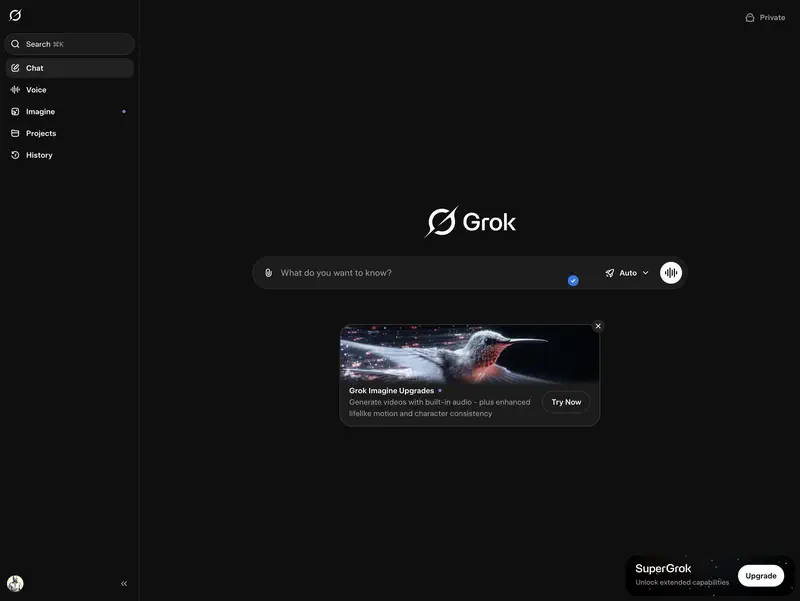
Quick Start
If you’re new to Grok, here’s how to get started in 30 seconds:
- Via X (Twitter): Click the Grok icon in the left or bottom menu. Requires a Premium subscription.
- Directly: Visit grok.com or download the mobile app.
- In Tesla: Press the voice control button on the steering wheel and say: “Grok, navigate to…” or ask any question.
Key Advantages
- Real-time X Integration – Grok has direct access to the X data stream, enabling analysis of events as they unfold. No other AI system has this kind of access to a social platform – it’s SpaceXAI’s unique moat. Ideal for monitoring news, market trends, and public sentiment.
- Multimodality (Grok Imagine) – image, video (10 seconds, 720p with audio), and audio generation. By January 2026, over 1.2 billion videos had been generated through Grok Imagine. Developer API at $0.05/sec – cheaper than competitors. Quality lags behind Sora 2 and Kling 3.0 (1080p), but minimal content filters and the Extend from Frame feature (chaining clips into longer sequences) make Grok Imagine a compelling rapid-prototyping tool.
- Native Video Input (Grok 4.3) – a new capability: upload videos up to 5 minutes for analysis with temporal understanding. Neither Claude nor ChatGPT support native video analysis through their APIs yet.
- Voice Control (Grok Voice) – Tesla integration for natural-language navigation and vehicle controls. New STT/TTS APIs at $4.20 per million characters (86–92% cheaper than OpenAI).
- Minimal Censorship – Grok follows “maximum truth-seeking” principles, answering complex questions more directly than competitors.
Grok Models (July 2026)
Grok 4.5 – the current flagship, released in June 2026. Architecture V9, 1.5 trillion parameters, 500K-token context window. Trained on the Colossus 2 supercluster, including data from Cursor (post-acquisition). API: $2 per million input tokens, $6 per million output. Supports Grok Build (/goal) mode for autonomous task execution. Available in SuperGrok and via API.
Grok 4.3 – the previous flagship, released April 30, 2026. 1M-token context window, knowledge cutoff November 2024. Reasoning is always on and can’t be disabled. Output speed around 207 tokens/sec. Native video input (up to 5 minutes), PDF/XLSX/PPTX generation. API: $1.25 per million input tokens, $2.50 per million output. Available via the SpaceXAI API, OpenRouter, Azure AI Foundry, Oracle OCI.
Grok 4.20 – the previous flagship (released March 10, 2026), built on the “Rapid Learning” architecture with weekly fine-tuning. 2M-token context window – the largest of any model. Reasoning can be toggled on/off via an API parameter. Its strength is agentic tool calling with the lowest hallucination rate on the market.
Core capabilities of 4.20:
- Multi-agent system: 4 or 16 parallel agents (depending on reasoning effort level) for fact-checking and answer synthesis.
- Medical analysis: Direct upload of test results, scans, and lab data for a “second opinion.”
- Deep Search: Multi-step topic investigation, cross-checking data from multiple sources.
Grok 4.1 Fast – a speed-optimized model with a 2M-token context. API: $0.20/$0.50 per million tokens – tens of times cheaper than the flagships. Available via API and partner services (Microsoft Copilot Studio, Azure). The optimal choice for routine queries and high-throughput pipelines.
Grok Code Fast 1 – a specialized coding model with visible reasoning traces.
Colossus 2 – SpaceXAI’s compute base has grown to two superclusters: Colossus 1 (230,000 GPUs) and Colossus 2 (550,000 GPUs, 2 GW of power, Memphis, Tennessee). Colossus 2 is training Grok 5 (expected Q3 2026).

Grok answers without filters. Our free open module shows what that looks like in practice – 9 tasks, no cost.
No payment required • Get notified on launch
Try Grok Right Here
Here’s a real management prompt where directness matters. Grok is known for answering without hedging – compare with DeepSeek, which tends toward a more diplomatic style at a similar intelligence level. Hit the button and judge the difference yourself.
How Managers Can Use Grok
For readers in Russia: As of July 2026, Grok is unavailable from Russia – grok.com, the mobile app, and the API are blocked for Russian users. Access is only possible via VPN. Grok models are also available through OpenRouter, which lets you use Grok 4.5 and 4.3 via API without direct access to SpaceXAI. For reliable access without a VPN, consider GLM-5, YandexGPT, GigaChat, or DeepSeek.
Preparing for difficult conversations – Grok answers more directly than competitors. Useful when prepping for a termination conversation, a team conflict, or a salary negotiation.
Deep research and fact-checking – Deep Search mode in Grok 4.20 runs a multi-step investigation of a topic, cross-checking data from multiple sources.
Creating visual content – with Grok Imagine, you can generate images for presentations, team updates, and onboarding materials, no designer needed.
Corporate agents – with the launch of Grok Business and Grok Enterprise, companies can build custom agents trained on their internal data.
Important: Minimal censorship cuts both ways. Grok may produce overly blunt responses or pick up unverified claims from social media. Always fact-check for critical business decisions.
Comparison with Competitors (July 2026)
| Feature | Grok 4.5 | ChatGPT (GPT-5.4) | Claude (Fable 5) |
|---|---|---|---|
| Flagship model | Grok 4.5 (1.5T parameters) | GPT-5.4 Thinking | Claude Fable 5 |
| Context window | 500,000 tokens | 1,000,000 tokens | 1,000,000 tokens |
| API (in/out per 1M) | $2 / $6 | $1.75 / $14 | $5 / $25 |
| MySummit benchmark | top 6 | not tested | ranking leader |
| Key feature | Real-time X / Grok Build / Tesla | Computer Use / 5 reasoning levels | Claude Code / Artifacts |
| Response style | Direct, uncensored | Balanced, customizable | Analytical, “honest” |
| For managers | Trends, monitoring, autonomous tasks | Routine automation, Excel | Deep analysis, reports |
We teach you to use Grok for trend monitoring
Grok's real-time access to X data makes it a unique tool for tracking trends and fast analysis. In the course, we cover how to build AI monitoring into a manager's daily workflow, even if Grok isn't your main tool.
Continue learning
Open the textbook and pick up where you left off
Benchmark Results
We tested six Grok models on 80 management tasks in the MySummit benchmark – from planning to conflict resolution. Between generations, the gap is huge.
Grok 4.5 is a breakthrough: it lands in the top 10 of the ranking. Especially strong in team management and planning, weaker in information lookup. Cost-per-test is comparable to MiMo v2.5 Pro, but Grok is blocked in Russia.
Grok 4.3 sits in the bottom half of the ranking. At the same price ($1.25/$2.50), GPT-5.4 Nano is more accessible and isn’t blocked. There’s no scenario where Grok 4.3 wins.
Earlier models (4.1 Fast, 4 Fast, Grok 4, Grok 3) land in the bottom quarter of the ranking. The paradox holds: Fast versions consistently outperform their full-size counterparts. That’s unusual for other families (GPT, Claude, Gemini).
Learning and development is Grok’s weakest category. If you’re planning to use AI for training materials, career plans, or mentoring, Grok isn’t the best choice. Grok’s real edge is real-time X integration and minimal content filtering, not analytical power.
Grok 5 is expected in Q3 2026 – it’s training on Colossus 2.
One more prompt – an analytical task where reasoning depth matters. Grok 4.3 with always-on reasoning should perform better here than 4.20 without reasoning:
Pricing
- Free ($0): Grok 4, roughly 10 prompts every 2 hours – enough to try it out.
- X Premium ($8/mo): Higher Grok limits, verified X account.
- SuperGrok Lite ($10/mo): New tier since March 25, 2026 – Grok 4, basic Grok Imagine, 1 agent, video up to 480p/6 sec. For those who want Grok without an X subscription.
- SuperGrok ($30/mo): Full access to Grok 4.5, Grok 4.3, unlimited image generation, DeepSearch, Voice mode, Grok Build (/goal), roughly 100 prompts every 2 hours.
- X Premium+ ($40/mo): Everything in SuperGrok, plus X Premium features (ad-free, higher post limits).
- SuperGrok Heavy ($300/mo): Immediate full access to Grok 4.5, Grok 4 Heavy with 16 parallel agents, maximum limits. For researchers and power users.
- Grok Enterprise: Custom terms for large organizations. Partnerships with Gen Digital (Norton), Oracle, Microsoft Azure.
Useful Links
This article is part of the GenAI Tools Review 2026 series. All tools are covered with hands-on exercises in the mysummit.school course.
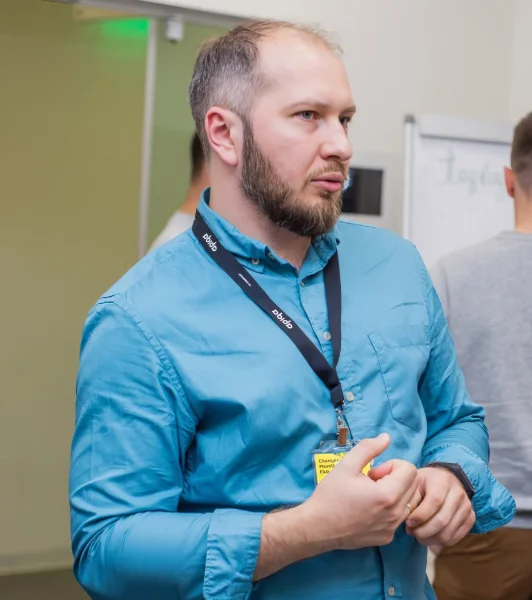
Stanislav Belyaev
Engineering Leader at Microsoft18 years leading engineering teams. Founder of mysummit.school. 700+ graduates at Yandex Practicum and Stratoplan.