Kimi by Moonshot in 2026: K3, K2.6, K2.7-Code and Agents for Managers
AI models in this article
Can an open-source Chinese model beat the closed flagships from OpenAI and Anthropic on availability? Based on our independent testing, the new Kimi K3 (released July 16, 2026) took 2nd place out of 47 models. The only model above it is GPT-5.6 Sol, which is blocked in restricted markets – which makes Kimi K3 the strongest model available without a VPN in markets where the Western flagships are restricted.
Over 2026, Kimi grew from a single model into a full family: the new flagship K3 with a 1M-token context window, the more affordable K2.6 for everyday work, the specialised K2.7-Code for development, and the desktop agent Kimi Work, which runs tasks right on your computer. Below: what that gives a manager, our benchmark results, and how to get started.
Who Is Moonshot AI
Moonshot AI is a Beijing startup founded in 2023 by former ByteDance employees (the company behind TikTok). It’s backed by Alibaba and HongShan (formerly Sequoia China). The founder and CEO is Zhilin Yang, an NLP researcher.
The startup bet on two things: long context and agentic capabilities. The first version of Kimi in 2024 attracted attention with a record-setting context window at the time. In early 2026, K2.5 carried both directions into the elite tier, but it was retired from service on May 25. The lineup was continued by K2.6 and the coding-focused K2.7-Code, and on July 16 the new flagship arrived – K3, which immediately took 2nd place in our benchmark.
What Kimi Can Do
Kimi models are built on a Mixture-of-Experts architecture: the K2.x line has 1 trillion parameters with 32 billion active, and the new K3 is scaled up to 2.8 trillion. Only a fraction of the experts run at any given moment – hence the combination of power and efficiency: responses are fast, and API costs are several times lower than Claude or GPT.
Key specs:
- Context window – 256K tokens on K2.x (roughly 350–500 pages of text per request), and 1M tokens on K3; tokenisation is less efficient for non-English text
- Native multimodality – understands text, images, and video out of the box
- Four operating modes: Instant (quick answers), Thinking (deep analysis), Agent (autonomous tasks with tools), and Agent Swarm (parallel sub-agents – up to 100 in K2.5 and up to 300 in K2.6)
- Open source – Modified MIT license, weights available on HuggingFace. K2.5 has been retired; the current models are the flagship K3, K2.6, and K2.7-Code (K3’s weights are promised for July 27)
Agent Swarm: The Headline Feature
This is a fundamentally new approach. Instead of solving a task sequentially, Kimi can split it into subtasks and launch dozens or hundreds of specialised sub-agents in parallel (up to 300 in K2.6, coordinating as many as 4,000 steps). Each sub-agent works independently while the main agent coordinates the result.
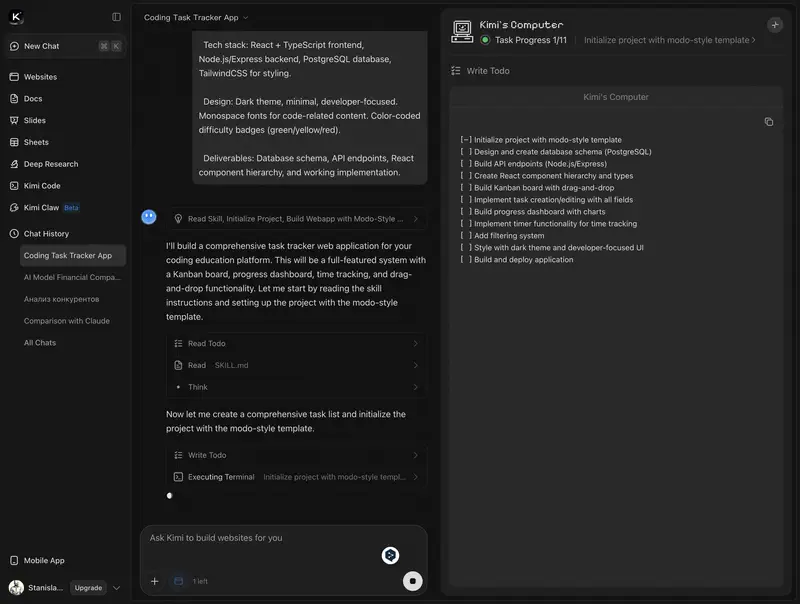
Why wait 10 minutes when you can split the task into 100 threads? In Swarm mode, Kimi K2.5 completes a complex analytical query in 2–3 minutes instead of 10. On the BrowseComp benchmark (web navigation and search), Agent Swarm scored 78.4% – the best result among all tested models, including GPT-5.2.
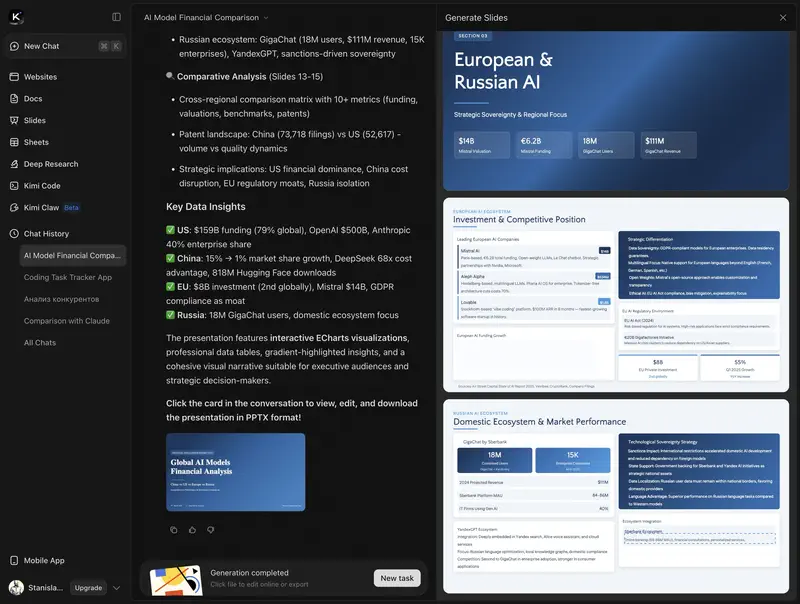
In terms of capabilities, Kimi can compete with Notebook LM from Google. On interactive presentations, the results looked quite solid at first glance – though the underlying data is from last year.
For a manager, this is relevant in scenarios like “analyse 10 competitor websites and compile a summary” or “prepare a report based on multiple sources.”
What the Benchmarks Show
Back at the start of the lineup, in early 2026, Kimi K2.5 competed confidently with the best closed models of the time on standard industry benchmarks (the figures below are historical; the current flagship is K3):
| Benchmark | Kimi K2.5 | GPT-5.2 | Claude Opus 4.5 | DeepSeek V3.2 |
|---|---|---|---|---|
| HLE with tools | 50.2% | 45.5% | 43.2% | 40.8% |
| BrowseComp (Agent Swarm) | 78.4% | 54.9% | 24.1% | 67.6% |
| SWE-Bench Verified (code) | 76.8% | 80.0% | 80.9% | 73.1% |
| AIME 2025 (maths) | 96.1% | 100.0% | 92.8% | 93.1% |
| VideoMMMU (video) | 86.6% | 85.9% | 84.4% | – |
Kimi K2.5 leads in agentic tasks (search, navigation, autonomous operation) and video comprehension. It trails Claude in coding and GPT-5.2 in maths. But these are gaps of 3–4 percentage points, not a chasm.
As always, benchmarks and real-world performance are different things. But the direction is clear: Kimi K2.5 played in the same league as the flagships early in the year. Since July the lineup has been led by K3 – and its results in our benchmark are what we dig into below.
Impressive capabilities – but how do you check whether a model actually handles your tasks? In our free module, we’ve collected 9 scenarios from real management work: from a business email to a strategic memo. You can run any of them on Kimi K3 or K2.6 and compare the result against other models.
9 management tasks – from a client email to a strategic memo. See how Kimi K3, K2.6 and other models handle your work. Free, no registration.
No payment required • Get notified on launch
Kimi’s Model Lineup: K3, K2.6 and K2.7-Code
Today the Kimi lineup has three active models. K3 (July 16, 2026) is the new flagship: 2.8 trillion parameters, a 1M-token window, native vision, and always-on reasoning. K2.6 remains the cheaper option for everyday work, and K2.7-Code (launched June 12) is a coding specialist not meant for ordinary chat. All three are open-weight under a Modified MIT license, with weights available on HuggingFace (K3’s are promised for July 27).

On price, K3 is no longer a “cheap Chinese model”: $3 / $15 per 1M input/output tokens versus roughly $0.74 / $3.49 for K2.6. That’s about half the cost of Claude Fable 5 and a reasonable price for flagship-tier quality – but for routine work K2.6 is still the better value.
What makes K2.7-Code interesting:
- Built for long-horizon development tasks: it plans, edits, runs tools, and debugs code across many steps in a single cycle. For ordinary management tasks, stick with K2.6.
- Architecture and context – 1T parameters, 32B active (MoE), a 256K-token context window, open weights (Modified MIT) on Hugging Face, available via the Kimi API and Kimi Code.
- 30% fewer “reasoning tokens” than K2.6 – an agentic loop that used to burn ~1,000 tokens thinking through an edit now burns ~700. At scale, that’s direct savings.
- Always-on thinking – reasoning mode is on permanently and can’t be switched off. A plus for coding tasks (the model is always “thinking”), but extra token spend for short questions.
- 6x HighSpeed Mode – accelerated generation up to ~180 tokens/sec, useful for agentic loops that make dozens of calls in a row.
- Reliable tool calls via MCP – the model confidently invokes external tools over the protocol: CI checks, ticket updates, and multi-file edits in a single pass.
Price – $0.95 / $4.00 per 1M input/output tokens: a bit pricier than K2.6, but cheap for running a daily developer agent.
Be careful with the numbers: every published K2.7-Code result is a Moonshot in-house benchmark (Kimi Code Bench v2: up from 50.9 to 62.0; MCP Mark Verified 81.1 vs 76.4 for Claude Opus 4.8). There are no independent public-suite results at launch – as with the GLM-5.2 story, vendor wins are worth re-checking.
For managers: if you need maximum quality, take K3 – it’s now the top model available in restricted markets. If your team writes code, K2.7-Code is worth testing as an inexpensive developer agent, and for everyday text, analysis, and communication the cheaper K2.6 is enough. We cover all three in the benchmark below.
Kimi Work and OK Computer: Kimi as an Agent
Beyond the models, Moonshot is building agent products – here Kimi competes directly with Perplexity Computer and Claude Cowork.
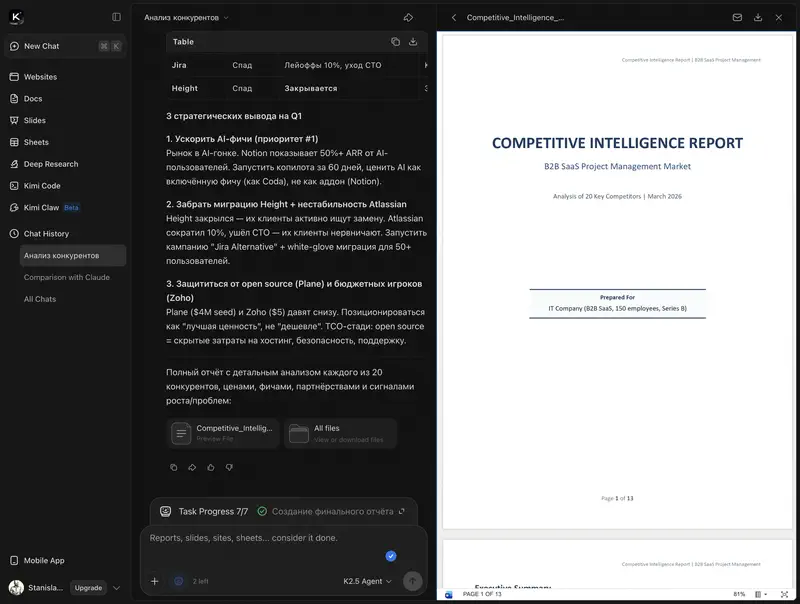
- OK Computer – an agent mode right inside Kimi chat. From a text prompt it builds multi-page sites and ready, editable slide decks, processes up to 1M rows of data at once, and outputs text, audio, images, and video. For a manager, this is a fast first draft of a presentation, landing page, or data report from a single prompt.
- Kimi Work (launched June 10, 2026) – a desktop app (macOS on Apple silicon and Windows) running on K2.6 that acts directly on your computer. You set a goal in plain language; the agent runs the research, turns it into a concise market brief as ready slides (sections built in parallel), and through the WebBridge extension uses your browser like a person: searches, scrolls, extracts data, and fills out forms. Inside is the same Agent Swarm, up to 300 sub-agents.
For managers: the combination of Kimi Work and OK Computer turns Kimi from a chat into a “digital employee” – set a task overnight and get a draft brief or deck by morning. The main caveat: data is processed by a Chinese service, which is worth weighing for sensitive information.
Update: MySummit Benchmark Results (July 2026)
In the MySummit benchmark (80 real management-task scenarios, two independent judges), all three Kimi models landed in the top tier of the ranking, and K3 set a new bar:
- Kimi K3 – 2nd place out of 47 models and the best result among all those accessible without a VPN in restricted markets. It takes #1 in four categories at once: planning, learning, communication, and decision analysis (see the current rank, score, and cost per test in the card above). The only model above it in the ranking is GPT-5.6 Sol, blocked in those markets.
- Kimi K2.6 – several times cheaper than Claude Opus 4.7 at a comparable quality level. It beats Claude Sonnet 4.6 on planning and team management at a noticeably lower price. A sensible choice when the flagship K3 is overkill on cost.
- Kimi K2.7 Code – runs nearly neck-and-neck with Claude Sonnet 4.6 on management tasks, but noticeably cheaper on output tokens. Optimal as an inexpensive coding agent.
All three models are directly accessible without a VPN in markets where Claude and GPT are blocked – a critical advantage there.
Judges’ verdict on K2.6: suits complex project structuring (planning is one of the model’s strongest categories), team-conversation scripts, daily analytics, and reporting. Not suited for detailed local employment-law questions (critical errors), financial calculations (a systematic weakness), or up-to-the-minute market data.
Verdict on K2.7 Code: the best planner under $5 – weekly reports, sprint planning, quarterly plans. Same limitations: employment law and financial models.
Results in Our Benchmark
In our benchmark on real management tasks, Kimi K3 took 2nd place out of 47 models and became the strongest model available without a VPN in restricted markets. The only model above it is GPT-5.6 Sol, blocked in those markets, so for a user in a restricted market K3 is effectively first on the list. The models that were sitting alongside Kimi at the start of the year have slipped or dropped out of the benchmark over six months – the top group has been completely reshuffled.
The gap to the best regional models is substantial. That’s not a nuance, but a fundamental difference in quality.
The radar shows why K3 holds so high: #1 in four categories at once – planning, learning, communication, and decision analysis – plus #2 in team management. Its regional awareness stands out separately: #4 of 47, the best result among all models available in restricted markets, whereas earlier Kimi versions were weak in this category.
Kimi vs Other Chinese Models
For a manager choosing between available tools, the comparison within the “Chinese group” matters more than an abstract race against Claude. All the models below are accessible without a VPN in restricted markets – full results in the benchmark.
| Model | Rank | Score | Cost/test | Strength |
|---|---|---|---|---|
| Kimi K3 | #2 | 8.95 | $0.219 | New flagship, #1 among those available in restricted markets |
| MiMo v2.5 Pro (Xiaomi) | #9 | 8.37 | $0.027 | Team management and HR tasks |
| Kimi K2.6 | #12 | 8.27 | $0.036 | Planning (#11), team management (#9) |
| Kimi K2.7 Code | #16 | 8.05 | $0.028 | Inexpensive coding agent |
| Qwen 3.6 Plus | #18 | 7.94 | $0.011 | Best price/quality in the top 20 |
| MiMo v2.5 (Xiaomi) | #19 | 7.82 | $0.018 | Communication (#13) at 25x lower cost than Claude Sonnet 5 |
| Qwen 3.7 Max | #20 | 7.77 | $0.037 | Planning and team management |
| DeepSeek V4 Pro | #21 | 7.75 | $0.005 | Cheapest in the top 25 |
| GLM 5.1 (Z.ai) | #29 | 7.38 | $0.016 | Team management |
Takeaways from the table:
Kimi K3 is the leader among models available in restricted markets. With 2nd place out of 47, it pulls away from the entire “Chinese group” – only the blocked Western flagships sit near it. For a user in a restricted market, it’s number one on the list.
MiMo v2.5 Pro from Xiaomi is a strong second tier. At #9 it holds close to MiniMax M3 (#8), Grok 4.5 (#10) and Claude Opus 4.7 (#11) – but already noticeably below K3. It’s good where team management and HR tasks matter.
Kimi K2.6 (#12) remains a solid workhorse. It won’t out-argue K3 on quality, but it’s an order of magnitude cheaper and still accessible in restricted markets. Plus the lineup’s unique free chat with agentic modes and Agent Swarm with 300 sub-agents.
DeepSeek V4 Pro is an outlier on price. Several times cheaper than Kimi K2.6, with only a small quality gap.
All Chinese models still significantly outperform Russian ones – the best Russian model, GigaChat 3.5 Ultra, trails Kimi K2.6 noticeably.
Kimi, DeepSeek, GLM-5, Qwen – which model is best for your tasks? Free module: 9 real management scenarios, any model of your choice. Free, no registration.
No payment required • Get notified on launch
Try It Yourself: Project Planning Under Regulatory Constraints
What to watch for: Kimi K2.6 usually builds a detailed sprint structure and lays out dependencies well (planning is one of its stronger categories, #11 of 47). But on US regulatory specifics (HIPAA, BAAs, state telehealth rules, Epic certification), the model often slips – confusing requirements or citing outdated rules (regional awareness is its weakest category). DeepSeek V4 Flash is 7x cheaper with a similar blind spot on local regulation. Claude Sonnet is a solid quality reference, but not accessible without a VPN in restricted markets.
How to Access Kimi
Web Interface: kimi.com
The website kimi.com works globally without a VPN. Sign in with a Google account – it takes about 10 seconds.
The interface is only in English and Chinese; there’s no localized UI for other languages. The model understands and responds in many languages, though quality drops noticeably outside English and Chinese (as with all Chinese models), but it’s good enough for most tasks.
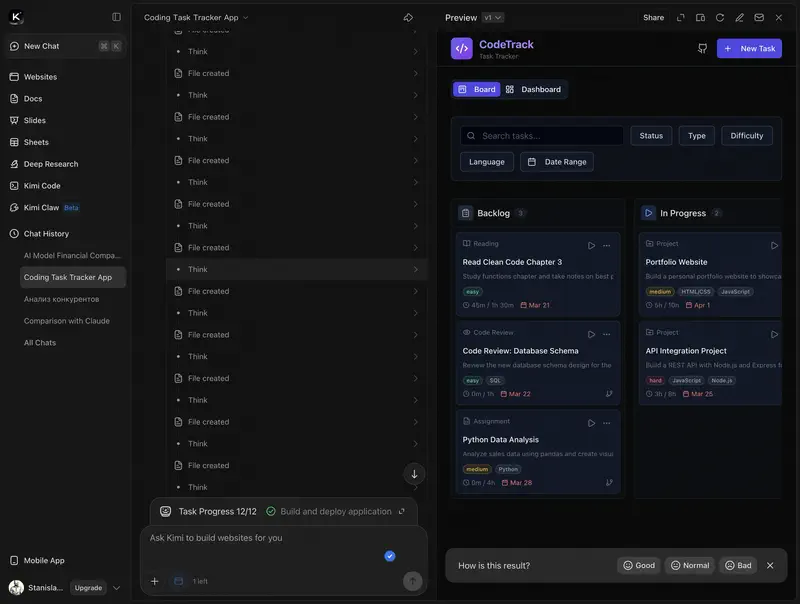
Two main modes of operation:
- Instant – quick answers for everyday tasks: drafting messages, answering questions, working with documents
- Thinking – deep analysis with chain-of-thought reasoning, the model shows its thinking process
- Agent – autonomous task execution: document generation (.docx, .pdf, .xlsx), web search, multi-step operations. If you’re asking it to prepare a report with tables – this is the mode
Mobile Apps
Kimi is available for iOS and Android. Functionality mirrors the web version, including all operating modes.
Pricing
Free Tier (Adagio)
- Unlimited text queries in Instant and Thinking modes
- Up to 3 agent requests per month (documents, spreadsheets, presentations)
- 1 Deep Research request per month
- Queue during peak hours
The free tier is enough to test the model and figure out whether it fits your tasks. For daily work, it’s not quite enough.
Paid Plans
| Plan | Price | What You Get |
|---|---|---|
| Moderato | $19/mo | More agent requests, priority, presentation generation |
| Allegretto | $39/mo | Higher limits, multi-agent tasking, access to Kimi Claw |
| Vivace | $199/mo | Unlimited agents, maximum speed, extended context |
API Pricing
| Option | Input tokens | Output tokens | ~Cost of analysing a 100-page report |
|---|---|---|---|
| Moonshot API (direct) | $0.60 / 1M | $3.00 / 1M | ~$0.50 |
| OpenRouter | $0.45 / 1M | $2.20 / 1M | ~$0.35 |
For comparison: Claude Opus 4.6 for a similar task costs around $3, GPT-5.4 – $1.50. Kimi K2.6 is 6–8x cheaper than Claude.
But among Chinese models, Kimi isn’t the most budget-friendly. DeepSeek V4 Flash costs $0.09/$0.18 per 1M tokens – 15x cheaper, and DeepSeek V4 Pro – 4x cheaper.
Limitations and Risks
Non-English languages – a predictable weakness. Like GLM-5, Kimi performs noticeably better in English and Chinese. It manages in other languages, but loses nuance. If your task allows it, write your prompts in English.
Response speed – Agent Swarm is fast for complex tasks, but standard Thinking mode is slower than Claude and GPT. In an independent test, Kimi K2.5’s median response time was 29.2 seconds versus 4.6 for Claude Sonnet 4.6. That raises a question: if Agent Swarm promises speed through parallelism, why is standard mode 6x slower than competitors? Tolerable for one-off queries, noticeable for intensive work.
Chinese censorship works the same way as with other Chinese models: politically sensitive topics are blocked. For management tasks, this is rarely an issue.
Payment friction – subscriptions and API access require an international card, which can be a barrier depending on your region. Local proxy services exist as workarounds but typically add a markup.
Model size – a trillion-plus parameters means self-hosting Kimi is unrealistic for a typical company. This isn’t Qwen3.5 9B, which you can deploy on a single GPU.
Should You Try It?
Kimi is objectively the strongest Chinese model lineup of 2026. The new flagship K3 took 2nd place out of 47 and became the strongest model available without a VPN in restricted markets; the only model above it is the blocked GPT-5.6 Sol. The unique Agent Swarm technology and open weights – all confirmed by independent testing.
For a manager, the recommendation depends on context. If you need maximum quality and work with multiple sources, reports, or multi-step research – take K3. If your tasks are simpler and cost matters, the cheaper K2.6 remains a solid all-round tool.
If you work primarily in a language other than English or Chinese and cost is critical – DeepSeek V4 Pro remains an excellent choice. It costs several times less ($0.005 per test) and handles regional context well. If your focus is team management, HR tasks, and feedback – MiMo v2.5 Pro from Xiaomi is still strong (#9 in the benchmark), though it trails K3 on overall quality.
Surprisingly, the strongest Chinese model of 2026 isn’t the one that got the most press early in the year. Kimi overtook both DeepSeek and Qwen without loud proclamations. Which raises a question worth sitting with: how reliable is media hype as a guide when choosing a working tool?
Head to kimi.com, sign in with Google, and spend an hour testing. The free tier is enough to form your own opinion.
Move from reviews to practice
The full course program: from prompt engineering and critical thinking to specializations in project management and analytics. Run the assignments on Kimi K3 or any other model – and see the difference between occasional and systematic AI use.

Stanislav Belyaev
Engineering Leader at Microsoft18 years leading engineering teams. Founder of mysummit.school. 700+ graduates at Yandex Practicum and Stratoplan.