Meta Muse Spark: Meta's First Closed Model Since 2023
Until today, this series had no chapter on Meta. While Llama 4 was the headline, the silence was justified: the model landed to mixed reviews, and there was nothing to tell a manager about it as a working tool.
On July 9, 2026, Meta released Muse Spark 1.1 and, the same day, opened public access to the Meta Model API. The announcement went out on the company blog. The Muse family itself, which replaces Llama, started three months earlier: version 1.0 shipped on April 8, and the current model is built on top of it. In the September LMArena snapshot, muse-spark-1.2 in xHigh mode sits fifth on the text leaderboard, muse-spark-1.1 tenth, and muse-spark is sixth on the image leaderboard. Anyone comparing tools by leaderboard will run into the name. Until now, this series had nothing to say about it.
The scores are only the third most important story here. The first is the licence: in nine months Meta replaced its AI leadership, rebuilt the stack and came back with closed weights. The second is what kind of model it turned out to be: 1.1 leads on tool-calling tasks and trails noticeably on writing code.
What happened to Llama
Llama 4 launched to mixed reviews, and the launch turned into a scandal: Meta admitted it had prepared a separate configuration of the model for one of the benchmarks. That admission cost the company trust with exactly the audience that reads score tables more carefully than anyone else.
In summer 2025 Zuckerberg reorganised everything AI-related. The Chief AI Officer role went to Alexandr Wang, 29, co-founder of Scale AI, and Meta Superintelligence Labs was built around him. Wang describes the work like this: “Nine months ago we rebuilt our AI stack from scratch. New infrastructure, new architecture, new data pipelines… This is the first step.”
The market saw that first step on April 8, 2026, when Muse Spark 1.0 came out – the first model family to replace Llama and the first visible decision of the new leadership. The second step was July’s 1.1, with the API opened the same day.
Closed weights
The model is available only through an API; the weights have not been released. Meta has not shipped a closed frontier model since July 2023, when Llama 2 came out. For three years the company told the market that open weights were the right strategy and built its case against Anthropic and OpenAI on it.
For 1.1 this means exactly what it meant for 1.0. You can’t run the model on your own hardware, you can’t fine-tune it on your data, and everything you send it goes to Meta’s servers.
Inside Meta, products have already moved to the new model: Muse Spark replaced Llama 4 in the company’s smart glasses. That is a telling detail. Glasses are a device where response latency and token consumption are directly visible to the user, and nobody ships a model there unless they trust it.
The open vs closed split has broken down
All year this series relied on a simple split: American labs sell closed models, Chinese labs give their weights away. In 2026 that stopped working, and from both sides at once.
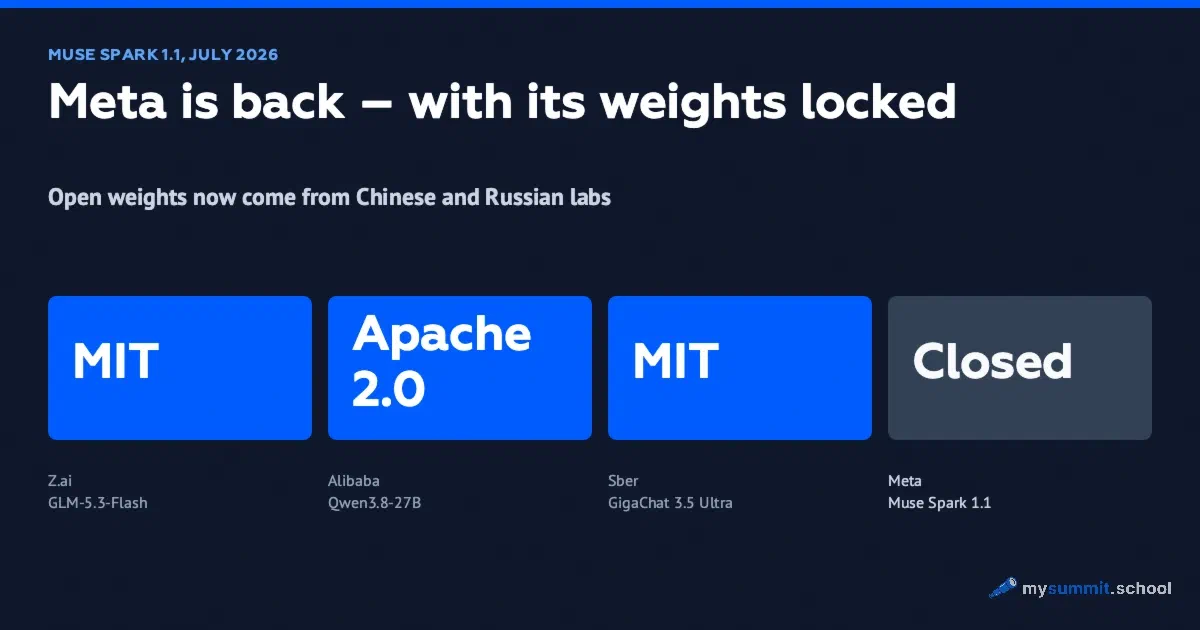
Meta closed its weights. In the same season Z.ai released GLM-5.3-Flash under MIT – no revenue threshold, no restrictions on use. Alibaba published Qwen3.8-27B under Apache 2.0: the model understands images and runs on a single consumer GPU.
Sber, Russia’s largest bank and the developer of the GigaChat models, released GigaChat 3.5 Ultra – 432 billion parameters, also under MIT.
Open weights now come from Chinese and Russian labs. Meta is the company asking you to trust its API.
Under the hood
Meta positions 1.1 against GPT-5.5, Claude Opus 4.8 and Gemini 3.1 Pro. The model has a 1 million token context window and manages it actively: it compresses and drops parts of the history on its own, so a long conversation doesn’t hit the limit.
It accepts images, video, PDF and audio as input. That is a broader range of inputs than GPT-6 Astra and Grok 4.6 offer – both handle images only.
The defining design feature of 1.1 is the orchestrator role. The model takes a request, gathers context for it, drafts a plan and distributes the work across parallel subagents, then assembles the answer from their results. In the Meta AI app and on meta.ai this is exposed as Thinking mode: on tasks the model judges to be hard, it thinks longer.
The practical value of this design is easiest to see on a task a manager actually gives: “here are three vendor proposals and our contract template – find the discrepancies in timelines, penalties and acceptance terms.” A single agent processes the whole set in one go and starts mixing up terms by the third document. An orchestrator splits the request into parts, hands each to its own subagent and assembles the answer from the pieces.
This design grew out of the first version. Muse Spark 1.0 was built as natively multimodal: one architecture processes text and images, rather than an image encoder bolted onto a text model. It had three reasoning modes. Instant answered simple requests right away, Thinking kicked in on hard tasks, and Contemplating broke a single request into parts and launched parallel subagents – which is where the 1.1 orchestrator comes from. During reinforcement learning Meta applied “thought compression”: the model solves hard problems with fewer reasoning tokens. According to Meta, 1.0 reached the target level of reasoning with an order of magnitude less compute than Llama 4 Maverick. Both figures – on compute and on compression – come from the vendor; we have no independent verification.
How many tokens a task takes
On its task suite (Intelligence Index v4.0), Artificial Analysis counted 58 million tokens for Muse Spark 1.0. Anthropic’s model spent 157 million on the same suite, OpenAI’s GPT-5.4 spent 120 million. That’s roughly a third of the consumption for comparable work. Those tokens end up on the invoice, and they are exactly what most often goes missing from comparison tables.
Two caveats. The tasks in the Artificial Analysis suite are standardised; on your long documents and in a back-and-forth conversation the consumption would differ. And the figure applies to 1.0: Meta hasn’t published consumption for 1.1, and an orchestrator with parallel subagents does more work than a single pass over a request, so it burns more tokens.
What independent rankings show
Muse Spark isn’t in our benchmark yet – below are figures from Meta and independent platforms; the model does not appear on the /research/benchmark/ page.
On LMArena, where people compare answers blind, muse-spark-1.2 (xHigh) holds 1499 ± 10 and fifth place on the text leaderboard, with muse-spark-1.1 tenth at 1492 ± 5. The top spot belongs to Claude Fable 5. On the image leaderboard muse-spark is sixth at 1294 ± 9, and muse-spark-1.2 xHigh eighth at 1292 ± 15. Third place there goes to qwen3.8-max.
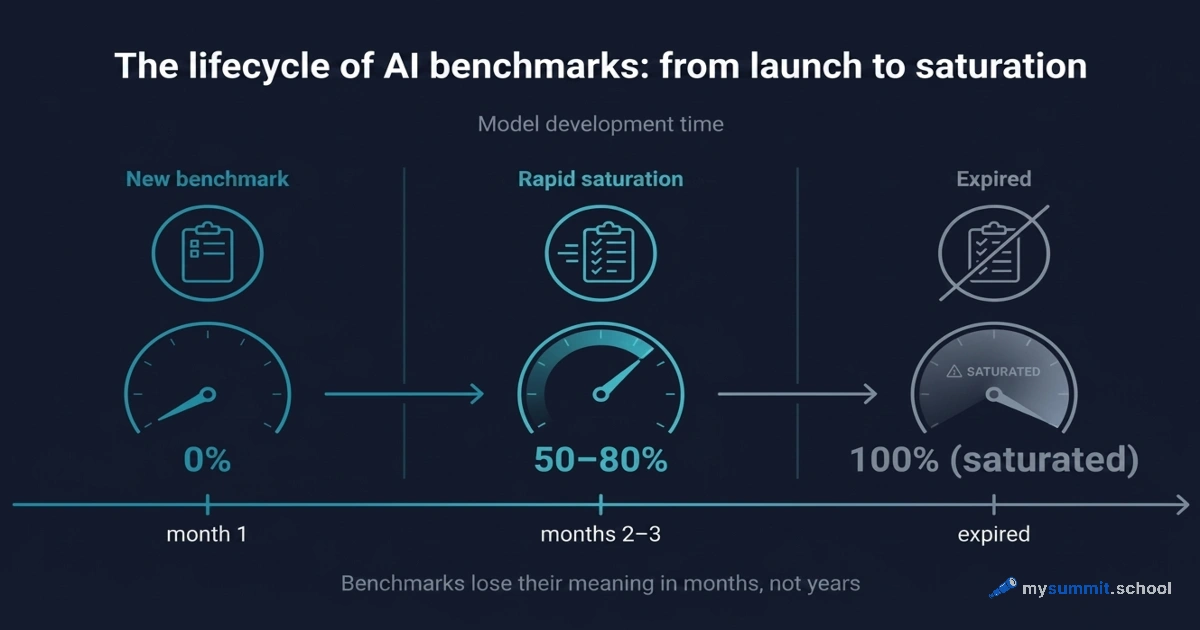
On both leaderboards the gap between neighbouring rows is smaller than the width of each row’s confidence interval. Positions one through nine are a statistical tie, and any write-up that crowns a best model from these tables reads more into them than they contain. We covered this in “AI benchmarks are losing their meaning”, and Muse Spark is a fresh reason to revisit it: the model makes the top ten of both leaderboards while staying inside the same indistinguishable pack.
In Intelligence Index v4.0, Artificial Analysis gives Muse Spark 1.0 an overall score of 52. On paper that beats Grok 4.6’s 51, but the two numbers can’t be compared: the platform publishes the index in versions and changes the scale between them. The “60” from the April announcement and the “49” in the live September table sit on different scales. Within a single snapshot, the picture splits by task type: on CharXiv Reasoning, where the model reasons over scientific charts, 1.0 scores 86.4, and on HealthBench Hard it scores 42.8 – well ahead of competitors.
Meta published 1.0’s weak spots itself. ARC-AGI-2, a test of abstract reasoning: 42.5, with competitors above 76. Coding: 77.4, while according to Meta, Claude and Gemini score above 80 on that suite.
Where it leads and where it lags
Three benchmarks from the July announcement describe 1.1 more precisely than its overall ranking. MCP Atlas, a test of large-scale tool calling: 88.1, first place. JobBench, professional tasks with tools: 54.7, also first. DeepSWE 1.1, long-horizon coding: 53.3 versus 67.0 for GPT-5.5.
All three numbers were published by Meta and have not been independently verified. But they add up to one picture, and it matches the profile of 1.0: strong on documents and charts, weak on coding.
Muse Spark is a model for orchestrating tools. Pulling context from several systems, drafting a plan, handing execution to subagents and reconciling the results – here it leads everything that has been measured. Writing and rewriting code over a long stretch – here it trails GPT-5.5 by more than thirteen points, and no amount of prompt tuning closes a gap like that.
Where to put a model like this
The data adds up to a concrete recommendation. If the task sounds like “pull data from three systems, check it against our template and show me the discrepancies,” the model is worth considering. “Write a migration” is a job for Claude or Gemini.
How this fits with the other models is covered in the summary part of the 2026 GenAI tools review.
The recommendation is short: tool orchestration, yes; code, no. In practice, the wording of the request decides everything. The orchestrator will break a request into parts, but which parts it needs is up to you. The difference between “the answer looks plausible” and “the answer can go into the report” is the skill of framing a task for AI.
Nine everyday manager tasks – from picking apart someone else's report to writing to a contractor – solved with AI in one free module. No registration needed.
No payment required • Get notified on launch
Access and pricing
Consumer access is free: the Meta AI app and the meta.ai website. Developer access goes through the Meta Model API, which opened in public preview on July 9, 2026 – the same day 1.1 was released – and only for developers in the US. The API is OpenAI-compatible, so code written for ChatGPT can be moved over by swapping the endpoint and the key. Pricing has been announced: $1.25 per million input tokens and $4.25 per million output tokens, with $20 of free credit to start. Meta names Replit, Cline, Box and the OpenClaw Foundation as its first partners.
For a company outside the US, the price list is not the deciding factor. API access currently requires a US developer account, and the consumer product is available only where Meta AI itself is offered; there is no separate route for Muse Spark.
What that means in practice: work data sent to the model goes to Meta’s US servers, under a preview programme built for US developers. Most corporate data policies will have something to say about that, however good the model is. Ask your legal and data protection team directly before anything sensitive goes in.
The open-weights promise
Wang says open weights for one of the Muse Spark 1.2 versions are coming “soon.” Developers are sceptical, and the scepticism has formal grounds.
The phrase “one of the versions” leaves Meta free to release a cut-down variant. Earlier Llama models came under Meta’s own licence with a threshold of 700 million monthly active users – in other words, Meta’s “open weights” have already meant “open with conditions” once. And the promise comes from the same leadership that previously explained why the open release of Llama 4 was delayed.
If the weights do get published, the calculation changes: your own infrastructure settles both the cost question and the question of handing data to a vendor. Until that happens, Muse Spark fits into your architecture only as someone else’s API, open for now only to US developers.
Scores, but no weights
Meta spent nine months getting back into the top five of a leaderboard where the first nine places are statistically indistinguishable. In the same months, Z.ai, Alibaba and Sber published their weights under MIT and Apache 2.0, with no revenue threshold.
The company that spent three years arguing that open weights were the only honest strategy has come back with closed ones. The question Muse Spark leaves open: were open weights a strategy for Meta, or a way to make up for lagging quality? We’ll find out when “soon” arrives.
You have the tool. Now the skill
From experiment to system
The program's foundation: prompt engineering, critical thinking and the limits of trusting AI – 4 chapters, 23 lessons.
Stanislav Belyaev
Engineering Leader at Microsoft18 years leading engineering teams. Founder of mysummit.school. 700+ graduates at Yandex Practicum and Stratoplan.