How Microsoft Quietly Won the Corporate AI Market: What It Means for Leaders
When was the last time you read a headline about Microsoft Copilot? Probably not recently. The media space is wall-to-wall GPT-5, Claude 4.7, Gemini Ultra. Copilot looks like the boring corporate tool that only gets written up on LinkedIn.
Now look at who is actually paying for what.
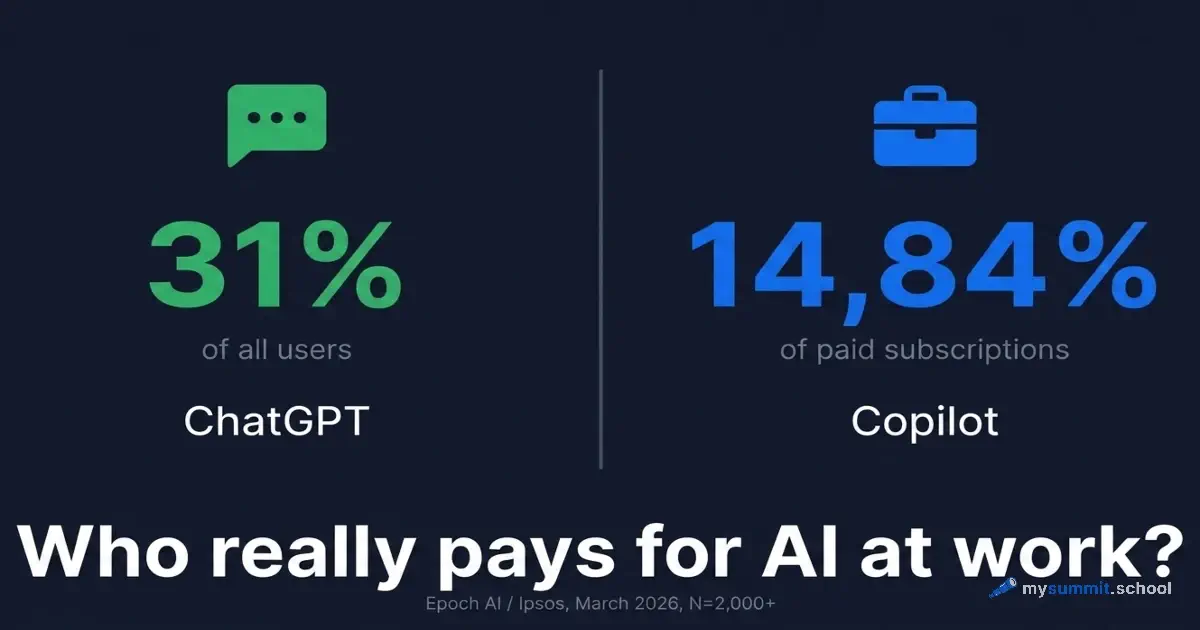
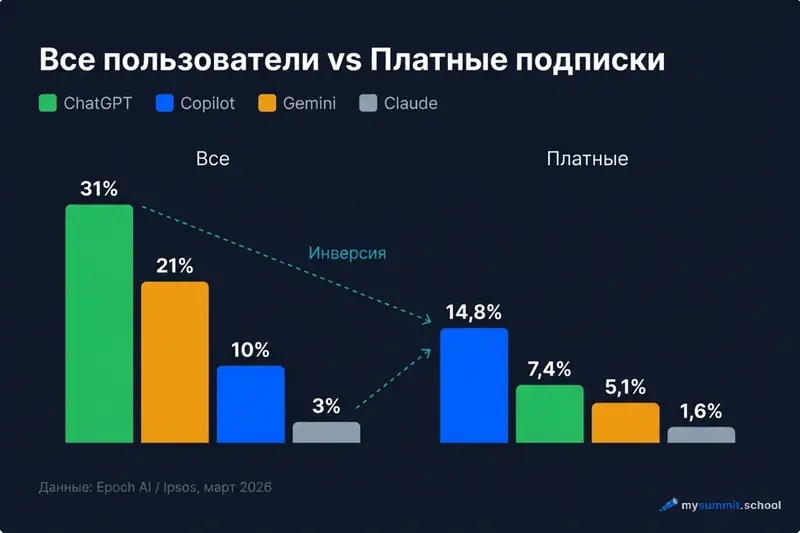
According to Epoch AI and Ipsos (a probability-based KnowledgePanel sample, N=2,000+ US adults, March 2026), 14.84% of all US adults hold a paid subscription to Microsoft Copilot. The figure for ChatGPT is 7.39%. That is nearly a two-to-one gap, and it runs directly against the story the media tells about who is winning the AI market.
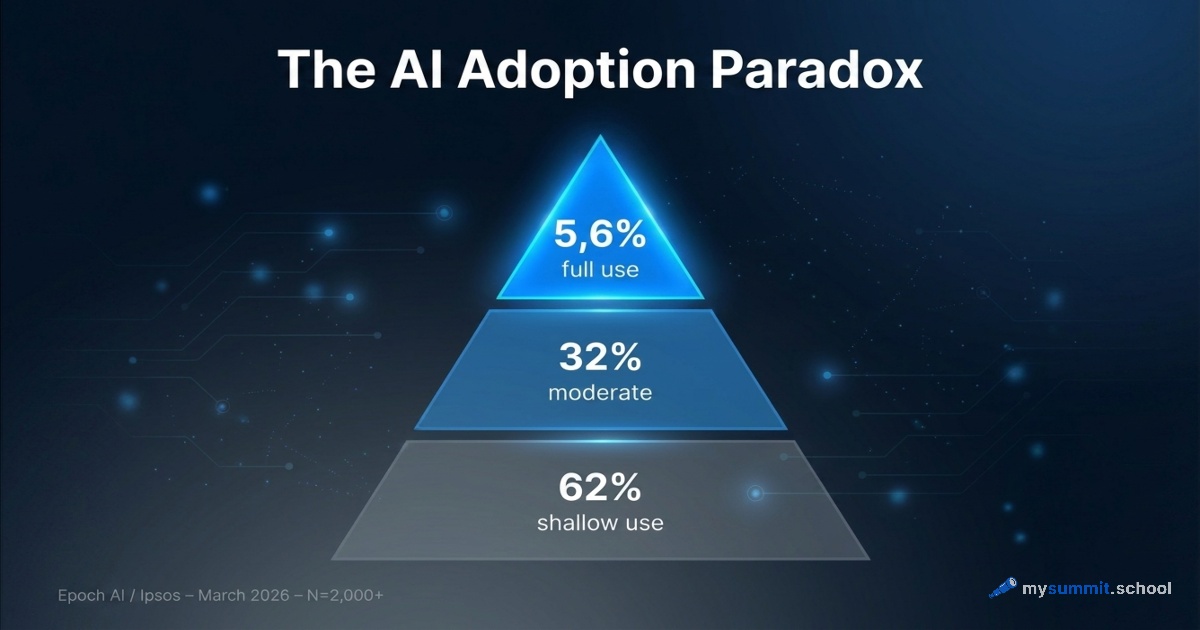
In the first part of this series we looked at why 62% of users apply AI only superficially – one or two quick tasks, no system. But a question we never closed: who actually decides which tool ends up on the employee’s desktop in the first place? The data suggests this is the single most powerful lever in corporate AI – and nobody is really talking about it.
Methodology: where the data comes from
Who ran it: Epoch AI together with Ipsos, one of the largest independent research agencies.
Method: KnowledgePanel – a probability-based sample that avoids the self-selection bias typical of online polls. Not “everyone who felt like taking a quiz,” but a representative panel of the US adult population.
Scale: 2,000+ respondents, March 2026.
Raw data: published openly by Epoch AI, with breakdowns by age, income, education and employment. Every number in this piece comes from there unless noted otherwise.
The inversion every media outlet missed
Put these two numbers next to each other:
| Tool | All users | Paid subscription |
|---|---|---|
| ChatGPT | 31.04% | 7.39% |
| Google Gemini | 20.89% | 5.13% |
| Microsoft Copilot | 10.48% | 14.84% |
| Claude | 2.96% | 1.58% |
This is not a typo. In free usage, ChatGPT is miles ahead. But in paid subscriptions, Copilot overtakes ChatGPT by almost 2x.
What does that mean? ChatGPT won the fight for attention. Microsoft won the fight for the corporate wallet. Those are fundamentally different victories.
What’s surprising is how little this inversion has surfaced in public discourse. Most industry overviews rank the tools by reach – and by that measure ChatGPT leads. But reach and revenue are different stories, especially in the enterprise segment, where licences get bought thousands of seats at a time.
Why: Copilot won through distribution
Fair question – if ChatGPT is the better-known brand, if it gets all the coverage, why are twice as many people paying for Copilot?
Because most of them didn’t pick Copilot. Their IT department did.
Microsoft 365 is the default corporate infrastructure for hundreds of thousands of companies worldwide. Once Microsoft started bundling Copilot into M365 Business Premium and Enterprise plans, companies got an AI tool as part of a subscription they were already paying for, or for a small upcharge. The employee opens Outlook – Copilot is there. Opens Teams – Copilot is there. Opens Word – Copilot is there.
This is a classic distribution win, not a product-quality win. Bing went through something similar – it didn’t beat Google on quality, it sat in the browser by default. The difference is that AI tools in a work context actually do get used once they’re there, and that shifts behaviour.
The data backs it up: among full-time employed adults, 20.85% pay for Copilot versus 11.26% for ChatGPT. Among people with household income of $100,000+, it’s 20.76% for Copilot versus 9.28% for ChatGPT. Among those with a bachelor’s degree or higher, 24.2% versus 10.9%.
These are not random patterns. This is the profile of the corporate knowledge worker who has Microsoft 365 on their work laptop.
The real lever: whoever pays is whoever uses it for work
Now to the single most important number in this study – and the one almost nobody is discussing.
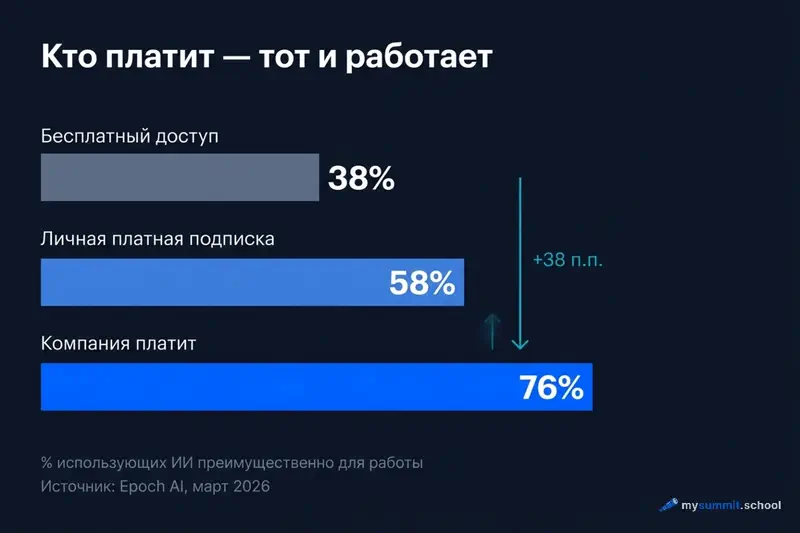
Epoch AI sliced AI users by source of access and looked at what share of each group uses AI primarily for work (the Work vs Personal breakdown by access type is in the primary source – the Epoch AI article):
- Free access / personal subscription: 38% use AI primarily for work
- Personal paid subscription: 58% use AI primarily for work
- Employer pays / provides: 76% use AI primarily for work
The gap between “free” and “company pays” is 38 percentage points. That is larger than the effect of age, education or industry.
From the study: employers pay for or provide AI for 33.72% of all users. Among full-time workers the share is higher – 38.8% get AI from their employer. Among part-time workers, only 6.57%.
The read-through is blunt. When the company pays for the tool, employees use it for work. When people pay out of pocket, they use it for everything – work is just one bucket. When it’s free, work doesn’t really come into it.
Which forces a rethink of how most companies approach AI rollouts.
The employer-effect data is just the start. Try AI on 9 real manager tasks – free, no signup.
No payment required • Get notified on launch
Why the free pilot doesn’t work
Plenty of companies test AI exactly this way: “Try ChatGPT for free, see if it’s useful.” The logic is obvious – no cost, no commitment.
But the data shows why it’s a weak strategy.
When someone gets access to a free tool, they subconsciously read the signal: “This is optional. This is an experiment. This is something personal.” And they behave accordingly – 38% use it primarily for work. When the company buys a licence and hands it to the employee, the signal changes: “This is a work tool. People expect to see it show up in your work.” Result – 76% use it primarily for work.
Tool quality is secondary here. What does the heavy lifting is the social contract around the tool.
This lines up with what we saw in the Brookings survey: 57% of Americans have tried AI, but only 19% see a productivity lift. Trying and using systematically are different things. An employer-paid licence is one of the most powerful switches between those two modes.
There’s a second factor too: when the company pays, it can actually require usage, wire AI into processes, train the team. With free access there is no such lever – you can’t mandate use of something that is formally optional.
Tools: when to pick which
The ChatGPT/Copilot inversion does not mean you should urgently switch to Copilot. It means tool choice ought to be deliberate – driven by what your team actually does, not by which one gets more press.
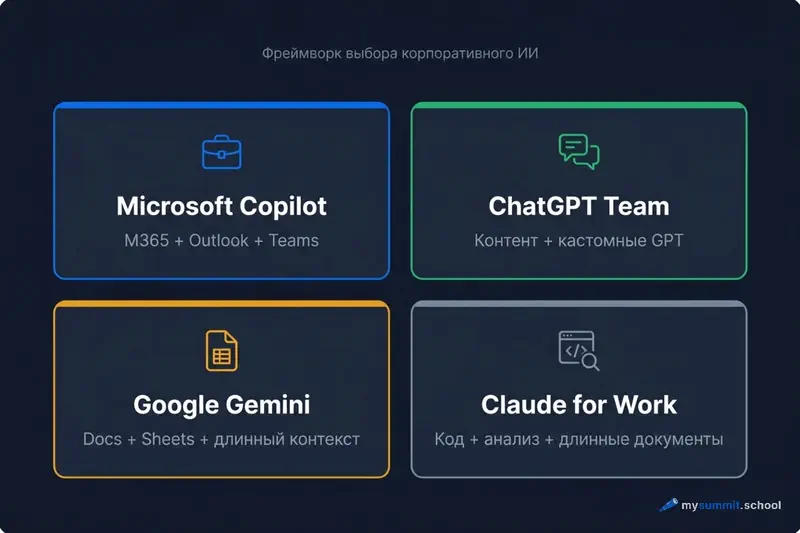
Microsoft Copilot – when it wins: You already live in M365. Outlook, Teams, Excel, SharePoint are the backbone of your work. For the team, integration with the existing stack matters more than having the frontier model. IT prefers a single vendor. Compliance and data security are priorities (Microsoft offers a clean enterprise data-protection story). Then Copilot is the obvious pick – Microsoft 365 is already paying for it, the incremental cost is minimal.
ChatGPT Team / Enterprise – when it wins: The team does content, marketing, communications. Access to the latest models matters (o1, o3, GPT-5 as they ship). The team experiments with Custom GPTs for specific jobs – templated customer responses, internal playbooks, that kind of thing. You want maximum flexibility without locking into an ecosystem.
Google Gemini for Workspace – when it wins: The company runs on Google Workspace: Docs, Sheets, Gmail, Meet. You need deep integration – meeting summaries in Meet, help inside Docs, formulas in Sheets. Long context matters (Gemini handles very long documents). Multimodal work: images, charts, PDFs.
Claude for Work – when it wins: The team works with long documents, legal or financial texts. Written output quality matters – Claude is traditionally rated higher on editing and analysis. A meaningful share of the work is code and technical content. The team values accuracy and the model being honest about uncertainty.
No tool wins on every dimension. Companies that pick “one main tool plus occasionally others” usually move faster than those who try to use everything at once or get stuck in an endless comparison.
A minimum viable AI rollout
The data gives a clear priority order: of all the possible interventions – model choice, prompting, hiring an AI specialist – the most powerful turns out to be a paid licence for employees.
But a licence alone isn’t enough. Here are five steps that make sense for any team:
1. Pay for licences – this is lever number one
Data above: 76% work usage when the company pays versus 38% with free access. This is the cheapest intervention with the biggest effect. If budget is tight – start with 5 to 10 key people, don’t try to spread one thin licence pool across the whole company.
2. Pick one tool as the default
Not “try whatever you like.” The team has to agree on one tool that becomes the standard. That simplifies training, creates a shared language and lowers cognitive load. Pick using the framework above, based on the team’s actual tasks.
3. Run a 90-minute onboarding with real cases from the team
Not “intro to ChatGPT with generic examples” – concrete scenarios. “Here’s how our marketer writes a post-launch release in 20 minutes instead of 2 hours.” “Here’s how the analyst processes a report.” Real work from the team’s real life. Without this step, most employees will open the tool once and forget it.
4. Hold weekly office hours for the first two months
Thirty minutes a week where anyone can bring a question or a case. This lowers the “I don’t know how to even ask” barrier that stalls half the team. Format is not a lecture – a live Q&A plus one new technique per session.
5. Measure tasks, not logins
The “how many times did you open Copilot” metric tells you nothing about value. Ask: “What routine task are you now doing faster, or have delegated to AI entirely?” Collect concrete examples monthly – this both motivates the team and gives you material for the next round of onboarding.
One additional step people often skip: communication. As the Gallup survey showed, only 37% of employees know their company has deployed AI – even though 74% of companies list AI among their top-three priorities. Silent rollouts don’t work. Tell the team what’s happening and why.
What’s still out of frame
The Epoch AI / Ipsos data shows the current picture but doesn’t fully explain it. A few questions we don’t have clean answers to:
How much is Copilot actually used? The high paid-subscription number may come partly from auto-inclusion in enterprise bundles. That is not the same as active daily use. This survey didn’t publish data on the depth of Copilot usage versus ChatGPT.
Will the next generation of OpenAI models break the pattern? GPT-5 is already out – and as the March 2026 data shows, a model-quality jump on its own did not shift the picture: Copilot continues to dominate at work. To move the balance, OpenAI would need to add enterprise distribution at a comparable level – cut deals with IT departments, get into Office-compatible bundles, clear security reviews. The answer comes down to the sales channel. An indirect confirmation of that logic: Microsoft Copilot Cowork, announced in March 2026. Microsoft integrated Anthropic’s models into Copilot – Claude now runs inside the corporate package. For the user nothing changes: same interface, same licence, same channel. Under the hood, one more model. That is exactly what cannot be replicated without distribution: even the “best” model on the market becomes part of someone else’s ecosystem, because that ecosystem is already sitting on millions of desktops.
Practical takeaways
If you are a manager or a leader deciding on AI for your team, the Epoch AI / Ipsos data gives three clear signals:
First: do not use media popularity as the guide for a corporate tool choice. ChatGPT is the best-known, but not the most-used in the paid corporate segment. Twitter popularity and CIO decisions live in different universes.
Second: employer-paid licences send a social signal to employees – AI is a work tool, built into professional expectations. That signal shifts behaviour more than any training session without a real licence behind it.
Third: tool choice matters, but it’s secondary. The right tool for your team is the one that integrates best into the workflows you already have. Not the one with the best benchmarks.
This is consistent with what we saw in the AI Skill Formation study from Anthropic: long-run results from AI come from how the work process is designed – the choice of a specific model is secondary on that backdrop.
While the media argues about who shipped the smarter model, the real corporate market has already been carved up. The winner turned out to be whoever was sitting on millions of work desktops first. It’s just data worth keeping in mind when you make a decision about AI on your own team.
Copilot or ChatGPT – the tool choice is only the start. Try AI on 9 real manager tasks – free, no signup.
No payment required • Get notified on launch
From tool choice to systematic results
The Foundation block of the course covers how to work with AI predictably: framing tasks correctly, spotting errors before they reach colleagues, embedding AI into real workflows. The manager specialisation is built on concrete cases – meetings, analytics, communications.

Stanislav Belyaev
Engineering Leader at Microsoft18 years leading engineering teams. Founder of mysummit.school. 700+ graduates at Yandex Practicum and Stratoplan.