Microsoft MAI Models in 2026: What You Can Actually Use, and What It Costs
At Build 2026 on June 2, Microsoft unveiled seven in-house models under the MAI (Microsoft AI) brand, covering reasoning, code, images, voice and transcription. A company that spent years as OpenAI’s biggest backer called it a move toward “long-term self-sufficiency.”
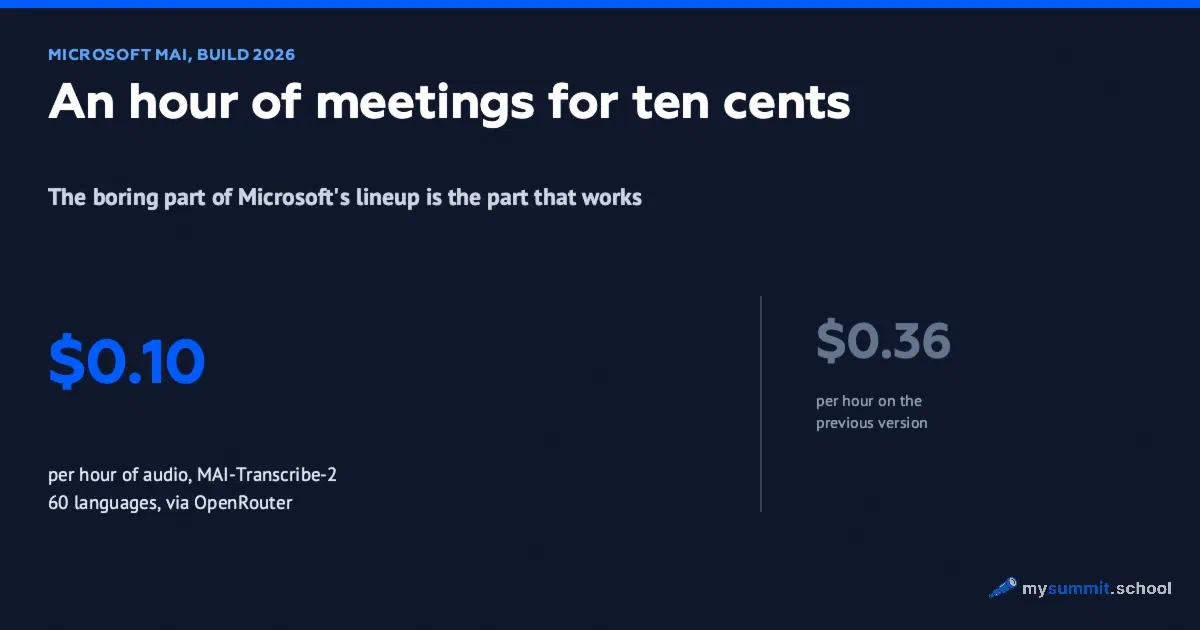
For a manager, two things in this announcement matter. The first is price: an hour of recorded meeting gets transcribed for $0.10, and you don’t need an Azure contract to do it. The second is Frontier Tuning – training a model on your own workflows inside your own compliance boundary. It’s the strongest idea Microsoft has shipped all year, and it comes only with the full Microsoft enterprise stack.
So let’s start with who can buy what, then get to the models and the numbers.
First, who can actually get access
MAI comes in two very different tiers. The corporate half – Microsoft Foundry and Frontier Tuning – is sold through an Azure enterprise relationship: an account, procurement, a contract. The other half is open to anyone with a credit card: image, voice and transcription models on OpenRouter at published prices, plus the coding model inside GitHub Copilot.
This article deliberately skips step-by-step Foundry setup. Microsoft’s documentation covers that for teams already inside Azure. The focus here is on what a manager can try this week without asking legal or purchasing.
Seven models built “from scratch”
Microsoft leans hard on provenance: “We don’t distill from other labs and we don’t rely on opaque data.” By its own account, the company built the architecture, the training pipeline and the post-training itself, and co-designed the models with its own Maia 200 chip – which bought a 1.4x efficiency gain. MAI-Thinking-1 was trained from scratch on clean, commercially licensed data, with no distillation from OpenAI or any other model family.
For an enterprise buyer with compliance requirements on data provenance, that is the real product differentiator. The benchmark is secondary: anyone can check quality numbers, but only the vendor can vouch for where the weights came from.
Last year we wrote that Microsoft had quietly won the enterprise AI market. That same playbook has now produced a model lineup of its own:
| Model | What it is | Key numbers |
|---|---|---|
| MAI-Thinking-1 | Flagship reasoning model | Sparse MoE: 35B active parameters out of roughly a trillion; 256K context, up to 64K output tokens, text only |
| MAI-Code-1-Flash | Agentic coding model | 5B active parameters, 256K-token context window |
| MAI-Image-2.6 | Image generation and editing | A Flash variant for cheap, high-volume work |
| MAI-Transcribe-2 | Speech recognition | 60 languages, domain terminology |
| MAI-Voice-2 | Speech synthesis | 15 languages, voice adaptation from a short sample, abuse safeguards |
Ten cents per hour of audio
What you can go and use today sits on OpenRouter – a model aggregator with published prices and no enterprise contract. Here’s what’s listed:
microsoft/mai-transcribe-2– $0.10 per hour of audio, 60 languages. The previous version,mai-transcribe-1.5, costs $0.36 an hour – the new one is 3.6x cheaper.microsoft/mai-voice-2– $22 per 1M characters, $15 for the flash variant.microsoft/mai-image-2.6– $5 per 1M, flash at $1.75; versions 2.5 and 2.5-pro at $5 per 1M each.microsoft/mai-ds-r1– 164K-token context, no price listed.
Ten cents for an hour of recorded meeting is the single most useful number in the whole MAI launch. Microsoft itself calls MAI-Transcribe-2 “the world’s fastest, most accurate and cheapest speech recognition model” and claims a 5x speed edge over competitors. As with any vendor claim, test the accuracy on your own recordings – but the price is real and published, and getting to it doesn’t require sign-off from legal or procurement.
The shape of the lineup says a lot. The flagship reasoning model is a preview you can barely get quota for, while the thing that’s production-ready today is a transcription model nobody writes headlines about. The part of MAI that works is the boring part.
Prices and access routes are knowledge that goes stale in months. Deciding which model gets which task, and how much budget to set aside for it, is a skill – and it outlasts any price list.
Ten cents per hour of audio is the price. The real question is what you hand the model for that money. Try AI on 9 real manager tasks – free, no sign-up.
No payment required • Get notified on launch
A 40-minute Russian meeting through three models
Microsoft claims first place on FLEURS for MAI-Transcribe-2: an average WER of 5.2% across 60 languages. It publishes no per-language figures at all. The model page lists 3.4% for the top 25 languages – so the spread within the set is wide, and there is no telling where any particular language lands.
The average actually went up from 3.7% for MAI-Transcribe-1.5 across 43 languages. The reason is the mix: 17 low-resource languages were added, so the average is now computed over harder material. And FLEURS itself is read speech – native speakers reading about 2,000 prepared sentences. A meeting with people talking over each other, background noise and mic checks sounds nothing like that.
That’s why we tested on something closer to real life, and in a language that isn’t English. We used Russian: it’s the language of our home audience, and Microsoft publishes no Russian figure, while ElevenLabs reports a WER of 3.1% for Russian on FLEURS. On the Artificial Analysis WER leaderboard, MAI-Transcribe-2 ranks second, behind Alibaba Fun-Realtime-ASR. Microsoft’s leadership claim rests on speed and price, not accuracy.
The recording: an open meetup of a Kazakhstan team-lead community, “Тимлид не кодит” (“Team leads don’t code”), held on June 3, 2026. 39.6 minutes of conversational Russian, several speakers, a mic check at the start; topics included a server test lab, moving the community from Telegram to Discord, and hiring culture. The recording is public, so anyone can recheck the numbers below. We ran MAI-Transcribe-2 through OpenRouter (microsoft/mai-transcribe-2) – the route that needs no Azure contract, so these results come from the same path a reader can use. The model is also available in Azure Speech as a preview, but that route requires an Azure account. For comparison we used Gemini 3.5 Flash and Yandex SpeechKit, the default speech API in the Russian market.
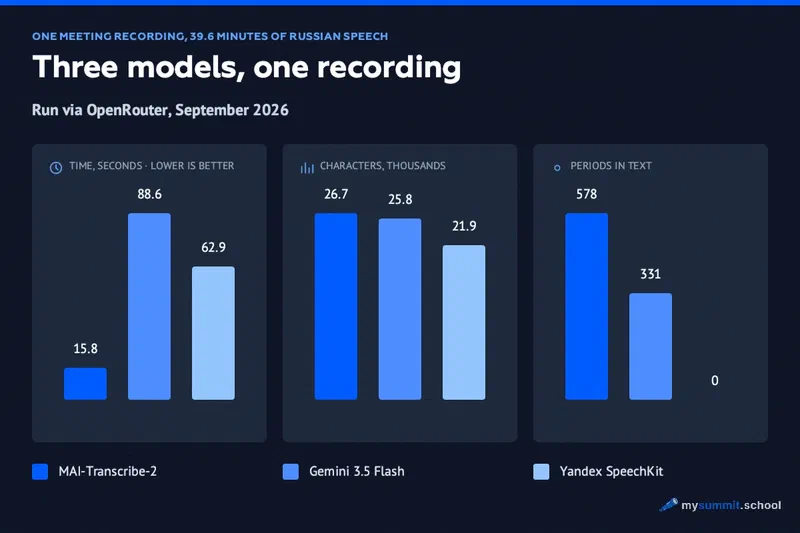
MAI was 5.6x faster than Gemini and 4x faster than Yandex: 39.6 minutes of audio in 15.8 seconds, four chunks in parallel – roughly 150x real time. Microsoft’s speed claim held up on real-world audio.
Yandex returned no punctuation at all: zero periods, zero commas, a single 21,910-character line. For meeting minutes, that means a mandatory second processing pass.
MAI keeps speech fillers: the Russian “uh” («э-э») appears 54 times in its transcript, zero times in the others. The model has verbatim and clean modes – you want the first for a transcript of record, the second for minutes.
Where the outputs diverge
The very start of the recording, the mic check (Russian as returned by each model):
| Model | Transcript |
|---|---|
| MAI-Transcribe-2 | «Добрый вечер. Так. А сейчас какой-то шум от меня хотя бы идёт. О, сейчас пошло. А, так, так, так, спикерс.» |
| Gemini 3.5 Flash | «Добрый вечер. Так. А сейчас какой-то шум от меня хотя бы идёт? О, сейчас пошло. А-а, так-так-так, спикером…» |
| Yandex SpeechKit | «Добрый вечер Так А сейчас какой то шум от меня хотя бы идет вова сейчас пошла а А так так так спикер с» |
The speaker says roughly “Good evening. OK. Is any sound coming from me now? Oh, now it’s working.” Yandex turned the interjection “Oh,” («О,») into the name “Vova” («вова») and even made the verb agree with it grammatically. It also lost the name “Aram,” which both other models caught.
The most serious case is a reversal of meaning in the middle of the recording:
| Model | Transcript |
|---|---|
| MAI-Transcribe-2 | «…музыку-то слышал. Мне интересно. Похоже, т- техника как бы, которая… всё портит.» |
| Gemini 3.5 Flash | «…музыку-то слышал? Мне интересно. Похоже тут техника как бы, которая всё портит.» |
| Yandex SpeechKit | «…музыку то слышал Не интересно. Покажите техника как бы которая Все портит» |
Two errors in one sentence, and both flip the meaning: “I’m interested” («Мне интересно») became “Not interested” («Не интересно»), and “Looks like” («Похоже») became “Show me” («Покажите»). In meeting minutes, that’s a different statement – and someone is going to sign off on it.
Listen for yourself
The mic check is the easy case. Let’s take the middle of the meeting, where the real conversation happens: from 10:55 to 11:55 the participants discuss moving the community from Telegram to Discord and handing out channel permissions. The audio is in Russian. Play it and switch between the tabs – each one holds that model’s verbatim transcript of exactly this minute, followed by a note in English on what it got right or wrong.
▸The product name is recognized every time but spelled two ways: first in Cyrillic («Дискорд»), then in Latin script, "Discord." Within a single minute.
▸Both product names in Latin script, spelled the same way in all four mentions.
▸The word Discord never appears. Instead: «лесики скорбь» (roughly "little forests grief"), «без слов» ("without words") and, twice, «диспорт» – four attempts, four misses.
A clip from the public recording of the Тимлид не кодит meetup on June 3, 2026, held by a Kazakhstan team-lead community. Dashes and hyphens inside the transcripts are exactly as the models returned them.
A garbled product name takes a second to spot, which makes this kind of error safer than a reversed meaning. The worse problem is elsewhere: «в принципе без слов мало кто пришёл» (“basically, few came without words”) reads like a complete sentence, and nobody will flag it in the minutes.
The same clip shows the difference between verbatim and clean modes. MAI kept the stammer «т- техника» (“t- the tech”), while Gemini smoothed it into «тут техника» (“the tech here”), adding a word that isn’t in the recording. That doesn’t mean “Gemini is more accurate”: the modes are different, and for a transcript of record the smoothed version is worse.
The third divergence is a fragment that vanished entirely. MAI has it: «Мо- может кто-то поговорить, э-э, просто так, чтобы… Раз-раз. Ну, раз-раз я слышу. О, ну всё хорошо тогда, хоть что-то слышат.» (“Ca- can someone say something, uh, just so… Testing, testing. Well, I hear the testing. Oh, all good then, at least they can hear something.”) In the Gemini and Yandex output, the “testing, testing” fragment isn’t there – both models skipped it.
What this test doesn’t show
- We didn’t measure WER: there’s no reference transcript for the recording, so the comparison is qualitative.
- We couldn’t test industry terminology – there wasn’t any in the recording. That’s exactly where MAI’s keyword biasing is supposed to help, and exactly what remains untested.
- One recording, one domain, one acoustic setting. This is a pre-purchase check; it isn’t a benchmark.
Specialist services for Russian audio
If you specifically need Russian-language minutes, there are alternatives that are tested on Russian audio. A review of the best speech recognition APIs on Habr (in Russian, February 2026) reports these WER figures:
- Nexara – 0.391
- Palatine – 0.414
- Shopot – 0.444
- Sber API – 0.448
- Yandex SpeechKit – 0.550, last place
Smaller Russian startups beat the two big local players, Yandex and Sber. If your team holds meetings in Russian, that’s a real option.
The takeaway is the same either way: test the model on your own recording before you build it into a process. Microsoft has the fastest transcription and the lowest price, not a single published figure for Russian, and on our recording MAI-Transcribe-2 delivered the best punctuation and structure. That’s enough to run a pilot. It’s not enough to buy sight unseen.
MAI-Thinking-1: a preview with a published price
The flagship sits in the Microsoft Foundry model catalog as a preview, but Microsoft published pricing right away: $2 per million input tokens and $8 per million output tokens [Microsoft Foundry blog].
From the same price table: Sonnet 4.6 costs $3 and $15, so on output MAI-Thinking-1 is almost half the price. A reasoning model’s input/output mix is skewed toward output, so the difference on your bill will be closer to 2x than to 1.5x.
A list price and access to a model are two different things. Preview quotas are handed out sparingly: requests to MAI-Thinking-1 regularly hit quota limits, and “the model is in the catalog” doesn’t mean it will run your task today. It’s too early to build a workflow on it.
From the model card: a 256K-token context window, a 64K-token output ceiling, text-only input and output, hosted on Azure. It doesn’t accept images or audio, so for work involving screenshots or meeting recordings it’s simply not an option.
Data residency guarantees depend on the Azure region, and regional coverage was still rolling out at launch.
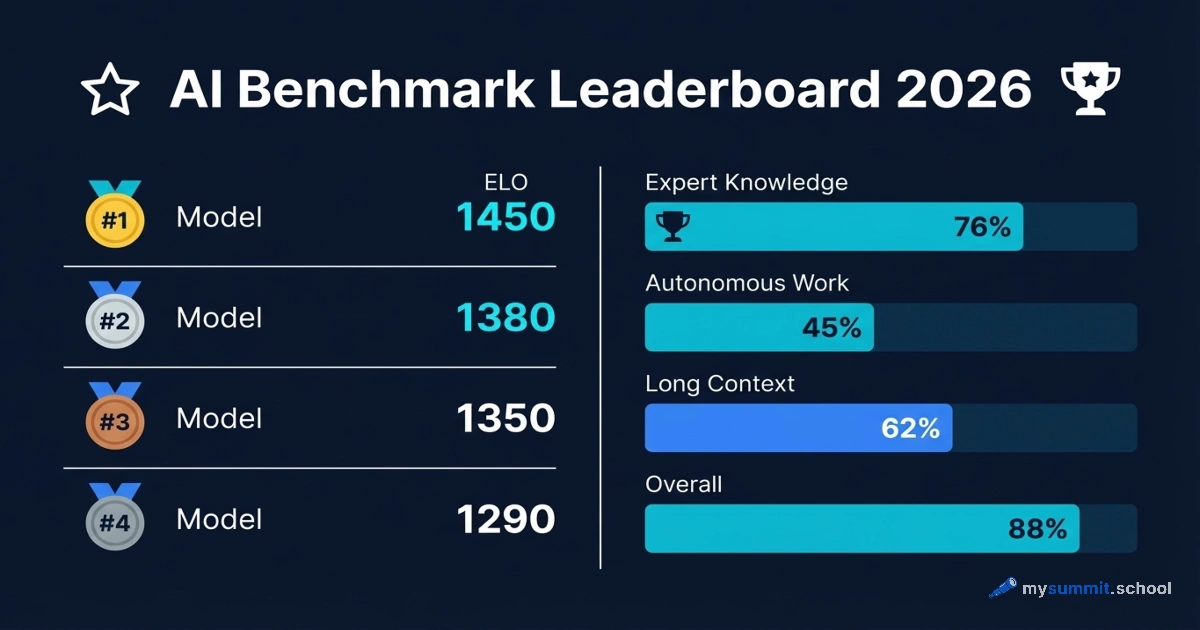
The quality claims are Microsoft’s own words too. By its numbers, MAI-Thinking-1 matches Opus 4.6 on SWE-Bench Pro and was preferred over Sonnet 4.6 in blind human evaluation. MAI-Code-1-Flash is credited with up to 60% lower token usage than Haiku 4.5 on coding benchmarks, at higher accuracy. None of these comparisons has been independently confirmed yet, and no MAI model is in our benchmark either. We have a separate piece on how to read claims like these: AI benchmarks are losing their meaning – so how do you pick a model?
MAI-Code-1-Flash: a price you can’t pay
The coding model is reported at $0.75 per million input tokens and $4.50 per million output tokens, with cached input at $0.075. Those are exactly the numbers for GPT-5.4 Mini.
They come with a caveat: the model has no public endpoint and no Azure AI Foundry listing, and its model card says pricing is “to be determined.” In other words, these rates describe internal token accounting inside Copilot. There is no API where you could actually pay them.
Where the model really is available is GitHub Copilot and VS Code: requests are routed to MAI-Code-1-Flash automatically, on every plan from Free to Max; a CLI version is planned. That makes it the second route into the MAI lineup, after OpenRouter, that needs no Azure contract.
Frontier Tuning: training inside your own perimeter
This is the genuinely new part of the announcement. Ordinary fine-tuning works on documents: you hand over a text corpus and get back a model that knows your terminology. Frontier Tuning works differently: reinforcement learning runs inside the customer’s own compliance boundary, and the model learns from real workflow traces – tool chains, decisions and their outcomes. Microsoft calls these reinforcement learning environments “gyms for AI”; the data never leaves the customer’s environment. For the first time on this platform, developers are allowed to tune the weights themselves.
We’ve written in detail about what training environments already offer executives: AI training environments: $1B worth of management insights.
The Frontier Tuning results are, for now, the word of the vendor and its partners:
- In Microsoft’s own HR deployment, the task completion rate went from 13% to 87% after tuning.
- An MAI model tuned for Excel matches GPT-5.4 at up to 10x higher efficiency.
- McKinsey reports the highest win rate of any model it tested, at roughly a 10x cost difference.
The point a manager should take away: a small model tuned to your workflow beats a general-purpose flagship at a fraction of the price. The arithmetic itself isn’t new – we saw it across a market of 53 models: 99% of the quality for 1.4% of the price.
The other half of the story is that Frontier Tuning is also an argument for buying the entire Microsoft stack: Foundry, Copilot Studio, Maia chips, Forward Deployed Engineers. The strong idea is sold only as a bundle with the ecosystem – if you’re not already a committed Azure enterprise customer, the entry ticket is everything. It’s still worth watching the direction: other vendors are moving the same way, and if your data can’t leave the building at all, the answer becomes your own hardware – Local LLMs for managers.
The Mayo Clinic case fits the same enterprise logic: a frontier model for medicine built on the clinic’s expertise and its de-identified clinical data, deployed inside Mayo first and promised for Foundry later. The key term in the deal: Mayo retains ownership of the model. For any industry leader, that’s the template for co-building a model with a platform without handing over your core asset.
Where to get access
All the routes, from the easiest to reach to the hardest:
| Route | What you get | Reality check |
|---|---|---|
| OpenRouter | Image, voice and transcription models, published prices | No Azure contract needed – the only route that works without a corporate relationship |
| GitHub Copilot / VS Code | MAI-Code-1-Flash, automatic routing | Plans from Free to Max; CLI version planned |
| Fireworks, Baseten | MAI-Thinking-1 | Third-party hosting |
| Microsoft Foundry | The full lineup, evaluation, safety, observability, Frontier Tuning | Requires an Azure enterprise account |
| Copilot Studio / Forward Deployed Engineers | Frontier Tuning projects | Direct contract, enterprise only |
No MAI model is in our benchmark yet; for what is in it and how the tested models compare, see the series hub, GenAI Tools Comparison 2026.
How to put this to work
- Record your next meeting and run the audio through MAI-Transcribe-2 on OpenRouter: an hour costs $0.10. Compare that with what you pay for transcription now, and with how often your current transcripts mangle your domain’s terminology.
- If your team already pays for GitHub Copilot, check which model your typical tasks go to and whether quality changes when routing picks MAI-Code-1-Flash.
- Don’t budget for Foundry unless your company is already deep in Azure. Instead, watch for workflow-tuning offers from the vendors you already work with.
After years as OpenAI’s biggest investor, Microsoft has arrived at an idea that’s awkward for the whole frontier market: a tuned small model delivers the same result for a tenth of the price. It sells that idea only together with its own cloud, its own hardware and its own engineers. The part any manager can use today is an hour of audio for ten cents.
The question here isn’t really about Microsoft anymore. If tuning to a workflow genuinely gets you the same result at a fraction of the price, how long can flagship price lists hold – and which of the vendors you already work with will respond first?
Token prices change. The skill of choosing a model stays
Full course programme: from prompt engineering fundamentals and critical thinking to specialisations in project management and analytics. Practical skills, not theory.
Stanislav Belyaev
Engineering Leader at Microsoft18 years leading engineering teams. Founder of mysummit.school. 700+ graduates at Yandex Practicum and Stratoplan.