Agent orchestration: the AI skill with the longest shelf life
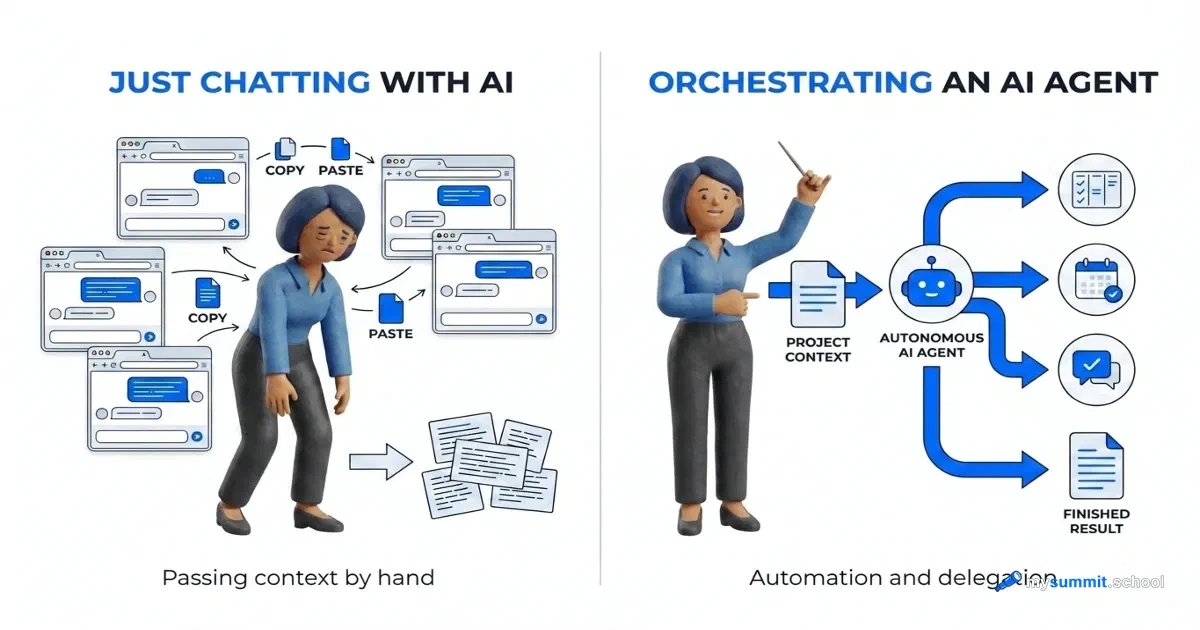
Picture a manager who is quite sure they have AI figured out. Thirty browser tabs are open. In one they spent half an hour pulling apart the risks in a contract; in another they were assembling a project status; in a third they asked for an email to a stakeholder to be rewritten. Every new task starts the same way: explain the project again, who is on the team, what the deadlines are, paste in a chunk of a Jira export, drop in a Slack thread. An answer comes back, gets copied out, the tab closes. Tomorrow, from the top.
They use AI every single day, diligently, and believe they are at the frontier. In reality they are stuck on the first rung, hauling context around by hand like a courier hauling boxes. The tool is powerful. The way they work with it is the most primitive option available.
What separates them from someone who genuinely gets value out of AI is not typing speed. It comes down to one skill that almost nobody teaches explicitly: delegating a task to an agent rather than chatting about it. Oddly enough, that is the longest-lived skill in the whole of AI training. It is also the one most often skipped.
What follows covers how orchestration differs from chat at the level of mechanics, why it is a foundational skill rather than an advanced one, and what it looks like in a manager’s working week, using the free tool OpenCode as the example. There is no step-by-step install guide here: the point is to grasp the principle and see exactly what is worth learning.
Chat versus orchestration: where the difference actually sits
Chat is a dialogue. You open a window, explain the task, get an answer, take the text. The project context lives in your head and in your hands: you decide what to paste in, you carry the export across, you move the answer back into your working system. The model is an interlocutor that wakes up with amnesia every time. Close the tab and everything you told it evaporates.
Orchestration runs in a different mode. You describe the context once: who is on the team, what the project is, the deadlines, the tone of communication, what must never be delegated. You set the rules once. After that you hand over whole tasks rather than fragments: “go through this contract and find the risks”, “build me a briefing for the Monday meeting”, “compare twelve vendors and give me a top three”. The agent does the work itself, reaching into your systems directly, and comes back with a finished result. Your job is to check it.
A plain definition, no jargon: orchestration means the context and the rules are written down once and reused, and the task is delegated whole. The difference is roughly that between dictating a letter and hiring an assistant. In the first case you control every word and hold the whole thing in your head. In the second you explain the situation once, hand over the job, then look at the result.
Worth noticing: this is a management distinction. It does not depend on which model is running underneath. What matters is who carries the context – you by hand, or a file on your behalf.
Why this skill has the longest shelf life
Start with something already visible, no forecasting needed: the labour market has begun paying a premium for the ability to direct AI’s work and check its quality. Google Cloud describes it outright as a new role, the agent supervisor (in Russian). The person sets the task, the agent executes, and the person keeps the checkpoint. Managers who have spotted this are already automating the routine parts of their jobs instead of waiting for the future to arrive.
Where it leads is described soberly in the AI 2027 scenario (in Russian) by former OpenAI researcher Daniel Kokotajlo: as AI capability grows, human work shifts from doing the job to managing the AI workers who do it. That is a pointer to which skill becomes central, rather than a forecast of replacement or a reason to panic.
Now the substance. Everything around AI moves at absurd speed: models get renamed every quarter, prices fall, yesterday’s prompt trick for a particular version stops working tomorrow. Those are skills with a short shelf life. Knowing how to give an agent the context once, hand over a whole task and check the result is tied to no model in particular. The tool changes, another provider appears – the skill transfers without loss. That is exactly why it lasts: it is a management discipline, and the tools underneath it are interchangeable. The numbers already back this up. In August 2026, three benchmark studies showed that the scaffolding around a model – the prompts, the control of execution – moves results further than swapping the model for the next one down the leaderboard (write-up, in Russian). We have also shown separately what such delegation looks like on a live management decision, where an agent argues against your call until it loses (in Russian).
Want to see where AI genuinely amplifies you as a manager, and where the decision stays with the human? Nine real management tasks in an open module – try them on your own work. Free.
No payment required • Get notified on launch
What it looks like in real work: OpenCode
The abstraction – delegate the task to an agent – sounds good, but a manager needs to see it done by hand. Let us use a concrete tool: OpenCode. It is an open-source agent that runs on your own laptop, with access to your files and systems; a manager installs it and sets it up for their project. How it is installed and which models it runs on is covered in a separate piece.
Do not be put off by the word terminal. The interface is not the point here. The three mechanics are, and each one is itself the step from chat to orchestration.
First mechanic: AGENTS.md, context that lives in a file
The first move is to create an AGENTS.md file beside the project. It is a plain text file. In it you write exactly what you keep retelling in chat:
# Project context

Project: mobile app for self-employed freelancers, fintech.
Stack: React Native, .NET backend, PostgreSQL.
Team: 8 people. Tech lead – Igor, analyst – Sveta.
Phase: steady development, release in September.

Key stakeholders: credit committee of the partner bank.
Decision style: data first, opinion second. Keep it short.

Do not delegate to the agent: correspondence with lawyers, budget decisions.
That is all. The agent no longer starts every session from a blank page. Ask “where are we with the release” and it already knows which release, who is on the team, what stage you are at. This is the shift: in chat the context lives in your head and dies when the tab closes; in orchestration it sits in a file and gets reused on every task. Written once, it works for months. In our course we put the saving from this one file at roughly 80 hours a year – purely from no longer retelling the project on a loop.
Second mechanic: skills, tasks delegated whole
The second mechanic is skills, also known as saved commands. A skill is a task described once that you then run with a single line. Not a one-off prompt: a routine you reuse. A couple of examples from our course.
/morning-brief – the briefing for the daily stand-up. The agent reads Jira and Slack itself, finds the tasks that have stalled, the people who have gone quiet, the meetings nobody confirmed, and puts together a short summary: what changed, what needs attention, what is on the stand-up agenda. Twenty minutes of scrolling through boards turns into two minutes of reading a finished brief.
/vendor-research – batch research on suppliers. Suppose you need to choose a payment gateway from twelve candidates. You give the agent the job: for each one, check pricing, the limits of the free tier, recent reviews, obvious red flags; build a comparison table and name a top three. With a limit attached: spend no more than five dollars. You launch it at the start of the day, go to meetings and lunch, come back and the table is ready. Two days of tab-hopping turns into an hour and a half while the agent works on its own.
Also in the set: /contract-review (a contract read by risk category, with quotes and questions for the lawyer) and /crisis-playbook (a crisis plan with triage, exit scenarios and a letter to stakeholders). The mechanic is the same in all of them: each skill is a task handed over whole, not assembled in fragments through a conversation with a chatbot.
Here is what such a skill looks like from the inside. Still just text with instructions:
# vendor-research

Input: list of candidates + comparison criteria.
Budget: no more than $5 for the whole task.
Mode: process 2-3 in parallel, save results as they come in.

For each candidate check:
– pricing and billing model
– free tier limits
– reviews from the last 6 months
– obvious red flags
– fit against the criteria in AGENTS.md (region, language, integrations)

At the end, build one comparison table and name a top 3 with reasoning.
Third mechanic: live data instead of copy-paste
The third difference: the agent works with the project’s real data, not with whatever you moved into a window by hand. It connects to your Jira and your Slack and reads them directly – either through a direct connection or through exports, where corporate security will not allow the former. In chat mode you are the carrier: copy the board into the prompt, copy the answer back. In orchestration the agent goes to the source itself. The courier is no longer needed.
All three mechanics together produce the shift. Context in a file, the task handed over whole, live data. You stop being the porter and start being the manager. The same logic works in other manager routines – in agent-led competitor research (in Russian), for instance, where the task is likewise handed over whole: web search, data collection and a sceptic’s review all run as one command.
“That’s for technical people.” No.
The main objection goes like this: it sounds like programming, so it is not for me. Let us take it apart, because it is false.
Look again at the AGENTS.md above. There is not a line of code in it. It is a description of your project in plain language, exactly what you would tell a new contractor on their first day. Look at the skill: also text, a list of what needs doing, phrased the way you would explain the job to an assistant. Nowhere do you have to programme anything.
The core point is simple: anyone who can brief a person can brief an agent. If you can explain clearly to a contractor what you need, what a good result looks like and where the boundaries are, you already have the substance of the skill. Everything else is interface detail you can pick up in an evening. That is why we call orchestration a foundational skill: the baseline every manager needs, whatever their role, not a bonus for a chosen few.
There is a simple way to feel the difference right now, before any OpenCode. Take a task you normally work through in fragments in chat and try handing it over whole – with the full context and rules for checking the result. The prompt below does exactly that, using vendor analysis as the example. Run it as it is, then swap in your own task and compare the experience with the way you usually chat.
Note the last point in that prompt: the agent has to say where the data was thin. That is your role in orchestration. You check the result and keep the judgement for yourself. The work is delegated; accountability stays with you, and that boundary gets a separate piece on delegation and accountability with AI (in Russian). What agents actually are, and how they are put together beyond a normal chat, we covered in how AI agents work.
Ready to build your own set of delegated tasks instead of thirty open tabs? The open module has nine manager tasks that show where AI carries the work and where the call is yours. Free.
No payment required • Get notified on launch
How to put this to use
Let us reduce it to actions you can apply straight away.
First, work out honestly which mode you are in. If every task starts with retelling the project and copy-pasting out of Jira, you are in chat mode, however advanced the tool feels. That is your growth point.
Second, create your own AGENTS.md, even if it starts life in your notes app. Describe the project, the team, the deadlines, the tone, the taboos – once. The exercise alone is half the step: you are pulling context out of your head and putting it somewhere it can be reused.
Third, pick one recurring routine – the morning briefing, contract review, vendor research – and try handing it over as a whole task rather than breaking it into chat turns. Start with one. Once a single delegated task is running, the rest follow the same pattern; this is a question of scale, not of acquiring a new profession.
The manager with thirty tabs has not fallen behind on technology. They have the most modern tool there is. They have fallen behind on the way they work: doing by hand what could have been delegated long ago. Moving from chat to orchestration does not require becoming technical. It requires one thing – treating AI as an executor you brief and then check, instead of retelling the context on every visit. That can be learned, and now is the moment: while the individual models keep replacing each other, the skill itself only gets more valuable.
The Operations Toolkit chapter of the project management module in our course for managers is built around exactly this: assembling a working set of delegated tasks in OpenCode from scratch, connected to Jira and Slack, with the checking left in your hands. You leave with a toolkit that runs on your projects from Monday, not with theory about agents.
Stop chatting. Start briefing the agent
In the Operations Toolkit chapter you build your own PM toolkit on the free OpenCode: project context in AGENTS.md, skill routines for daily work, a connection to Jira and Slack, and the habit of checking what the agent returns. All of it on live tasks, all of it portable into your real work.
Часто задаваемые вопросы
How is agent orchestration different from ordinary chat with AI?
Is orchestration for technical people or for any manager?
Why do you call it the skill with the longest shelf life?

Stanislav Belyaev
Engineering Leader at Microsoft18 years leading engineering teams. Founder of mysummit.school. 700+ graduates at Yandex Practicum and Stratoplan.