Perplexity AI in 2026: A Manager's Guide to the Smart Answer Engine
By mid-2026 the AI-tool market has grown specialized: ChatGPT’s grip has loosened, and professionals work with a “stack” of several models rather than a single one. Perplexity has carved out the niche of a smart navigator in an ocean of information – and over the past year it has grown from a search box into a browser and a working assistant.
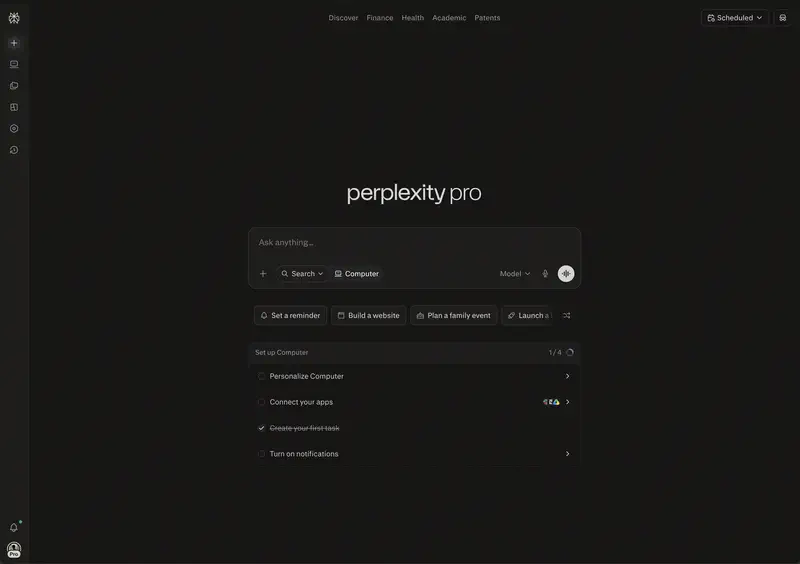
Perplexity started as a search engine built around a chat interface: it scans sources across the web and returns a synthesized answer with direct links to where each claim came from. Its key advantage is minimizing hallucinations by grounding every statement in cited sources. Today it runs not only on the website but in its own Comet browser, inside Microsoft 365, and on the Mac.
The platform runs on the best AI models in the industry: its own Sonar 2 plus pluggable models – Claude (Sonnet 4.6 and Opus 4.8), GPT-5.4/5.5, Gemini 3.1 Pro, Kimi K2.6, and Nemotron 3 Ultra – each tuned for a different kind of query.
Modes of operation: from instant answers to deep research
Quick Search
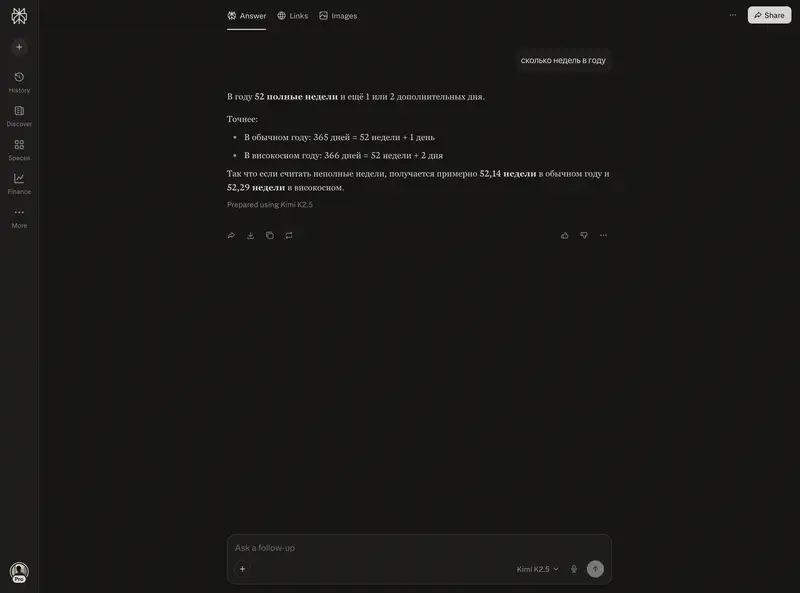
The default mode for fast questions. In seconds it’ll answer “today’s exchange rate,” “this morning’s industry headlines,” or “a short bio of this speaker.” Free and unlimited.
Pro Search
An advanced mode that asks clarifying questions to tailor its answer. Ask “how do I choose a CRM” and it will check your team size, budget, and industry before making a recommendation.
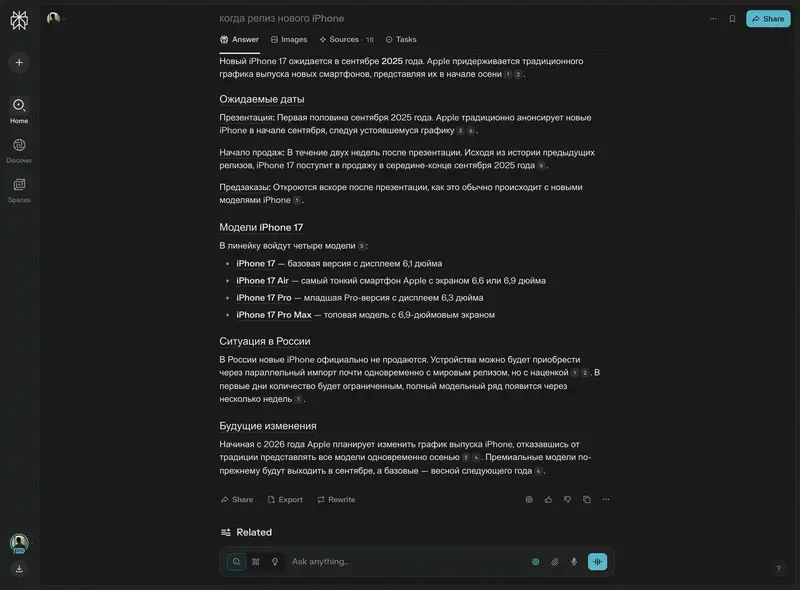
Research (Deep Research)
An autonomous agent that analyzes dozens of sources in 2–4 minutes and produces a full analytical report. It now runs on top-tier models – including Claude Opus 4.8 for Max subscribers – so the reports have become deeper and more accurate. It’s ideal for market analysis and putting together strategic briefs.
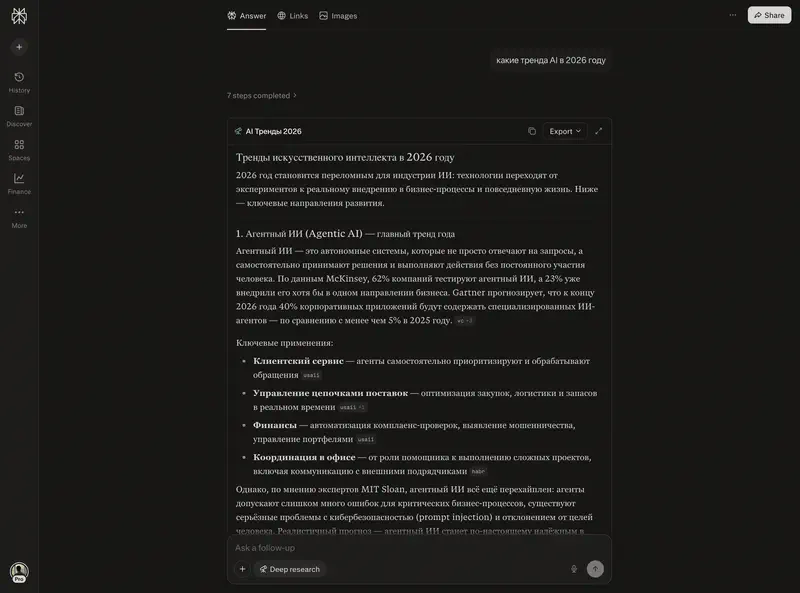
Perplexity Spaces
A workspace built for teams. Create a shared space, upload your company’s documents (PDFs, spreadsheets, reports), and Perplexity searches your files and the open web at the same time – all while keeping your corporate data private.
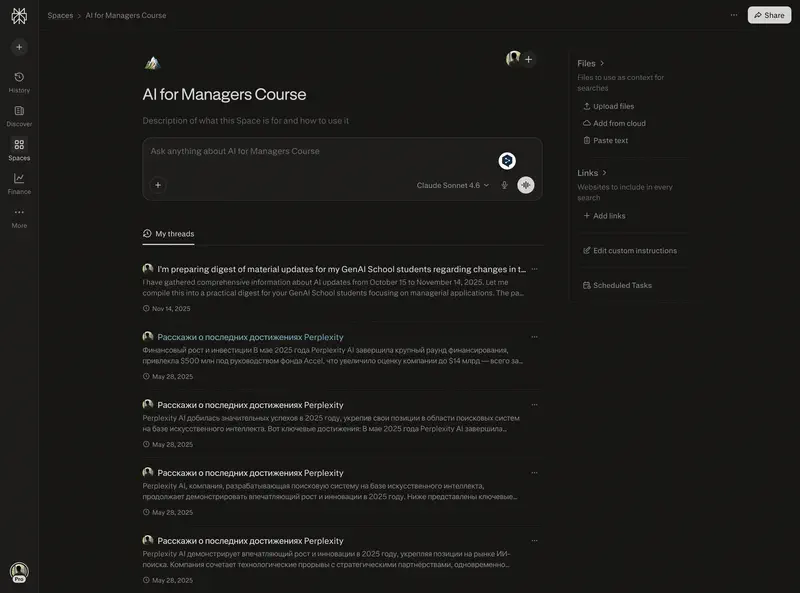
Pages and Focus
Pages compiles your searches, notes, and sources into a single shareable page – handy for a report or an internal knowledge base. Focus restricts a search to the sources you choose (say, only scientific journals or only corporate domains), so it filters out junk and you don’t have to re-check every link.
Quick Search, Pro Search, and Deep Research solve different problems – but all three come down to how you phrase the query. Spaces adds corporate context, yet without solid prompting skills the results stay shallow. That skill is exactly what you practice in our free module.
Perplexity does the searching for you – but answer quality depends on how you ask. The free module has 9 hands-on tasks where you'll see that difference for yourself.
No payment required • Get notified on launch
Choosing a model in Perplexity
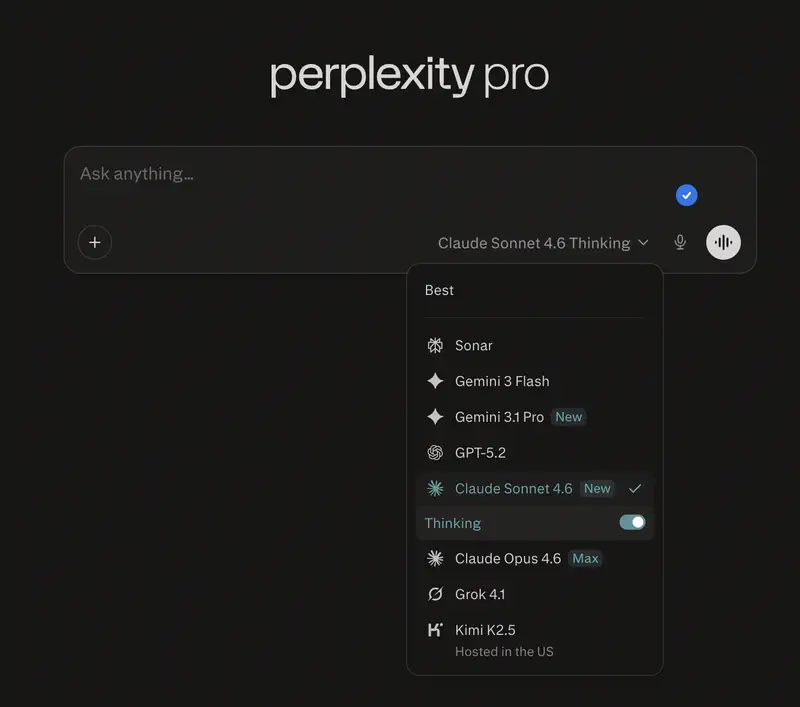
In Pro mode you can pick the “brain” behind your search:
- Sonar 2 (Default): Best for fact-checking and breaking news. The fastest response.
- Claude Sonnet 4.6 / Opus 4.8: The gold standard for text analysis and writing code. The most natural and precise answers (Opus 4.8 is on the Max plan).
- GPT-5.4 / 5.5: For creative work, brainstorming, and marketing copy (GPT-5.5 is on the Max plan).
- Gemini 3.1 Pro: For multimedia data and searching across Google’s ecosystem.
- Kimi K2.6: A strong model for reasoning and research tasks.
- Nemotron 3 Ultra: A new open model from NVIDIA.
For quick fact-checking, the free Sonar 2 model is more than enough – it delivers current, source-cited information in seconds.
The top models – Claude Opus 4.8 and GPT-5.5 – are on the Max plan; Pro opens up GPT-5.4, Claude Sonnet 4.6, Gemini 3.1 Pro, and Kimi K2.6.
Below are examples of how Perplexity’s answers differ depending on the model you pick:
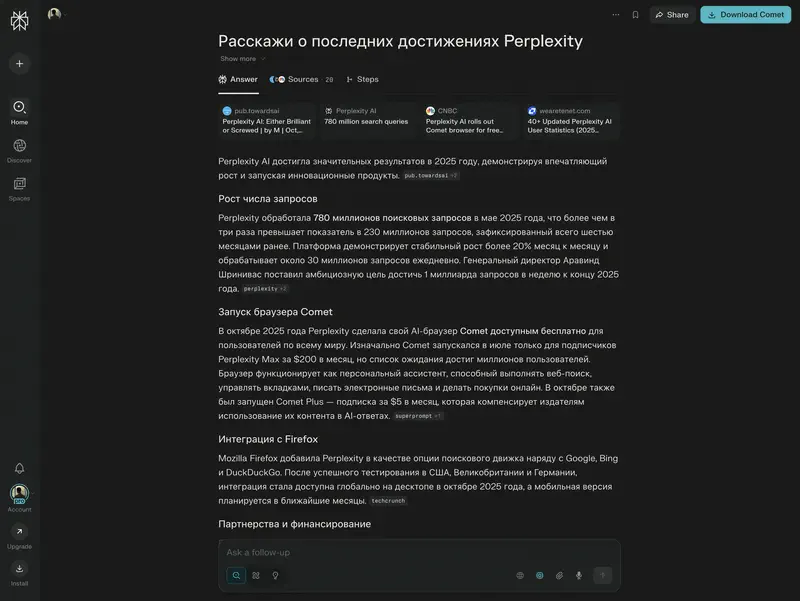
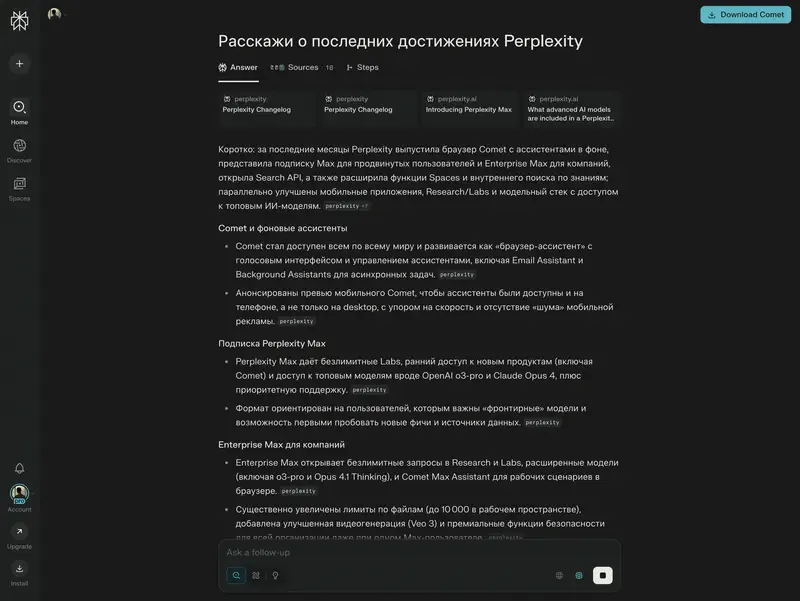
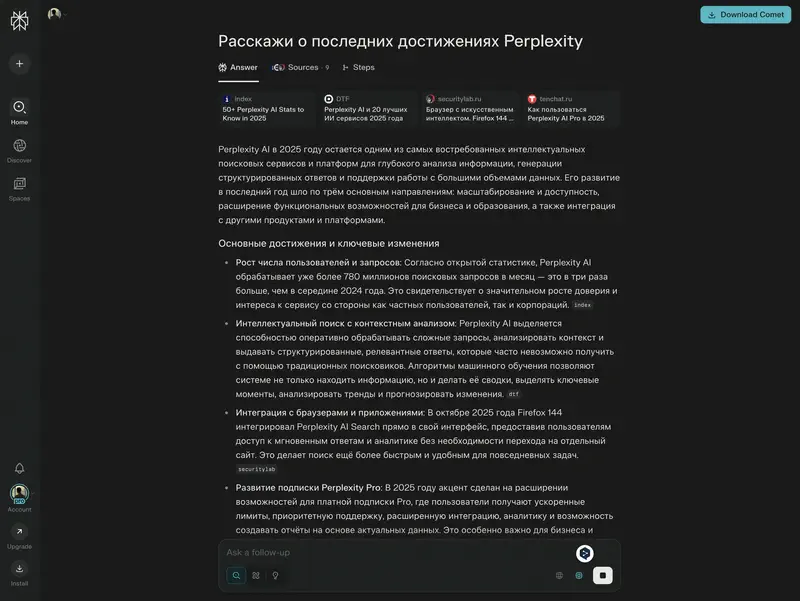
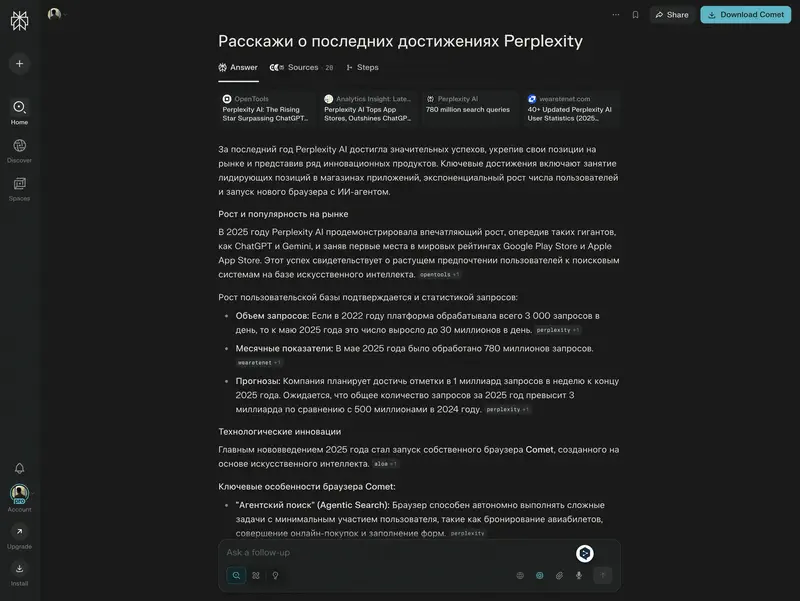
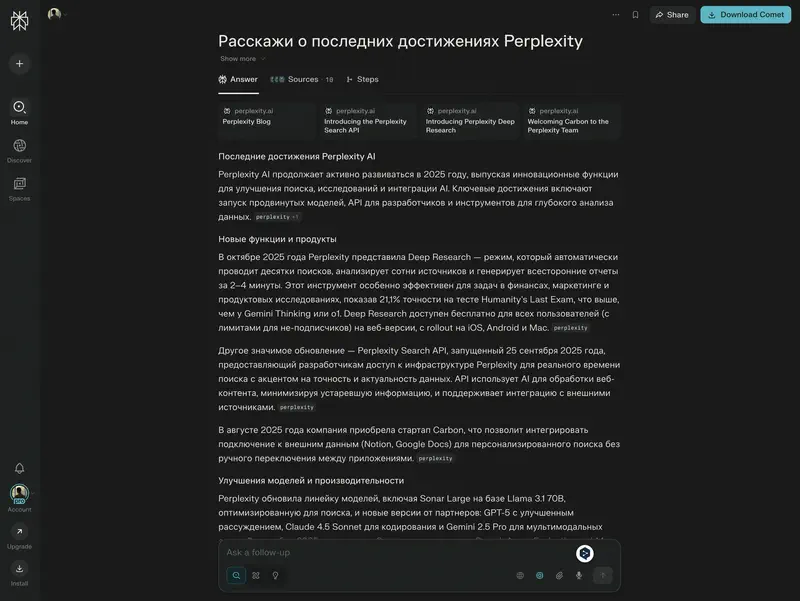
You can already see it: the same question, five different results. In the free module we break down how to choose a model and frame your query to get a predictable answer.
No payment required • Get notified on launch
Where to use Perplexity
Perplexity has already moved beyond the website, and for a manager that changes how you work with it:
- The Comet browser. Perplexity’s own AI browser – free and available to everyone. The built-in assistant works right on your open tabs: it helps with research, breaks down meetings, fills in forms, and sees tasks through to the end.
- Microsoft 365. A side panel is built into Word, Excel, PowerPoint, and Outlook – search, summarize, and fact-check with source citations without leaving the document.
- Personal Computer on Mac. An agent that runs tasks across local files, native Mac apps, and the web – closer to a “digital employee” than to a search engine.
On top of that, the web app and mobile apps keep context and history in sync across every surface.
Putting it to work
- Competitive analysis: A task that used to take a week now takes 15 minutes. Research mode builds a table comparing competitors’ features, pricing, and reviews.
- People management: Tracking labor-market trends. Ask for “business analyst salaries in February 2026” and you’ll get up-to-date figures pulled from multiple sources.
- Sales prep: A dossier on a company before a meeting – from financials to the leadership team’s latest interviews.
How it scored in our benchmark
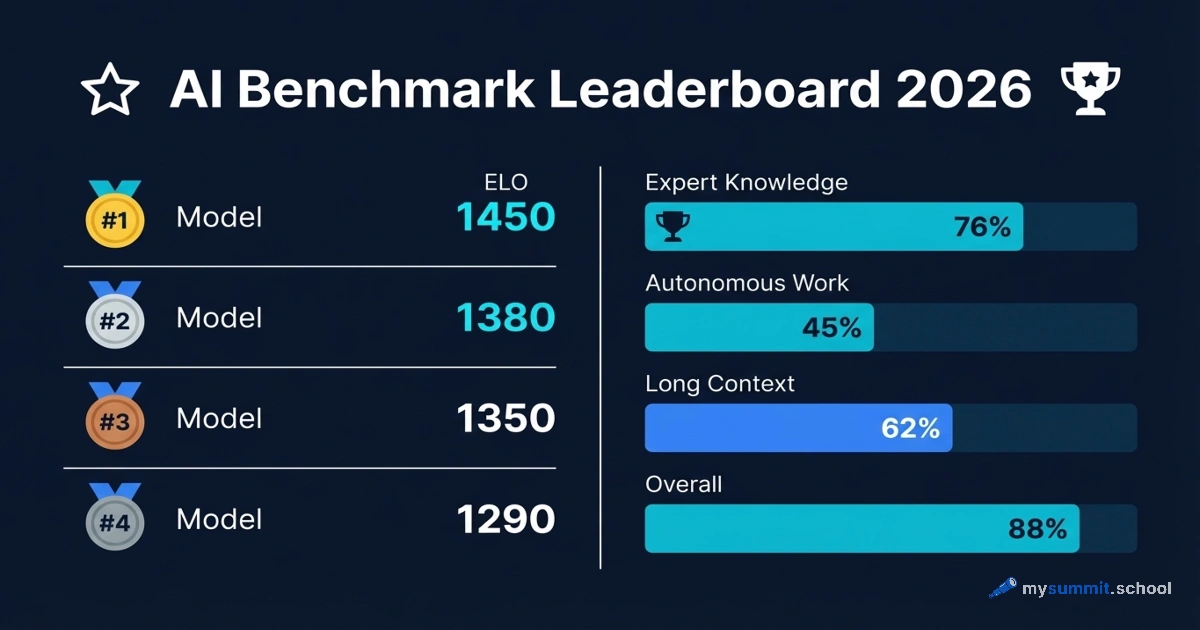
We tested Perplexity’s own models – Sonar Pro and Sonar – in our independent benchmark on manager-focused tasks. Both landed in the middle of the pack, trailing most competitors in the key categories.
The central irony: a search-first tool posts some of the weakest scores in the “information retrieval” category. Sonar Pro does reasonably well on learning and people-management tasks but stumbles on analysis and problem-solving. Sonar follows the same pattern, just a notch weaker.
But Perplexity’s value isn’t in the raw model – it’s in the search → synthesis → sources pipeline. That pipeline is something benchmarks can’t measure. And in the Pro tier, Perplexity gives you access to Claude and GPT – models from the elite group in our benchmark. Which model you pick inside Perplexity matters more than the quality of its homegrown Sonar.
See the full interactive results ->
Try it yourself: synthesis without search – what a “bare” model gives you
What to notice: None of these models has access to the internet – they’re answering from memory. This is exactly where Perplexity’s value shows up: its search → synthesis → sources pipeline solves this problem with real links attached. Models without search either hallucinate sources or honestly admit they can’t provide them. Try the same prompt in Perplexity and the difference will be obvious.
Perplexity pricing (2026)
- Free plan: Basic Sonar 2 search, a limited number of Pro queries per day, and the free Comet browser.
- Pro Individual ($20/mo): 300+ Pro queries per day, access to GPT-5.4, Claude Sonnet 4.6, Gemini 3.1 Pro, and Kimi K2.6, plus unlimited Research mode.
- Max ($200/mo): Maximum limits, the top models (Claude Opus 4.8, GPT-5.5), Deep Research on them, and early access to new features.
- Enterprise ($40/user): Corporate Spaces, search across internal company knowledge, and full data security.
Limitations
- Source dependency: If reliable data doesn’t exist online, the AI can’t invent it.
- Language coverage: Analysis tends to go deeper on widely-covered, English-language topics than on niche or non-English subjects.
Useful links
Go from searching to working systematically with AI
Perplexity, ChatGPT, DeepSeek – there's no shortage of tools, but results depend on how you frame the task. The full program: Foundation plus specializations in project and product management with AI.
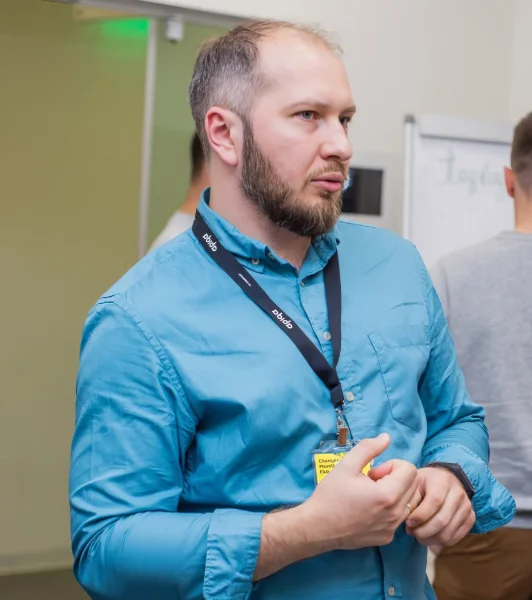
Stanislav Belyaev
Engineering Leader at Microsoft18 years leading engineering teams. Founder of mysummit.school. 700+ graduates at Yandex Practicum and Stratoplan.