Prompts 2026: 7 Mistakes That Kill Quality + Perfect-Request Checklist
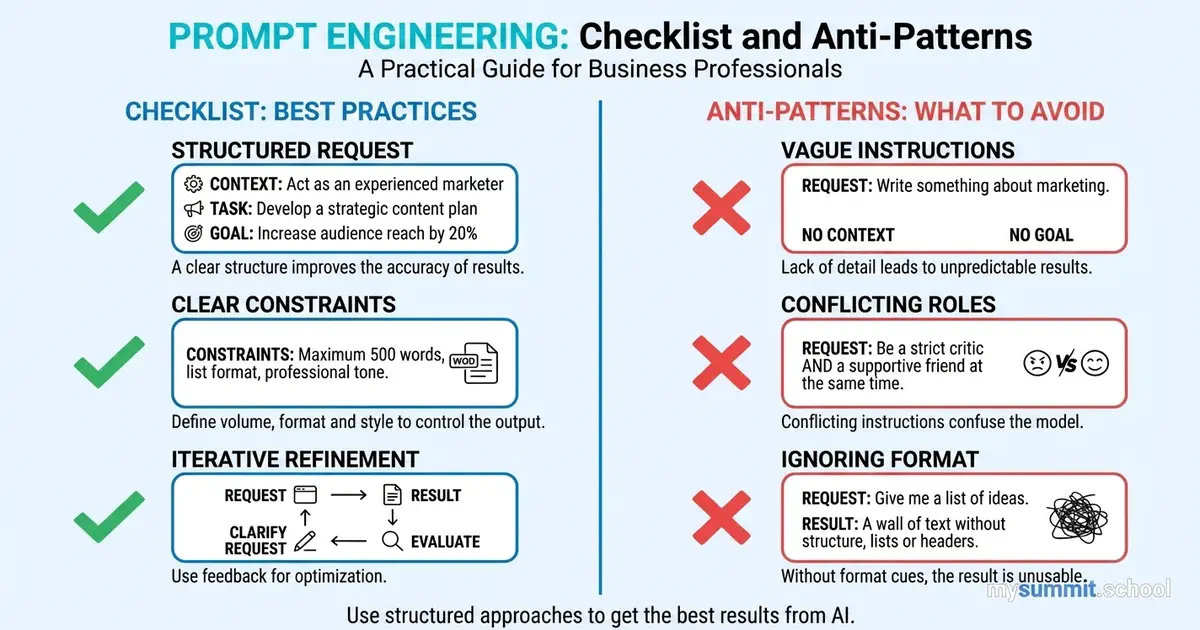
We’ve covered prompt structure, the persona pattern, and working with long texts. Now – a practical checklist and the typical mistakes that drag down the quality of AI answers.
Checklist: before you hit send
Structure (non-negotiable)
- Role – who is answering? (not “an expert,” but “a senior marketer in e-commerce”)
- Context – what’s the situation? (what’s already known, what’s the goal)
- Task – a concrete action verb (write, shorten, analyze)
- Constraints – what NOT to do (no more than X words, no emoji, no apologies)
- Format – what should the answer look like (table, list, JSON)
Positioning (for long prompts)
- Key instructions – at the beginning and at the end
- Raw data – in the middle
- For prompts of 10,000+ tokens – anchor reminders every 5–10 thousand
- For very long tasks – break it into a chain of shorter prompts
Final check
- Is the prompt understandable to a person who doesn’t know the context?
- Are there any conflicting instructions?
- Are there concrete success metrics? (“cut by 50%” instead of “cut it down”)
7 anti-patterns: what kills quality
1. Vague instructions
❌ “Make the text better”
✅ “Cut by 30%, remove filler openers, add concrete numbers”
Why: AI doesn’t know what “better” means to you. For some people it’s brevity, for others it’s detail.
2. Excessive politeness
❌ “Please, if it’s not too much trouble, could you possibly try to…”
✅ “Shorten the text. Format: 3 paragraphs”
Why: Extra words dilute the instruction. AI is trained to answer politeness with politeness – you’ll get fluff.
3. No negative constraints
❌ “Write a business email”
✅ “Write a business email. DO NOT use: ‘I would like to note,’ ‘allow me to inform you,’ apologies without cause”
Why: Models default to “polite” boilerplate. Without explicit bans, you’ll get it.
4. Names instead of functions
❌ “You are Elon Musk”
✅ “You are an entrepreneur applying first principles thinking”
Why: The model imitates the celebrity’s style, not the methodology. You get bravado instead of logic.
5. Conflicting roles
❌ “You are a creative marketer and a strict accountant”
✅ “Create a campaign. Then switch to the CFO role and evaluate ROI”
Why: Contradictory values average out the result. Better – sequential roles.
6. Critical information in the middle
❌ A long prompt with the budget constraint buried on page 3
✅ Budget – in the first 100 words + repeated in the final instruction
Why: The “Lost in the Middle” effect – AI handles the middle of long texts worst.
7. One prompt to rule them all
❌ 50 resumes + 10 criteria + analysis in a single prompt
✅ 5 prompts of 10 resumes each with intermediate conclusions
Why: A chain of short prompts is more accurate than one long one. You control every step.
Quick wins: what to roll out today
1. A template for recurring tasks
Build a template for repeat requests. Fill in only the variables:
# ROLE
You are [role with experience]

# CONTEXT
[What's known, what's the situation]

# TASK
[Concrete verb] + [object]

# CONSTRAINTS
- DO NOT [constraint 1]
- DO NOT [constraint 2]
- Maximum [X] words/items

# OUTPUT FORMAT
[Table / List / Structure]
2. Few-Shot for tricky formatting
If you need a specific format – show 2–3 examples:
Input: "Customer complains about slow delivery"
Output: { "type": "logistics", "urgency": "high", "action": "contact within 24h" }

Input: "Question about warranty"
Output: { "type": "legal", "urgency": "low", "action": "forward to support" }

Input: [your text]
Output:
3. The “start + end” rule
Key instructions – always in the first 200 words and the last 100.
Wrapping up the series
Across 4 articles we’ve covered:
- Prompt structure – 5 elements: role, context, task, constraints, format
- Persona – why the role works, and how to phrase it in 2025
- Prompt size – the “Lost in the Middle” effect and techniques for long texts
- Practice – the checklist and anti-patterns (this article)
That’s the foundation. From here – practice and experiments with your own specific tasks.
We validated all 4 techniques quantitatively: 10 approaches, 4 models, 1,717 runs. Structured prompts and role assignment ranked in the top three. Full results in the Prompt Engineering: What Actually Works study.
Ready to put it into practice?
Course program: Foundation module on prompt engineering with dozens of exercises, plus specializations in project management and analytics.
Next step
Theory without practice is useless. At mysummit.school/prompts you can:
- Try every technique from this series in interactive mode
- Compare results from different models (ChatGPT, Claude, Gemini)
- Get feedback on your own prompts
Stanislav Belyaev
Engineering Leader at Microsoft18 years leading engineering teams. Founder of mysummit.school. 700+ graduates at Yandex Practicum and Stratoplan.