Qwen by Alibaba in 2026: From Open-Source Leader to Closed Flagships
AI models in this article
While managers pay for ChatGPT Plus and Claude Pro, Alibaba has built one of the largest AI ecosystems in the world – free chat, open models, and API prices a fraction of the competition. Qwen (pronounced “chwen”, from 通义千问 – “A Thousand Questions”) had, by mid-2026, surpassed every Western rival in download counts and become a tool every manager should know. But the ecosystem changed dramatically over six months: flagship models went closed, key developers left, and the strategy shifted from “everything free” to the familiar “the best models cost money.”
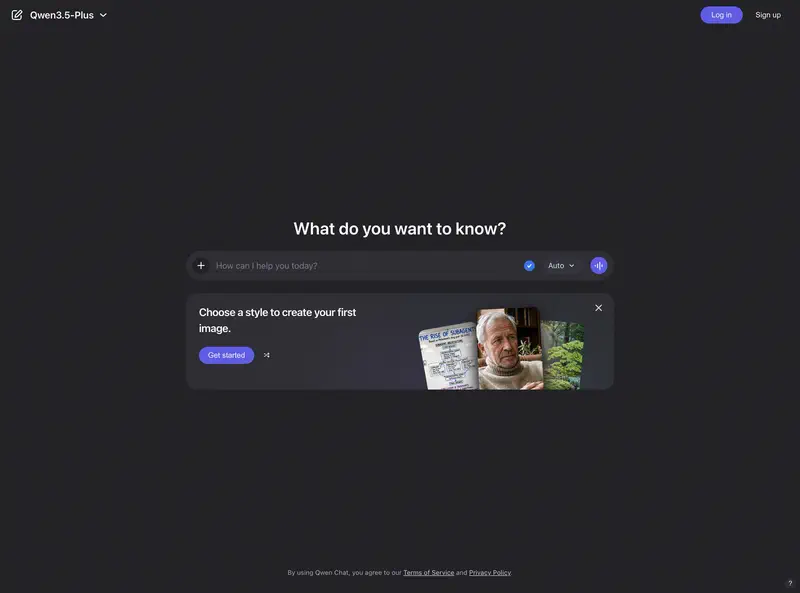
The core appeal of Qwen for managers is simple: it’s a full-featured AI assistant available for free through Qwen Chat – no subscription, no request limits. By April 2026, Qwen model downloads had approached 1 billion – the family accounts for over 50% of all open-source model downloads worldwide. Qwen’s consumer app has 203 million monthly active users, ranking third globally after ChatGPT and DouBao.
What makes Qwen different?
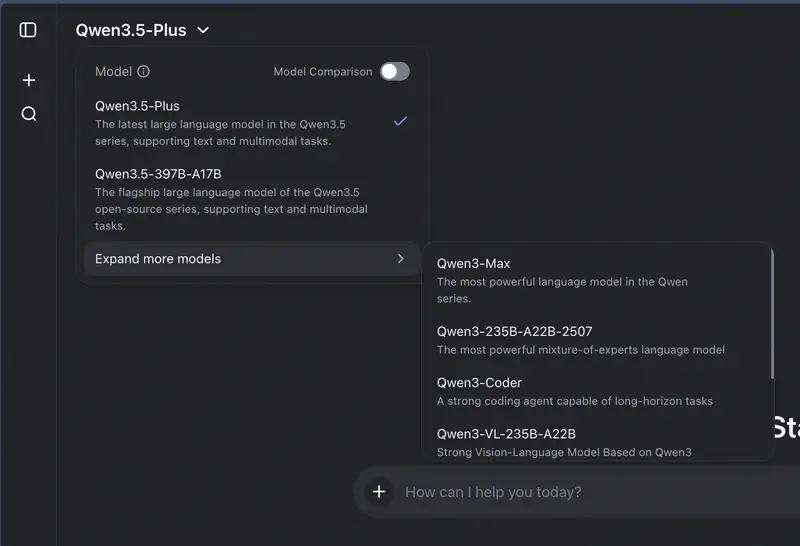
The key differentiator from most competitors is scale and flexibility. Alibaba publishes a significant share of its models openly on Hugging Face – any company can download them and deploy them on its own servers. Among those who have used Qwen as a foundation: Oylan, Kazakhstan’s national language model. That said, the flagship 3.7 series (Max and Plus) is API-only – Alibaba is increasingly following the OpenAI and Anthropic playbook.
- Most Qwen models are available for download and self-hosting – but not all: the 3.7 series is closed. For companies with strict data security requirements, the open models (Qwen3.6-Plus, Qwen 4 Coder) remain among the best in the world.
- Flagship models run on a specialization principle: each request activates only the relevant “knowledge segment”, not the whole model. In practice, a laptop-sized model delivers response quality that used to require server hardware costing hundreds of thousands of dollars.
- The Qwen3 text model series supports 119 languages and dialects; the newest versions support 201 languages, including Russian. Russia is one of Qwen’s largest markets: around 30% of the platform’s traffic comes from Russian-speaking users.
- Text, images, video, audio, speech generation – all in one ecosystem.
What Qwen can do in July 2026
The Qwen lineup today covers nearly every type of task a modern company faces:
- Next-gen agents. Qwen 3.7 Max (May 2026) is built as an “agentic model” – capable of autonomously running chains of 1,000+ tool calls in a single session without quality degradation. 1M token context, the lowest hallucination rate among frontier models (22.9%).
- Multimodal agent. Qwen 3.7 Plus (GA – June 1, 2026) understands text, images, and video, sees the screen, and returns UI element coordinates (GUI agent grounding). 1M token context, priced at $0.40/$1.60 per 1M tokens – 6x cheaper than Qwen 3.7 Max.
- Next-level code. Qwen 4 Coder 32B-A3B (June 2, 2026) – the first open model to cross 82% on SWE-Verified. MoE architecture: 32B parameters, only 3B active – runs on a Mac with 24 GB of memory at 58 tokens/sec. Apache 2.0 license.
- Long-document work. Qwen3.6-Plus holds up to 1 million tokens in memory – around 2,000 A4 pages per request. Load an entire annual report, a customer support archive, or a full code repository and query the whole thing at once.
- Complex reasoning. Qwen3.7-Max in chain-of-thought mode scores 92.4% on GPQA Diamond – above Claude Opus 4.6 Max (91.3%) and K2.6 Thinking (90.5%). On math tasks (Apex Math) – 44.5% versus 34.5% for Claude Opus 4.6 Max.
- Agentic coding. Qwen3.6-35B-A3B plugs into Claude Code, Qwen Code, and similar tools and solves tasks at the level of Claude Sonnet 4.5 at a fraction of the price. Open license – deployable inside the company.
- Voice and video in one model. Qwen3.5-Omni simultaneously understands text, images, audio, and video within a single architecture. It powers “Audio-Visual Vibe Coding” – describe a task in voice and show your screen on video, and the model generates the code.
- Image and speech generation. Qwen-Image-2512 produces photorealistic images with accurate multi-line text rendering – rare among generative models. Qwen3-TTS synthesizes speech with voice cloning for narration and voice assistants.
- Top of the open-source pack. Qwen3.5-Max-Preview sits in the LM Arena top 5 with a score of 1464 – first among Chinese models, sixth in the world. Qwen3.5-397B-A17B is the third-best open-source model in the world, comparable to GPT-5 and Claude Opus.
Core Qwen Models (July 2026)
By mid-2026, Alibaba has assembled one of the most extensive model lineups in the industry.
Qwen 3.7 Max – Agentic flagship (May 2026)

Qwen 3.7 Max (written without a space as Qwen3.7-Max) was announced at the Alibaba Cloud Summit on May 20, 2026, after a quiet appearance on LM Arena on May 14. The 3.7 series includes two models: Qwen3.7-Max (the text flagship for reasoning and agentic tasks) and Qwen3.7-Plus (the multimodal agent, GA since June 1, 2026).
Key specs of Qwen3.7-Max:
- 1M token context – double Qwen 3.6 Max (256K)
- Agentic architecture – the model can run autonomous sessions up to 35 hours long, chaining 1,000+ sequential tool calls without quality loss. In the summit demo, the model autonomously optimized a kernel through 1,000+ code modifications, achieving a 10x inference speedup
- Lowest hallucination rate among frontier models – 22.9%
- “Thinking” mode – a toggleable reasoning chain, visible in the Qwen Chat interface
Benchmark results:
| Benchmark | Qwen3.7-Max | Comparison |
|---|---|---|
| Intelligence Index v4.0 | 56.6 | 5th in the world, 1st among Chinese models |
| GPQA Diamond | 92.4% | Above Claude Opus 4.6 Max (91.3%) |
| Apex Math | 44.5% | Above Claude Opus 4.6 Max (34.5%) |
| MRCR-v2 128K (long context) | 90.4% | Above Qwen3.6-Plus (85.9%) |
| Terminal-Bench Hard (code) | 50.8% | – |
Important: Qwen3.7 is API-only – there are no open weights. Alibaba has historically released open versions after a closed preview (as it did with Qwen 3.6), but no timeline has been announced for the 3.7 series. This is part of a broader trend: flagships are going closed.
Qwen 3.7 Plus – Multimodal agent (GA – June 1, 2026)
Qwen3.7-Plus appeared on LM Arena on May 14 as a preview and reached general availability (GA) on June 1, 2026. It’s the multimodal version of the 3.7 series: the model accepts text, images, and video as input and returns text.
Key difference from Qwen3.7-Max:
- GUI Agent Grounding – the model “sees” a screenshot and returns precise pixel coordinates for UI elements. This enables autonomous agents that control applications visually – no API required
- 1M token context, up to 65,536 output tokens, an internal reasoning budget up to 256K tokens
preserve_thinkingparameter – retains reasoning state across tool calls in an agentic loop- Price: $0.40 / $1.60 per 1M tokens (input/output) – 6x cheaper than Qwen 3.7 Max
Qwen 3.7 Plus is a closed model (API-only, no open weights). For managers, this is an important signal: Qwen’s most capable multimodal models are now available only through the cloud API, not for local deployment.
Qwen3.6-Plus – Flagship with 1M token context
Released in April 2026 as a response to Gemini 2.5 and GPT-5. The hybrid architecture combines linear attention and a sparse mixture of experts – enabling work with massive documents without sacrificing speed.
- Context up to 1 million tokens – around 2,000 A4 pages per request. Load an entire code repository, an annual report, or a customer support database.
- 78.8% on SWE-bench Verified – near the level of closed flagship models on programming tasks.
- Audio-Visual Vibe Coding: describe a task in voice and show the mockup on camera – the model generates the code.
- Apache 2.0 license – weights downloadable for local deployment.
Qwen3.5 – Multimodal model family
Released in March 2026, available on Microsoft Azure. The key difference: these models “understand” text, images, audio, and video as a unified whole within a single architecture. A single prompt can simultaneously reference an uploaded document, a screenshot, a video clip, and text context.
The series spans an unprecedented range – from 0.8B parameters (smartphone-runnable) to 397B (comparable to GPT and Claude):
- Qwen3.5-4B / 9B – the smartest models in their weight classes; run on a laptop and outperform models 2–3x larger. Even on a phone.
- Qwen3.5-27B – strict instruction-following: structured reports, form completion, multi-step tasks.
- Qwen3.5-35B-A3B – balanced quality and speed: 35B parameters, only 3B active.
- Qwen3.5-122B-A10B – complex analytics and large information volumes.
- Qwen3.5-397B-A17B – open-source flagship; on the GDPval-AA benchmark, outperforms its predecessor Qwen3-235B by 361 points. Third-best open-source model in the world.
Shared across the series:
- Around 400 pages of A4 per request; context can be extended to a small book equivalent.
- Two modes – “Think” (step-by-step reasoning for complex tasks) and “No Think” (instant answers for routine) – switchable within a single model without switching services.
- Support for 201 languages, including Russian.
- Competes with leading multimodal models on independent benchmarks at significantly lower cost.
Mode switching is one of the key innovations in Qwen3/3.5. No need to choose between a “smart” and a “fast” model: the same model adapts to task complexity. Deep analysis mode for a financial report. Instant answer for “when’s the meeting?”
Qwen3-235B – Flagship open-source text model
Released in April 2025, trained on twice the data of the previous generation. Specialized architecture achieves flagship quality at significantly lower compute costs – noticeable when working via API.
- Model code is open – any company can download and run it on their own servers. Serious server hardware required.
- The model “thinks” before answering – checking logic step by step. Important for complex calculations, legal analysis, financial planning.
- Qwen3-Max – a cloud version via API for those who prefer not to manage their own installation.
- Up to 200 pages of A4 per request; up to 400 pages in extended mode.
Qwen3-30B – Optimal for corporate server deployment
An enterprise-class model: processes requests quickly and cheaply despite its large size. Outperforms older models that required three times the resources.
- For teams that need a powerful assistant on their own servers without data center costs.
- Up to 200 pages of A4 per request.
Qwen3-Coder-Next – Developer model (February 2026)
Specialized model for writing and reviewing code. Outperforms DeepSeek models on independent benchmarks, with results comparable to Claude Sonnet 4.5.
For managers, this is likely a tool for the development team rather than direct use: the model can hold an entire project in memory – not just a single file, but the full repository. Local deployment requires approximately 51 GB of RAM.
Qwen 4 Coder – First open-source coder to hit 82% SWE-Verified (June 2026)
Qwen 4 Coder 32B-A3B, released June 2, 2026, is the first model to mark a transition to the fourth Qwen generation, and the first open model to cross 80% on SWE-Verified – a benchmark that correlates with real developer productivity.
- MoE architecture: 32B total parameters, 3B active per token. 256K context
- 82% SWE-Verified – above Devstral, Qwen3.6-Coder, and every laptop-runnable model
- Runs on a 24 GB Mac: 58 tokens/sec on an M4 Pro – full local use, no server needed
- Trained on real tests: unlike its predecessors, Qwen 4 Coder was trained with reinforcement learning on results from real GitHub-issue test runs, not just a code corpus
- Apache 2.0 license, unrestricted – can be embedded in commercial products, fine-tuned, resold
For a CTO or head of engineering, Qwen 4 Coder is a reason to reconsider subscription spend: a model that runs on a developer’s work laptop solves tasks at the level of cloud flagships.
The lineup looks impressive, but picking the right model is only part of the job. The difference between “getting an answer” and “getting a reliable result” comes down to how well you frame the request and check the output. That’s exactly what our free module covers.
Qwen gives you free access to powerful models – but the result still depends on how you frame the task. 9 hands-on exercises to test that for yourself.
No payment required • Get notified on launch
Qwen3-VL – Image and document analysis
Understands images, video (over an hour long), PDF documents, and handwritten text. Text recognition works in 32 languages, including Russian: upload a contract scan or a photo of a whiteboard after a meeting and get structured text back.
Qwen3.5-Omni – Native multimodality (March 2026)
Text, images, audio, and video are processed by a single architecture, without separate encoders. Best-in-class results on 215 audio and audio-visual understanding tasks. Supports real-time voice input and output in Russian, built-in web search, and external tool calls. It powers the Audio-Visual Vibe Coding scenario: a developer describes the requirements in voice and shows the interface on video – the model writes the code.
Qwen3-TTS and Qwen-Image-2512 – Voice and images
Qwen3-TTS (open license) – speech synthesis with voice cloning and streaming generation for voice assistants and narration. Qwen-Image-2512 – an updated image generation model with photorealistic detail and accurate text rendering: multi-line headlines, paragraphs, branded elements – the same areas where Midjourney and DALL-E typically fall short.
Models for local deployment
Alibaba offers a range of compact models that can be run on your own hardware – from a laptop to a corporate server:
| Where to run | Model | Max document | Best for |
|---|---|---|---|
| Smartphone or tablet | Qwen3-0.6B | ~50 pages | Autocomplete, simple prompts |
| Regular laptop (4 GB RAM) | Qwen3-1.7B | ~50 pages | Email drafts, summarization |
| Powerful laptop (8 GB RAM) | Qwen3-4B | ~50 pages | Document analysis, quality of old top models |
| Workstation (16 GB RAM) | Qwen3-8B | ~200 pages | Complex documents, tables, long dialogues |
| Department server (32 GB RAM) | Qwen3-14B | ~200 pages | Full team assistant |
| Corporate server (48 GB RAM) | Qwen3-32B | ~200 pages | Quality close to top cloud models |
| Server cluster (140+ GB) | Qwen3-235B | ~400 pages | Flagship quality, competes with GPT and Claude |
If your company cannot send data to external servers – finance, healthcare, public sector – you can download the model and deploy it inside your corporate network. Data never leaves your perimeter. This is impossible with ChatGPT or Claude.
Qwen3-4B, fitting on a regular laptop (from 4 GB RAM), demonstrates quality comparable to a model that previously required a full server rack. This is one of the clearest examples of how rapidly open model efficiency is advancing.
A practical guide to choosing hardware, installing Ollama, and comparing local models against cloud alternatives – in the local LLM guide for managers.
How Qwen compares to competitors
The flagship Qwen3-235B competes with DeepSeek-R1, o1, Grok-3, and Gemini 2.5 Pro on independent benchmarks. For everyday business tasks, mid-tier models deliver results on par with the best cloud services.
| Criterion | Qwen | ChatGPT / Claude | DeepSeek |
|---|---|---|---|
| Flagship quality | Top-tier (competitor to GPT and Claude) | Top-tier | Top-tier |
| Free web access | Yes, chat.qwen.ai unlimited | Limited | Limited |
| Self-hostable | Partial – up to the 3.6 series and Qwen 4 Coder; the 3.7 series is closed | No | Partial |
| API cost | Lowest in class ($0.40/$1.60 for 3.7 Plus) | Medium–high | Low |
| Image and video support | Yes (3.7 Plus, 3.5-Omni) | Yes | Limited |
| Russian language support | Good | Excellent | Good |
For 90% of business tasks – writing, data analysis, document summarization – Qwen 3.7 Plus delivers results comparable to Claude Sonnet 5, at 5x lower cost.
Qwen, DeepSeek, ChatGPT – there are dozens of models, but the tasks stay the same. In the free module, you'll try 9 real manager scenarios and see which tool actually fits your work.
No payment required • Get notified on launch
Results in our benchmark (update – July 2026)
Qwen is the most heavily represented ecosystem in our benchmark: 5 models in the top 25 out of 42 tested. All are directly accessible from Russia. Results are based on 80 real-world manager task scenarios (analysis, planning, communication, team management).
Three flagships – Qwen 3.6 Plus, Qwen 3.7 Max, and Qwen 3.7 Plus – are covered above with fresh benchmark data (rank, score, cost per task, and test date in the cards under their headings). Two remaining mid-tier models:
Qwen 3.6 Flash beats Gemini 3.5 Flash at a fraction of the price; Qwen 3.6 27B is especially strong at planning. On price-to-quality, Qwen 3.6 Plus looks more compelling than both Claude Sonnet 5 and GPT-5.4 Mini – at a noticeably lower price.
The lineup’s main paradox: Qwen 3.7 Max costs more than Qwen 3.6 Plus but ranks lower overall. It specifically wins in the “planning” and “team management” categories – if those tasks are central to your work, Max is worth the premium.
Qwen 3.6 Plus’s profile across eight categories shows the gap clearly: strong text and analysis work – and weak spots wherever local context is required.
Common weaknesses across the Qwen lineup:
- Russian labor law – invents nonexistent statutes and penalties. Critical legal questions shouldn’t be resolved without verification.
- Financial calculations – systematic arithmetic errors.
- Regional awareness – the weakest category across all Qwen models.
Usage strategy: Qwen 3.6 Plus – the primary model for 80% of tasks. Qwen 3.7 Plus – for high-volume routine operations where budget is critical. Qwen 3.7 Max is worth it only for planning and team-management tasks, where it’s specifically stronger.
Try it yourself: planning + employment law
What to look for: Qwen usually produces an excellent plan structure (planning is its strongest category), but when it references specific US employment rules it often invents nonexistent statutes or requirements (regional/regulatory awareness is its weakest category). DeepSeek has the same issue with US labor regulations, and Kimi K2.6 is the strongest planner of the three but is likewise weak on local regulatory detail.
Practical applications for managers
Most managers who try Qwen start with Qwen Chat – a free web interface with access to current models. It supports web search, image generation, and document analysis without any subscription. A good entry point for those who want to evaluate the tool before talking to IT.
Qwen handles Russian-language documents confidently: contract scans, handwritten notes, whiteboard photos from meetings. Upload a photo – get structured text. Recognition works in 32 languages, and quality on Russian text is noticeably better than with many Western tools.
A separate use case is corporate deployment without the cloud. For companies prohibited from sending data outside their perimeter, Qwen offers something unavailable with ChatGPT or Claude: models can be downloaded and run on your own servers. This is the same logic used by government bodies building sovereign AI systems – control over data matters more than the convenience of cloud access.
Finally, Qwen3-Omni and Qwen3-TTS make it possible to build a voice assistant in Russian: speech recognition, request processing, speech synthesis – all from one ecosystem, without needing to stitch together several separate services.
Strategic pivot: from open-source to closed models
The first half of 2026 brought a shift that changes Qwen’s core value proposition. Alibaba moved its flagship models – Qwen3.7-Max and Qwen3.7-Plus – to a closed format (API-only, no open weights). This puts Alibaba in direct competition with OpenAI and Anthropic for enterprise API contracts.
The approach isn’t a full retreat from open source: Qwen3.6-35B-A3B and Qwen 4 Coder shipped under the Apache 2.0 license. But the trend is clear – the most capable models are now closed. Alibaba has confirmed it will keep releasing open models, but there’s no firm commitment on when, or whether, the 3.7 series will open up.
Against the backdrop of this pivot, key figures left the team. In March 2026, technical lead Lin Junyang departed, posting on social media: “me stepping down. bye my beloved qwen.” The same day, Yu Bowen, who led post-training, also resigned. Earlier, Hui Binyuan, the lead code researcher, had already left. A colleague on the team commented: “I know leaving wasn’t your choice.” Alibaba’s stock fell 5.3% that day.
For a manager choosing Qwen, this creates a mixed picture:
- Open-source models remain strong – Qwen3.6-Plus and Qwen 4 Coder are available for download and local deployment. For tasks where data control is critical, nothing has changed.
- The best new models are API-only – if you need a multimodal agent (3.7 Plus) or top-tier reasoning quality (3.7 Max), you’ll pay for cloud access, just as with ChatGPT or Claude.
- Staffing instability – the departure of the project’s architects creates long-term uncertainty, though it hasn’t slowed the release pace so far.
Limitations and risks
- Flagship lock-in: The most powerful 3.7-series models aren’t available for download. If you built your strategy around a fully open ecosystem, you’ll need to rethink your approach or use previous-generation models.
- Staffing losses: The departure of the technical lead and the head of post-training in March 2026 is a serious signal. Alibaba reorganized the team, creating a cross-group foundation model unit, but the long-term consequences are still unclear.
- Censorship and filters: Like all Chinese models, Qwen has built-in restrictions on discussing certain political and historical topics. Rarely an issue for business tasks.
- Geopolitical risk: The model belongs to Alibaba (China). For some organizations, this may be a constraint when using the cloud API. Solution: local deployment of open-source versions.
- Quality in Russian: Despite the claimed support for 200+ languages, response quality in Russian can lag behind English. Test on your specific use cases.
- Integrations: Ready-made connectors to Western services – Slack, Notion, Google Workspace – are far fewer than for ChatGPT or Claude. Qwen is better integrated with Chinese enterprise tools.
Pricing and availability
| Option | Cost | Best for |
|---|---|---|
| chat.qwen.ai | Free | Try Qwen without API registration |
| Qwen3-0.6B / 4B (download) | Free | Laptop deployment, full data control |
| Qwen 4 Coder 32B-A3B (download) | Free (Apache 2.0) | Coding on a laptop, 82% SWE-Verified |
| Qwen3-235B (download) | Free | Flagship locally, requires a server cluster |
| Qwen3.7-Plus (API, GA) | $0.40 / $1.60 per 1M input/output | Multimodal agent, GUI grounding, 1M context |
| Qwen3.7-Max (API) | $2.50 / $7.50 per 1M input/output | Text flagship, agentic scenarios, 1M context |
| Qwen3.6-Plus (preview) | Free during preview | 1M token context, open code |
| Qwen3.5-Plus (API) | $0.40 / $2.40 per 1M input/output | Regular tasks, cost-quality balance |
| Qwen3.5-397B-A17B (API) | $0.39 / $2.34 per 1M input/output | Open-license flagship |
For comparison: an equivalent analysis of a 100-page report via GPT-4o costs about $0.35, and via Claude Sonnet, around $0.55. Qwen3.7-Plus delivers multimodal analysis at one-third the cost of Claude Sonnet.
Qwen still offers three entry points: free chat, cheap cloud API, and local deployment. But with the 3.7 series, the balance has shifted: the most powerful models are now cloud-only, while local deployment is left with excellent – but no longer the best – versions.
Is it worth trying?
Six months ago, the main argument for Qwen was simple: “everything ChatGPT offers, but free and open-source.” By July 2026, the picture has gotten more complicated.
Open source hasn’t gone anywhere – Qwen 4 Coder, with 82% on SWE-Verified, and Qwen3.6-Plus, under Apache 2.0, remain the strongest open-source models in their classes. For companies that need local control over their data, alternatives are still scarce. But the newest and most capable models – Qwen 3.7 Max and 3.7 Plus – are now closed and available only through the API. Alibaba is following the same path as OpenAI and Anthropic: research models ship open, commercial flagships don’t.
On most tasks, all top models today deliver comparable results, and the difference isn’t obvious in day-to-day work. Qwen 3.7 Plus, at $0.40/$1.60, does what Claude Sonnet 5 charges $2/$10 for – multimodal analysis, agentic scenarios, screen-reading tasks. For high-volume work, that’s real savings.
The departure of key developers and the team reorganization is a risk worth tracking. The release pace hasn’t slowed so far, but that’s no guarantee. If you’re building critical processes on Qwen, it’s wise to have a fallback – DeepSeek or cloud models with a more stable corporate structure.
Move from reviews to hands-on practice
The full program: a Foundation module with hands-on practice on Qwen, ChatGPT, Claude, DeepSeek, plus specializations in project management, analytics, and automation. Learn to choose tools deliberately.
Sources
- Qwen Chat – free web interface – Alibaba’s official chat, works without registration
- Official Qwen website – documentation and description of all models
- Qwen models on Hugging Face – 433 open models for download, 300M+ downloads
- Qwen repository on GitHub – source code and documentation, 40+ repositories
- API via Alibaba Cloud Model Studio – cloud access to Qwen-Plus and Qwen-Max

Stanislav Belyaev
Engineering Leader at Microsoft18 years leading engineering teams. Founder of mysummit.school. 700+ graduates at Yandex Practicum and Stratoplan.