AI Model Review

Microsoft MAI Models in 2026: What You Can Actually Use, and What It Costs

18 min read

At Build 2026 on June 2, Microsoft unveiled seven in-house models under the MAI (Microsoft AI) brand, covering reasoning, code, images, voice and transcription. A company that spent years as OpenAI’s biggest backer called it a move toward “long-term self-sufficiency.”
Microsoft AI main page

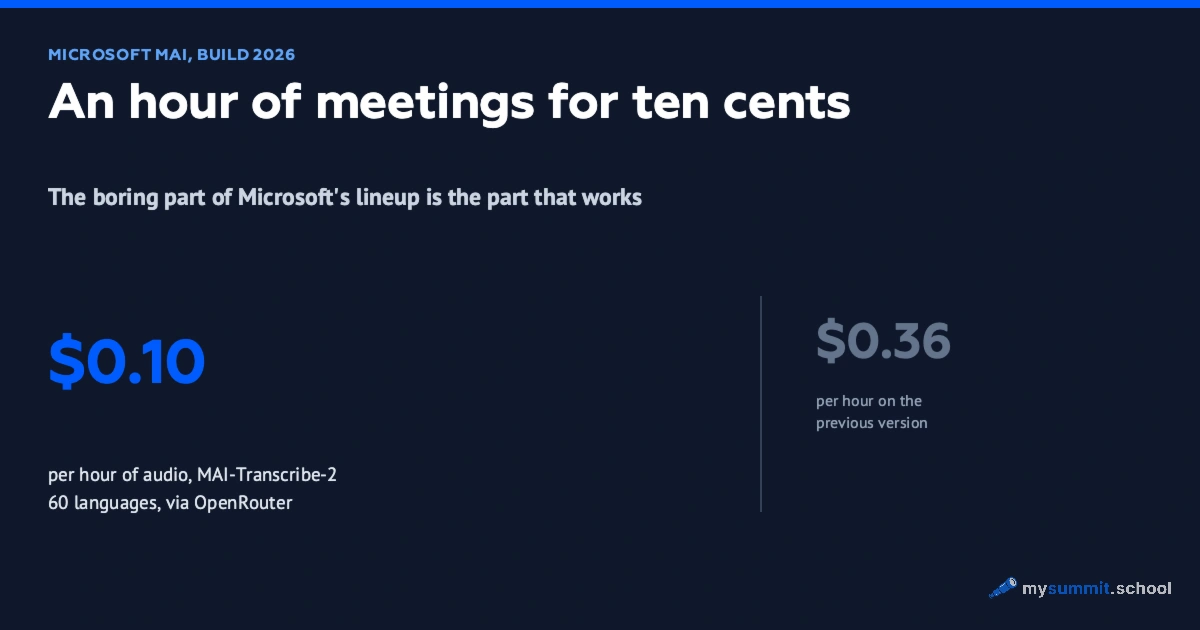
For a manager, two things in this announcement matter. The first is price: an hour of recorded meeting gets transcribed for $0.10, and you don’t need an Azure contract to do it. The second is Frontier Tuning – training a model on your own workflows inside your own compliance boundary. It’s the strongest idea Microsoft has shipped all year, and it comes only with the full Microsoft enterprise stack.

So let’s start with who can buy what, then get to the models and the numbers.

Read more
Microsoft MAI Models in 2026: What You Can Actually Use, and What It Costs
Meta Muse Spark: Meta's First Closed Model Since 2023
12 min

Meta Muse Spark: Meta's First Closed Model Since 2023

Until today, this series had no chapter on Meta. While Llama 4 was the headline, the silence was justified: the model landed to mixed reviews, and there was nothing to tell a manager about it as a working tool.

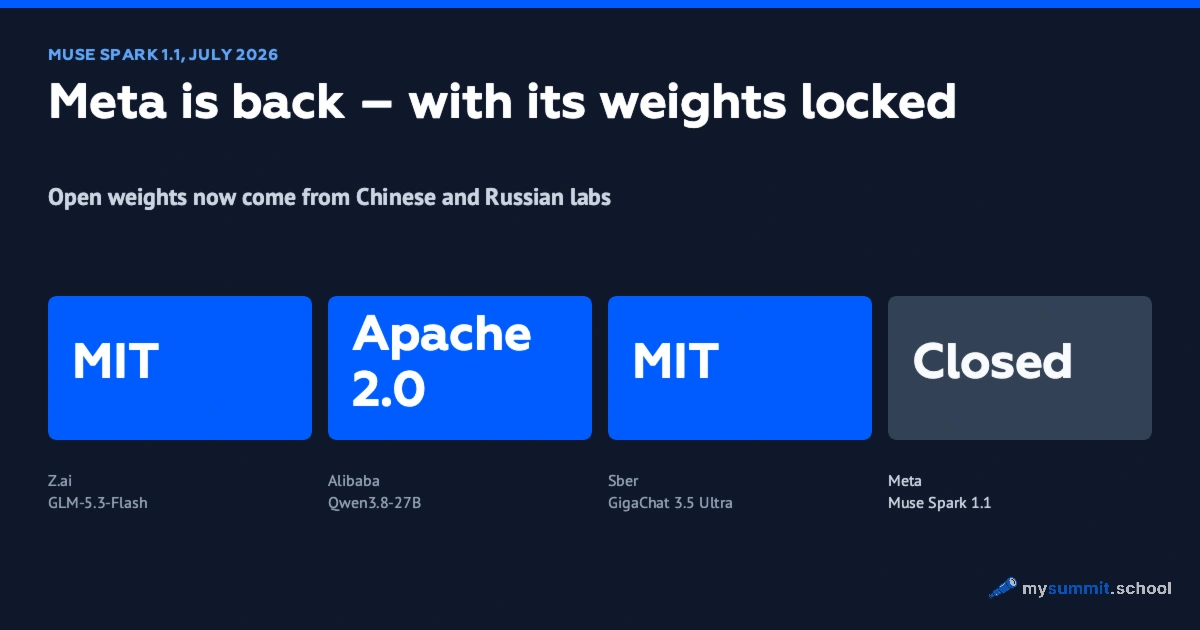
On July 9, 2026, Meta released Muse Spark 1.1 and, the same day, opened public access to the Meta Model API. The announcement went out on the company blog. The Muse family itself, which replaces Llama, started three months earlier: version 1.0 shipped on April 8, and the current model is built on top of it. In the September LMArena snapshot, muse-spark-1.2 in xHigh mode sits fifth on the text leaderboard, muse-spark-1.1 tenth, and muse-spark is sixth on the image leaderboard. Anyone comparing tools by leaderboard will run into the name. Until now, this series had nothing to say about it.

The scores are only the third most important story here. The first is the licence: in nine months Meta replaced its AI leadership, rebuilt the stack and came back with closed weights. The second is what kind of model it turned out to be: 1.1 leads on tool-calling tasks and trails noticeably on writing code.

Local LLMs for Managers: What You Can Actually Run at Home
22 min

Local LLMs for Managers: What You Can Actually Run at Home

Anyone who has spent enough time with ChatGPT or Claude eventually asks the question: can I run something similar right on my own laptop – without a subscription, without data leaving the machine, without depending on someone else’s servers?

In 2026, the answer is yes – but the caveats matter more than the answer.

This article is for people already using cloud LLMs who want to understand what local execution actually gives you, what hardware you need, and where expectations break down. No deep technical dive, but concrete numbers.

Chat Z.AI (GLM-5) in 2026: The Chinese Model That Pretends to Be Claude
25 min

Chat Z.AI (GLM-5) in 2026: The Chinese Model That Pretends to Be Claude

On February 6, 2026, an anonymous model called “Pony Alpha” showed up on OpenRouter – free, with no word on who built it. The AI community immediately started trying to work out who did. Its coding skills came close to Claude Opus 4.5. Ask it “who are you?” and it answered “I am GLM.” But ask it to build a web page describing itself, and it wrote: “I am Claude, created by Anthropic.”

That happened every single time. And it frames everything you need to know about GLM-5 before we get to benchmarks and pricing.

Qwen by Alibaba in 2026: Open Weights Are Back at the Top
31 min

Qwen by Alibaba in 2026: Open Weights Are Back at the Top

While managers pay for ChatGPT Plus and Claude Pro, Alibaba has built one of the largest AI ecosystems in the world – a free chat app, open models and API prices that undercut the competition several times over. Qwen (pronounced “chwen”, from 通义千问 – “A Thousand Questions”) had overtaken every Western rival in downloads by mid-2026 and became a tool every manager should know. In the spring it looked as if the ecosystem was drifting toward the OpenAI and Anthropic playbook: the 3.7 flagships shipped closed, and key developers walked out. In August, Alibaba released three models and turned back. The flagship Qwen3.8-Max comes with a promise of open weights, and Qwen3.8-27B, under Apache 2.0, runs on a single consumer GPU.

DeepSeek in 2026: V4-Pro and V4-Flash Reviewed After the Price Hike
20 min

DeepSeek in 2026: V4-Pro and V4-Flash Reviewed After the Price Hike

DeepSeek (often misspelled “Deep Seek”) is a Chinese AI startup that took two years to become one of the industry’s front-runners. It shipped V4 in April 2026. On 13 August V4-Pro came out of beta, and on 16 August the company rewrote its pricing.

The previous version of this review called DeepSeek the budget flagship and promised prices 10–50 times below the competition. The first claim still holds. The second needs redoing: DeepSeek raised its rates, introduced peak-hour windows, and pushed the price of a cache hit up by as much as 1,100% over the first preview pricing. The company frames this as becoming a sustainable compute provider. Whatever the reason, a budget built on spring prices no longer adds up.

GigaChat in 2026: Honest Review – Is It Worth Using for Work?
20 min

GigaChat in 2026: Honest Review – Is It Worth Using for Work?

GigaChat is the generative AI model from Sber – Russia’s largest bank, which has spent the last decade turning itself into a technology group. It was built for Russian speakers from the ground up: trained on Russian data, with a solid grasp of the cultural context, slang and everyday realities behind the language. And inside Russia it works without a VPN – which matters there, because ChatGPT, Claude and Gemini don’t officially serve Russian users.

Grok by SpaceXAI in 2026: A Review of Elon Musk's AI
19 min

Grok by SpaceXAI in 2026: A Review of Elon Musk's AI

Grok, built by Elon Musk’s SpaceXAI (formerly xAI), sets itself apart from ChatGPT and Claude in two ways: it skips most of the heavy content filtering (“political correctness”) and it reads the X feed in real time.

In June 2026, SpaceX absorbed xAI and formed SpaceXAI – one company covering rockets, Starlink satellite internet and AI. An agent ecosystem has grown up around the model: the current flagship is Grok 4.6 (August 12, 2026), while Grok 4.5 (June 2026, 1.5 trillion parameters) is the version we have our own measurements for in the mysummit.school benchmark.