Management

P5.express and Agentic AI: Where It Helps, Where It Breaks Things

24 min read

In the PMI world, portfolio management is typically imagined as something monumental: steering committees, Tableau dashboards, hundreds of Jira fields, weekly status meetings with a deck of slides. P5.express offers a different approach. Three cycles, five documents, two roles. The entire system fits on a single page.

This is exactly the kind of system where agentic AI makes sense: minimalist architecture that’s easy to understand, clearly defined roles, structured data. But “makes sense” doesn’t mean “everywhere.” Some parts of P5.express stop working when automated – not because the AI is bad, but because those parts derive their value from the human process itself.

Below is a cycle-by-cycle breakdown. What’s worth delegating to an agent, what’s better left to people, and which model fits these tasks best.

Read more
P5.express and Agentic AI: Where It Helps, Where It Breaks Things
9 Questions for Yourself: Are You Using AI – or Is AI Using You?
11 min

9 Questions for Yourself: Are You Using AI – or Is AI Using You?

Not long ago I was putting together a proposal for a new client. The amount was unusual, the terms – likewise. My gut said: go with X, you know this market. But I decided to “check” with Claude. The model produced a well-reasoned answer with a different number – 15% below my estimate. It sounded convincing. I changed the number.

A week later the client signed without negotiation. And instead of satisfaction, I felt annoyed: what if my original number would have gone through too? I’ll never know – because at the moment of decision I suppressed my own judgment in favor of the algorithm’s “statistically grounded” answer.

This is the very pattern that Anthropic’s researchers call Disempowerment – loss of control. Not dramatic, not obvious. Just a quiet swap of “I decided” for “AI suggested.”

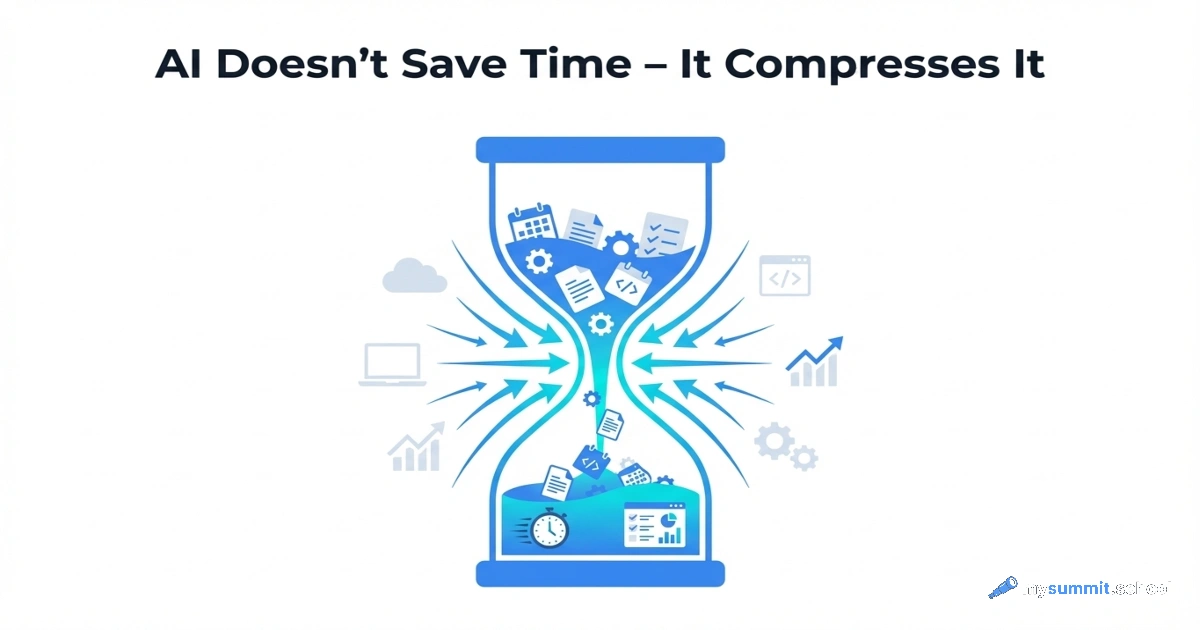
AI Doesn't Save Time – It Compresses It: 8 Months of Observations
11 min

AI Doesn't Save Time – It Compresses It: 8 Months of Observations

Companies are worried about getting employees to use AI. The promise is seductive: AI will handle the drudgery – document drafts, information summarisation, code debugging – freeing up time for higher-value work.

But are companies ready for what happens if they actually succeed?

Researchers at Stanford conducted an 8-month observational study of roughly 200 employees at an American tech company that had rolled out generative AI. The company didn’t mandate AI use – it simply provided corporate subscriptions to commercial tools. Employees decided for themselves whether to adopt them.

The result was paradoxical. AI didn’t reduce work. It intensified it. Workers moved faster, took on more tasks, spread their work across more hours in the day – often without any explicit external pressure. AI made “doing more” possible, accessible, and in many cases internally rewarding.

Strikingly, the same pattern shows up in other research. Microsoft found that 62% of product managers use Gen AI daily, yet while 81% say AI saves time, 56% deny that effort has decreased. A paradox? No – a pattern.