OpenCode

Agent orchestration: the AI skill with the longest shelf life

14 min read

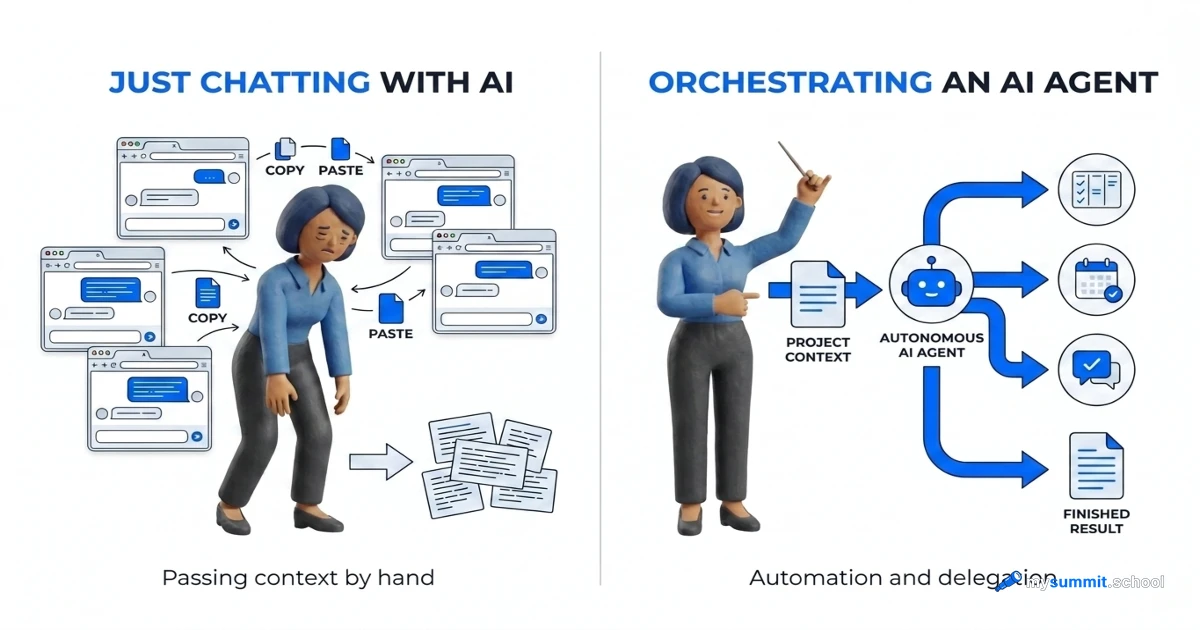
Picture a manager who is quite sure they have AI figured out. Thirty browser tabs are open. In one they spent half an hour pulling apart the risks in a contract; in another they were assembling a project status; in a third they asked for an email to a stakeholder to be rewritten. Every new task starts the same way: explain the project again, who is on the team, what the deadlines are, paste in a chunk of a Jira export, drop in a Slack thread. An answer comes back, gets copied out, the tab closes. Tomorrow, from the top.

They use AI every single day, diligently, and believe they are at the frontier. In reality they are stuck on the first rung, hauling context around by hand like a courier hauling boxes. The tool is powerful. The way they work with it is the most primitive option available.

What separates them from someone who genuinely gets value out of AI is not typing speed. It comes down to one skill that almost nobody teaches explicitly: delegating a task to an agent rather than chatting about it. Oddly enough, that is the longest-lived skill in the whole of AI training. It is also the one most often skipped.

Read more
Agent orchestration: the AI skill with the longest shelf life
P5.express and Agentic AI: Where It Helps, Where It Breaks Things
24 min

P5.express and Agentic AI: Where It Helps, Where It Breaks Things

In the PMI world, portfolio management is typically imagined as something monumental: steering committees, Tableau dashboards, hundreds of Jira fields, weekly status meetings with a deck of slides. P5.express offers a different approach. Three cycles, five documents, two roles. The entire system fits on a single page.

This is exactly the kind of system where agentic AI makes sense: minimalist architecture that’s easy to understand, clearly defined roles, structured data. But “makes sense” doesn’t mean “everywhere.” Some parts of P5.express stop working when automated – not because the AI is bad, but because those parts derive their value from the human process itself.

Below is a cycle-by-cycle breakdown. What’s worth delegating to an agent, what’s better left to people, and which model fits these tasks best.

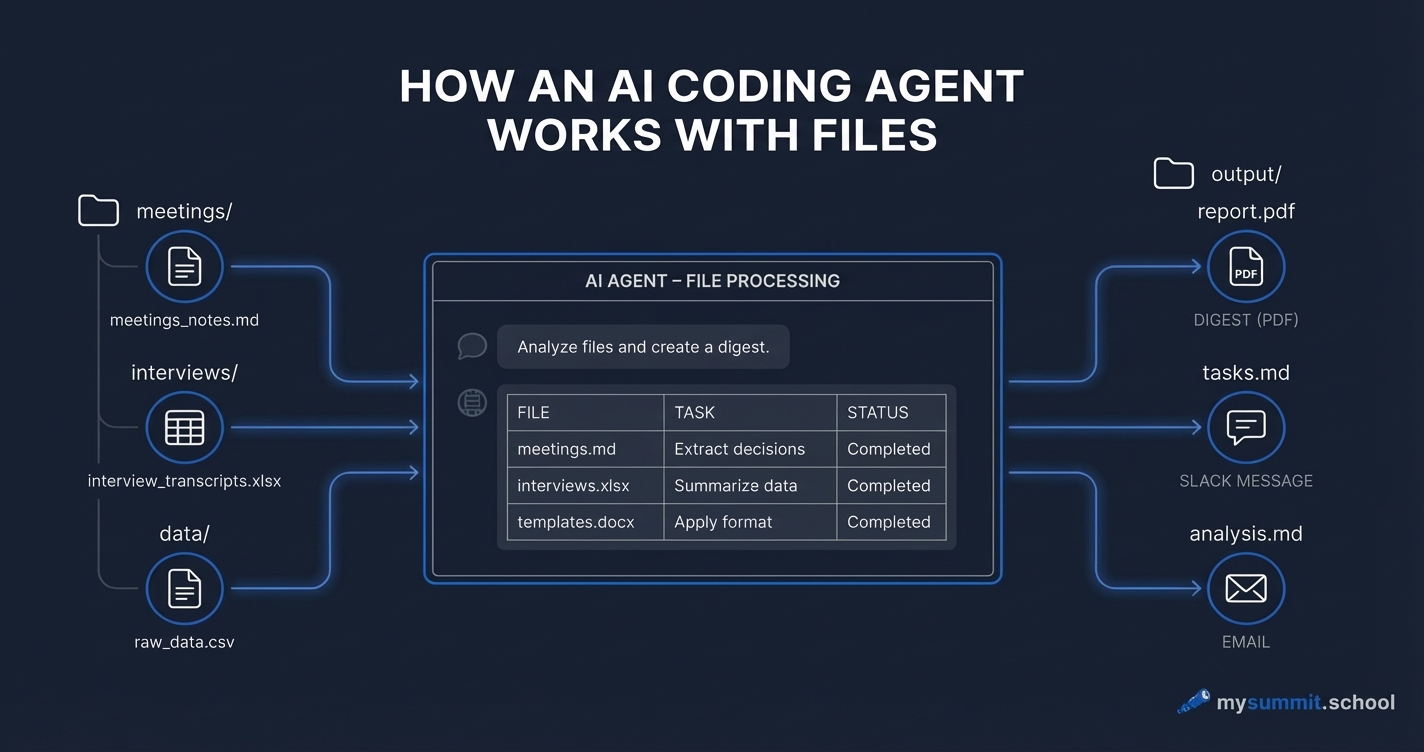
The Agent Instead of Chat: Data Analysis Without Copy-Paste
11 min

The Agent Instead of Chat: Data Analysis Without Copy-Paste

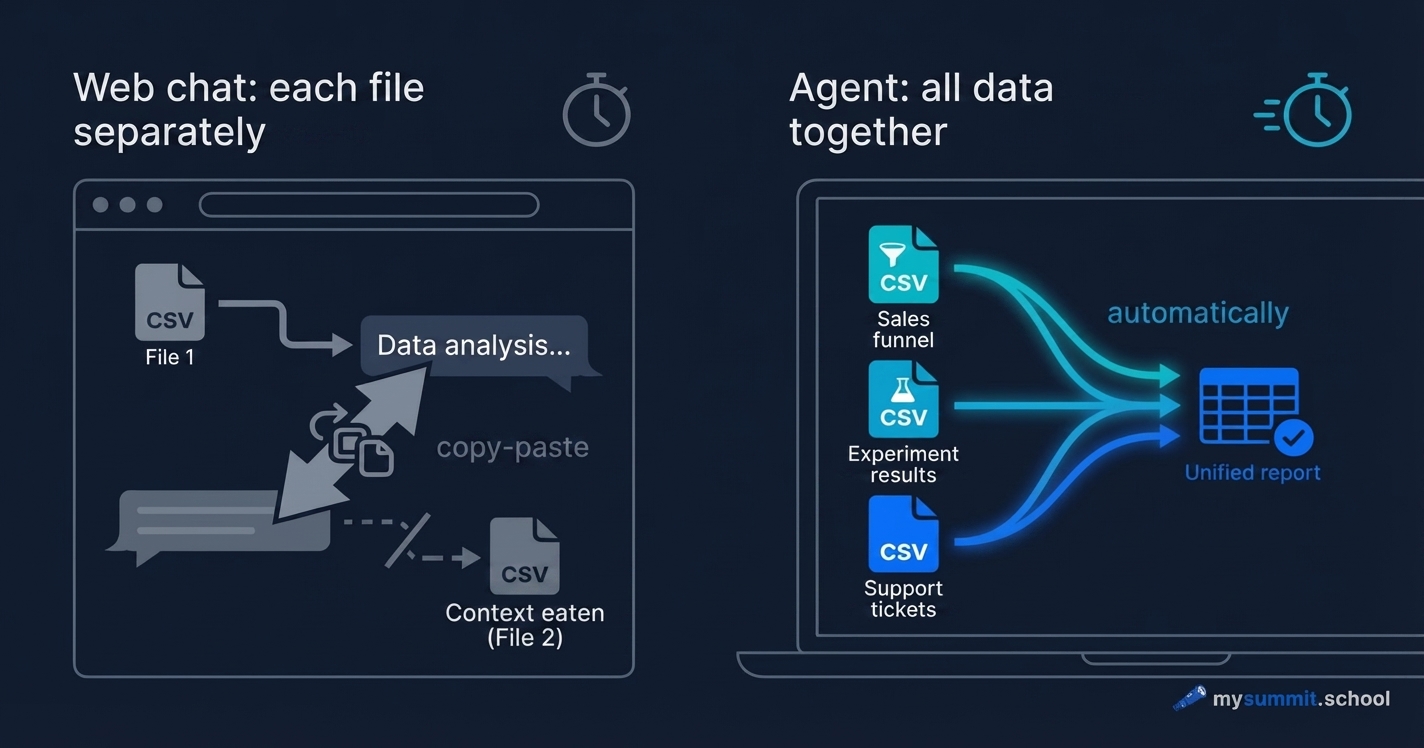
You have three data files: an activation funnel, A/B test results, and support tickets. The task – figure out why onboarding is underperforming. You open ChatGPT, upload the first file, ask your question. You get an answer. You upload the second file. ChatGPT asks: “Can you remind me of the context?” You upload the third. The context of the first file has already been pushed out.

Forty minutes later you have three separate conversations, none of which answer the original question. Because the question was one, and the data was in three places.

This isn’t a ChatGPT problem. It’s a problem of approach.

Claude Code Costs $100/Month – OpenCode Does the Same Thing for Free
13 min

Claude Code Costs $100/Month – OpenCode Does the Same Thing for Free

In March 2026, Lenny Rachitsky published an article with a telling headline: “Everyone should be using Claude Code”. It went viral on LinkedIn and tech newsletters, picked up hundreds of thousands of views, and now every week a manager somewhere asks: how do I try this?

The answer is uncomfortable. The Anthropic Max subscription that unlocks Claude Code costs $100 per month. That’s $1,200 a year for a single tool – before you’ve even figured out whether it fits your workflow. And it locks you into a single vendor, a single model, and a pricing tier designed for power users, not for someone exploring whether AI agents are worth the investment.

There’s a direct alternative. OpenCode is an open-source project that does exactly the same thing, works with any model (including free ones), and takes 15 minutes to set up.