82% of Executives Use AI Weekly: How AI Penetrates Industries – Wharton 2025 Report
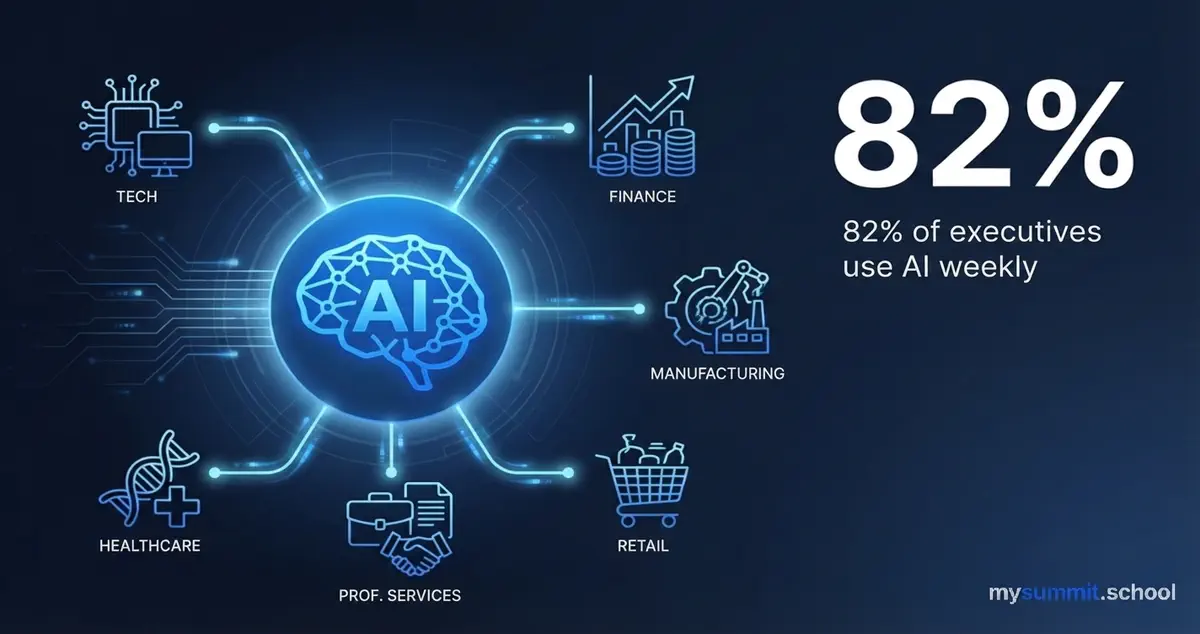
For the third year running, Wharton School of Business and GBK Collective have been tracking how US companies deploy generative AI. The fresh October 2025 numbers tell a clear story: the technology has moved from experiment to daily practice. In a previous article we looked at the gap between rank-and-file AI use (19% see results) and corporate projects (80% succeed). The new Wharton report shows exactly how companies get to that 80% – and why results differ across industries.
Spoiler: tech, finance and professional services are racing ahead. Manufacturing and retail are lagging. And it’s not about being “behind” – it’s a fundamental difference in the nature of the work.
About the study: methodology and scope
Who ran it: Wharton Human-AI Research (part of the Wharton AI & Analytics Initiative) and GBK Collective.
Scope: 800 senior executives from US companies:
- At least 1,000 employees
- Revenue of $50M+ per year
- Third wave of the study (2023 -> 2024 -> 2025)
Focus: Not “are they trying it,” but “how are they deploying it and what results are they getting”. This is what sets the report apart from surveys of regular users.
The headline numbers: AI has become a daily habit for executives
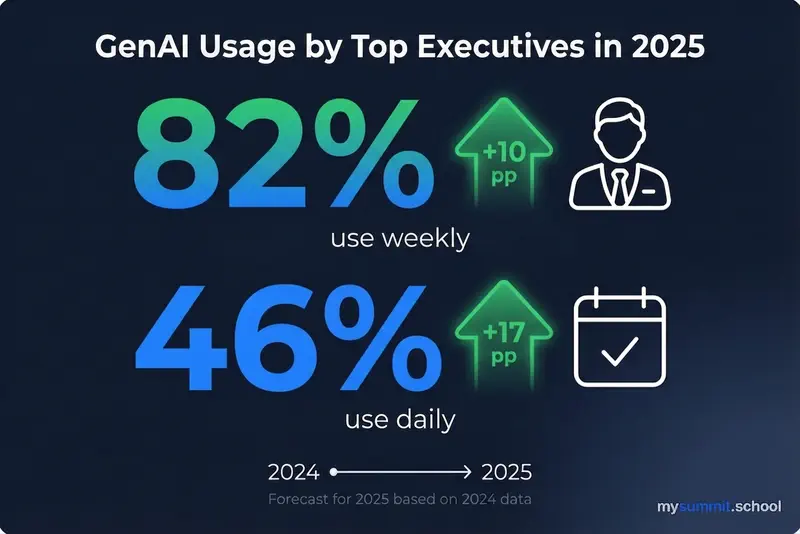
Frequency of GenAI use among executives
| Metric | 2025 (October) | Year-over-year change |
|---|---|---|
| Use weekly | 82% | +10 pp |
| Use daily | 46% | +17 pp |
82% of executives use generative AI at least once a week. For comparison, a year ago it was 72%. One in two leaders now works with AI every day.
Compare this with the Stanford research: there we saw 23% professional use among regular employees. Here it’s 82% among senior management. The gap explains why corporate AI projects succeed 80% of the time: executives are using the technology themselves, not delegating “figure it out” to someone younger.
A real example: Satya Nadella, Microsoft’s CEO, spent his Thanksgiving weekend building a cricket analytics app with Deep Research AI. “It gave me areas of consensus, the debates, the chains of reasoning – it was all fantastic,” he told a corporate event in Bangalore. This isn’t just a PR story. When the CEO of a $3 trillion company is personally coding AI apps in his spare time, it becomes pretty clear why Microsoft is leading the AI race.
✅ Takeaway: When senior management uses AI daily, it changes the culture of the whole company. This isn’t hype or a pilot project – it’s the new norm for how decisions get made.
Priorities have shifted: AI is in the top-3 strategic directions
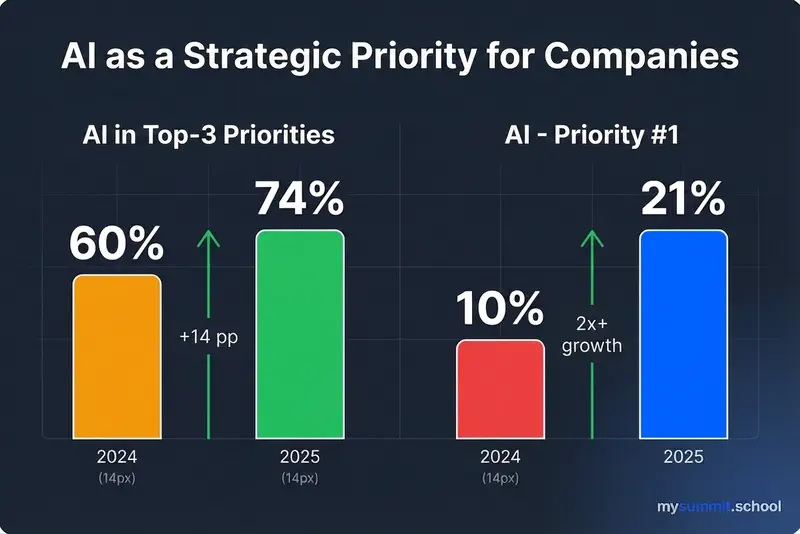
AI prioritization in corporate strategy
| Metric | 2024 | 2025 | Change |
|---|---|---|---|
| AI in top-3 priorities | 60% | 74% | +14 pp |
| AI as priority #1 | 10% | 21% | +11 pp (more than doubled) |
Three quarters of companies now place AI in their top-3 strategic directions. And one in five calls it their number one priority – twice as many as a year ago.
This isn’t just rising interest. It means budgets allocated, specialists hired, processes reorganized.
Chief AI Officer – the new norm
61% of companies have already appointed a Chief AI Officer or equivalent role. A year ago fewer than half had one.
It’s a meaningful signal: AI has stopped being “an IT project”. It’s now a strategic function at the C-suite level.
ROI is no longer a hypothesis: 72% of companies measure returns
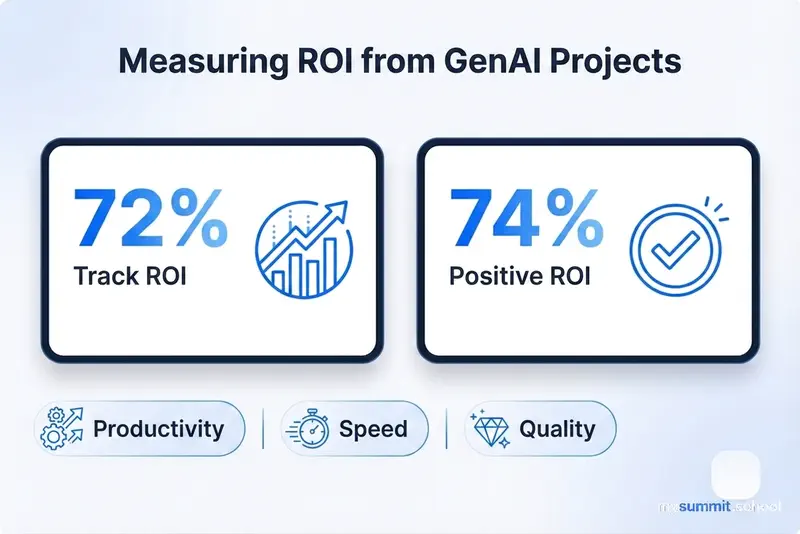
| Metric | Value |
|---|---|
| Companies tracking ROI | 72% |
| Companies with positive ROI | 74% |
72% of companies have already rolled out structured metrics to measure the return on AI. This isn’t subjective “it seems to help” – these are hard numbers:
- Productivity: how many tasks get done faster
- Speed: time to complete key processes
- Quality: fewer errors, better outcomes
74% see positive ROI – which lines up with the Bain figure from our previous article: 78% of projects show measurable revenue growth or cost reduction.
⚠️ Important: This doesn’t mean “every project succeeds”. It means “companies that measure ROI see results”. They’ve learned to filter: pilot -> measure -> scale only if ROI is positive.
The industry gap: why tech leads and retail lags
Here’s where it gets interesting. AI penetration varies dramatically by industry.
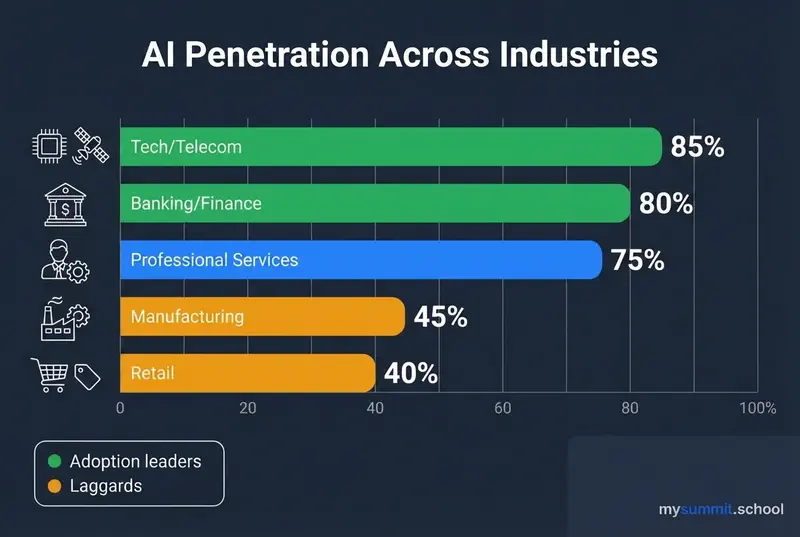
Leaders and laggards in AI adoption
| Industry | Adoption level | ROI | Characteristics |
|---|---|---|---|
| Tech/Telecom | High | High | Early adopters, strong foundation |
| Banking/Finance | High | High | Mass rollout into production |
| Professional Services | High | High | Consulting, legal services |
| Manufacturing | Low | Slow growth | Complexity of physical operations |
| Retail | Low | Slow growth | Complex logistics and warehousing |
Why do tech, finance and professional services lead?
1. The nature of the work:
- Their core job is processing information
- High share of knowledge work
- Plenty of routine operations that are easy to automate
2. Technical maturity:
- Digital infrastructure already in place
- Data is structured and accessible
- IT teams are ready to integrate new tools
3. Competitive environment:
- High competition demands speed
- Early adopters gain a significant advantage
- Customers expect digital services
Why are manufacturing and retail lagging?
Not because they’re “backward”, but because the tasks are harder:
1. The physical world:
- GenAI works brilliantly with text, code and images
- But manufacturing and logistics are about physical objects
- AI for robots and warehouse automation needs different technologies (computer vision, control systems)
2. Complex integration:
- AI has to be integrated with manufacturing equipment
- Linked to supply chain management systems
- Synced with legacy systems that are decades old
3. ROI is harder to measure:
- In finance: “AI processed 1,000 loan applications instead of people” – obvious savings
- In manufacturing: “AI optimized materials procurement” – the saving is diffused over time and hidden in overall metrics
✅ Takeaway: The gap between industries isn’t about “smart vs backward”. It’s a difference in the nature of the work. GenAI first transforms industries where the main job is information processing. Manufacturing and retail follow, but they need more complex solutions.
Distribution by function: IT and procurement lead, marketing lags
Wharton also analyzed AI adoption by function inside companies.
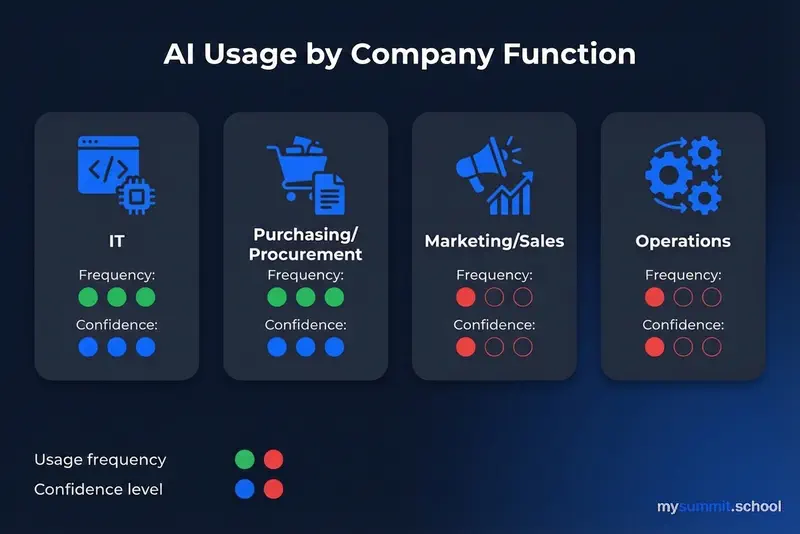
AI adoption distribution by function
| Function | Usage frequency | Confidence level |
|---|---|---|
| IT | High | High |
| Purchasing/Procurement | High | High |
| Marketing/Sales | Low | Low |
| Operations | Low | Low |
Why do IT and procurement lead?
IT:
- AI plugs naturally into software development (73% of companies use AI for coding)
- Specialists are technically fluent and pick up new tools fast
- There’s a clear understanding of how to measure the result
Purchasing/Procurement:
- Lots of routine document work: RFPs, contracts, specifications
- AI is great at analyzing supplier proposals
- Savings are easy to measure: compare prices before and after AI
Why are marketing and sales lagging?
This is paradoxical: marketing was one of the most hyped areas for AI (content generation, personalization). But the numbers say otherwise.
Possible reasons:
1. The gap between promise and reality:
- Promised: “AI will create creative campaigns”
- Reality: “AI generates mediocre copy that needs heavy rewriting”
2. ROI is harder to measure:
- In IT: “AI wrote 500 lines of code” – an obvious time saving
- In marketing: “AI created 10 posts” – but conversion depends on a hundred other factors
3. Creativity vs templates:
- Procurement is a process that’s easy to standardize
- Marketing demands creativity, context, emotional intelligence
- AI is good at templates, but creative breakthroughs still come from humans
⚠️ Important: The 2023 trend (“AI for everyone!”) has given way to a sober 2025 view: AI is used where it’s actually effective. Marketing and sales are rethinking their approaches.
Access to AI tools: 70% of companies opened access to all employees
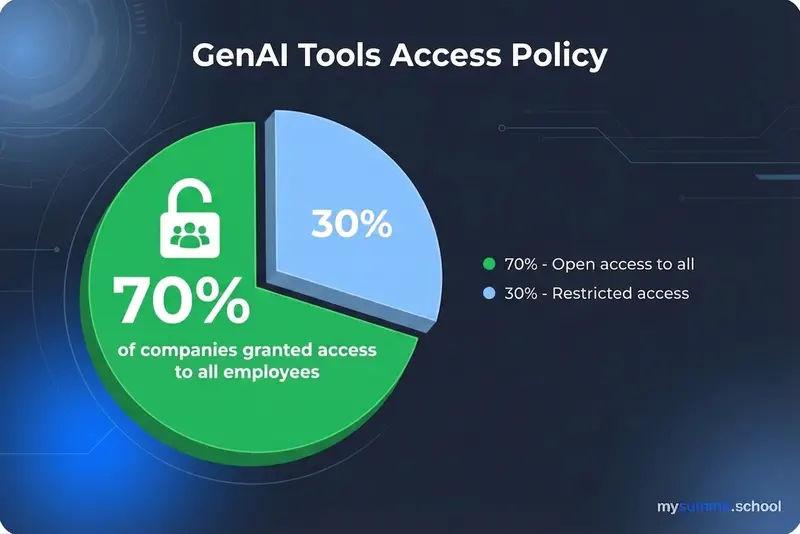
70% of companies have opened access to GenAI tools for all employees. That’s a radical shift from 2023, when most companies feared data leakage and restricted AI use.
What changed?
1. From bans to training:
- 2023: “Ban ChatGPT until we sort out security”
- 2025: “Train everyone on safe AI use and give them access”
2. Enterprise solutions:
- Not public ChatGPT, but corporate versions (ChatGPT Enterprise, Microsoft Copilot)
- Data stays inside the company
- Usage control and auditing
3. The democratization of AI:
- Not just for developers and analysts
- HR, legal, finance, managers – everyone gets access
- AI becomes a productivity tool for everyone, the way Excel once did
✅ Takeaway: 70% of companies have turned AI into infrastructure, as basic as email or the office suite. This is the clearest signal of the shift from experiments to mass adoption.
Software development – the killer app for GenAI
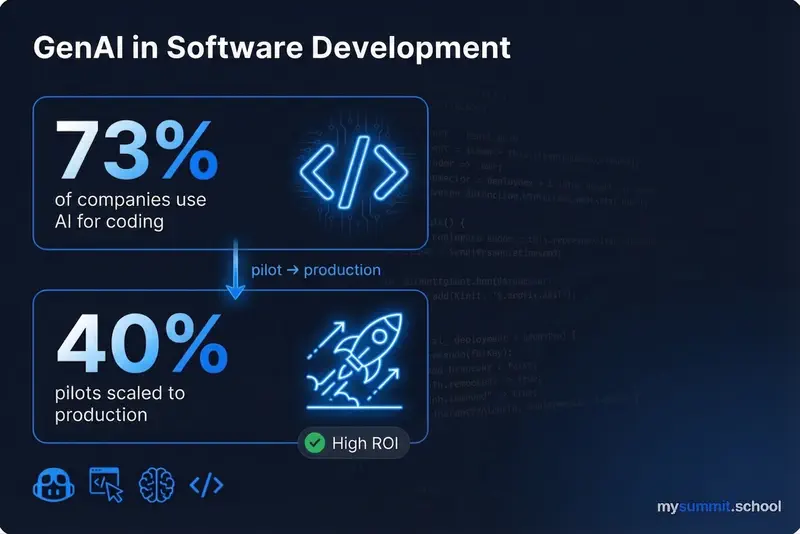
AI usage in software development
| Metric | Value |
|---|---|
| Companies using AI for coding | 73% |
| Pilots scaled to production | 40% |
73% of companies use AI for software development. And these aren’t just experiments: 40% of pilots have already been scaled to production.
Why is software development the killer use case for AI?
1. A clear task:
- Write a function that does X
- Translate code from Python to Java
- Find and fix a bug
2. A measurable result:
- Time to write a function: was 2 hours, now 30 minutes
- Bug count: down 20%
- Code review: AI checks code before it goes to a human reviewer
3. High accuracy:
- AI handles syntax very well
- Knows best practices for all popular languages
- Can explain someone else’s code
4. Fast deployment:
- GitHub Copilot, Cursor, Codeium – integrate in minutes
- Developers see results on day one
- No complex infrastructure or legacy integration
✅ Takeaway: If your company is just starting with AI, start with software development. It’s the area with the highest and fastest ROI.
The scaling problem: why a third of projects get stuck at the pilot stage
Despite the progress, Wharton identified a serious problem: a third of AI projects never make it past the pilot.
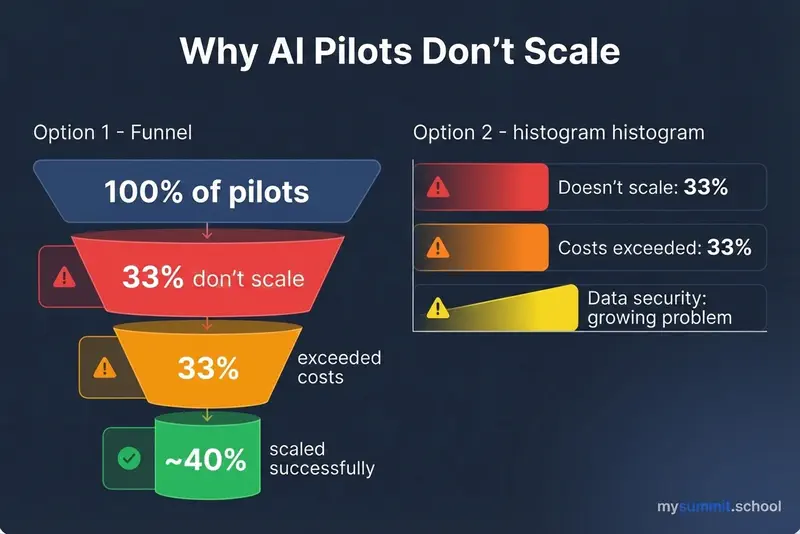
Reasons scaling fails
| Reason | % of dissatisfied companies |
|---|---|
| “Worked in pilot, didn’t scale” | 33% |
| Development costs exceeded expectations | ~33% |
| Data security concerns | Growing |
Why does the pilot work but production doesn’t?
1. A difference in data volumes:
- Pilot: 100 customers, hand-picked cases
- Production: 100,000 customers, all the edge cases and exceptions
2. Integration with existing systems:
- Pilot: Standalone solution, runs on its own
- Production: Has to integrate with CRM, ERP, billing
3. Cost expectations vs reality:
- Pilot: “The OpenAI API costs $50/month”
- Production: “100,000 requests a day = $15,000/month, it doesn’t pay for itself”
4. Data security:
- Pilot: Test data
- Production: Real personal customer data, GDPR/CCPA requirements
⚠️ Important: Scaling AI isn’t just “running it on more users”. It’s process reengineering, negotiating enterprise pricing with vendors, building governance structures.
Agentic automation vs AI assistant: 2x the satisfaction
Wharton uncovered a critical pattern that explains a lot.
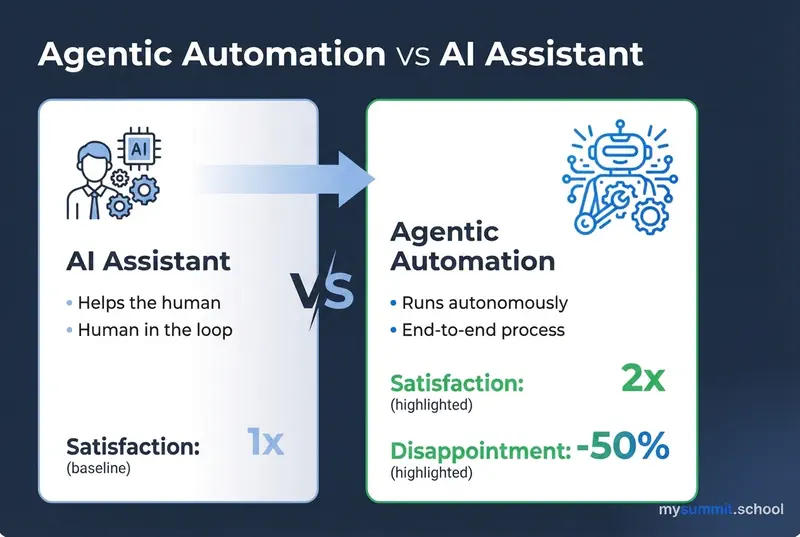
Companies using agentic automation (AI executes tasks autonomously) report 2x higher satisfaction and 50% less frustration than those using AI simply as an assistant.
What is an AI assistant?
- ChatGPT: “Draft me an email to this client”
- Copilot: “Suggest completions for this function”
- Human stays in the loop: AI proposes, the human picks and polishes
What is agentic automation?
- Autonomous process: “When a refund request comes in, the system automatically checks purchase history, applies the refund policy, approves or rejects, notifies the customer”
- AI makes decisions: The human sets the rules but isn’t in every transaction
- End-to-end automation: The whole process, from start to finish
Why does automation deliver 2x the satisfaction?
1. Real time savings:
- Assistant: Saves 30% of your time (AI wrote a draft, but I’m editing it for 20 minutes)
- Automation: Saves 90% of your time (AI did the whole job, I just checked the result)
2. A measurable outcome:
- Assistant: “It helps, but it’s hard to say by how much”
- Automation: “500 requests processed without a human – an obvious metric”
3. Scalability:
- Assistant: Helps one person work faster
- Automation: Replaces an entire team on routine tasks
✅ Takeaway: If you want real ROI from AI, don’t stop at the assistant stage. Build autonomous processes.
What this means for managers: practical takeaways
At mysummit.school we work with managers who want to roll AI into their own work and their team’s. Here are the key takeaways from the Wharton report.
1. Senior management has to use AI themselves
82% of executives use AI weekly. That’s not an accident. When the CEO, CFO and COO work with AI personally, it changes the culture of the entire company.
What to do:
- Don’t delegate “figure out AI” to someone below you
- Start with your own tasks: meeting prep, analyzing reports, drafting strategies
- Become a role model for your team
2. Start with software development (if you have a dev team)
73% of companies use AI for coding, 40% have scaled to production. This is the most mature area of GenAI application.
What to do:
- Roll out GitHub Copilot or an equivalent
- Measure development time before and after
- Use the dev team’s success as a proof of concept for other departments
3. IT and procurement are your early adopters
Wharton showed: IT and Purchasing/Procurement lead on usage frequency and confidence.
What to do:
- Start the rollout with these departments
- Collect case studies and success metrics
- Use their experience to train other teams
4. Marketing and sales – don’t rush
Contrary to the hype, marketing and sales are lagging in real AI deployment.
What to do:
- Don’t expect AI to “create creative campaigns”
- Focus on the routine: competitor analysis, report prep, email personalization
- Leave the creative work to humans for now
5. Plan the shift from assistant to automation
2x higher satisfaction for companies with agentic automation.
What to do:
- Stage 1: Use AI as an assistant (ChatGPT for drafts)
- Stage 2: Automate simple processes end-to-end (standard request handling)
- Stage 3: Scale to complex processes with a human in the loop for control
6. 70% gave access to everyone – but with training
Democratizing AI is the trend. But access without training = chaos.
What to do:
- Give everyone access, but run safe-use training first
- Use enterprise versions (ChatGPT Enterprise, Microsoft Copilot)
- Set policies: what’s allowed, what isn’t, which data must never go into AI
7. Prepare for scaling barriers
A third of projects get stuck at pilot. That’s not a failure, it’s a normal filtering process.
What to do:
- Define the pilot’s success criteria before you start: ROI metrics, costs, security
- Plan scaling in advance: integration, costs, governance
- Don’t be afraid to close projects that don’t pay off at scale
Why the mysummit.school course prepares you for real-world deployment
The Wharton report makes it clear: the difference between experiments and results is a systematic approach.
In our course “Artificial Intelligence for Managers”:
From assistant to automation. You start with simple tasks (ChatGPT for emails) and gradually move to autonomous processes. That’s the path that delivers the 2x jump in satisfaction.
Focus on measurable ROI. We don’t teach “how to write a prompt” – we teach “how to cut 5 hours of routine a week” with concrete metrics.
Security from day one. A dedicated module on protecting corporate data – the very scaling barrier Wharton calls “a growing concern”.
Practice on real tasks. Meeting prep, reviewing resumes, producing reports – things you do every day.
All the tools. ChatGPT, Claude, Gemini, Perplexity and region-specific models – you pick the right tool for each task.
Conclusions: AI has gone mainstream, but not evenly
The Wharton 2025 report paints a clear picture:
AI has become the norm for senior management. 82% weekly, 46% daily. These aren’t experiments anymore.
The industry gap is explained by the nature of the work. Tech, finance and professional services lead because their core job is information. Manufacturing and retail lag because the physical world demands different solutions.
IT and procurement are the internal early adopters. Marketing and sales, despite the hype, haven’t yet found a killer use case.
70% of companies opened access to all employees. AI has moved from “specialized tool” to “basic infrastructure”.
Software development is the most mature application. 73% of companies use it, 40% have scaled to production.
Agentic automation delivers 2x higher satisfaction than AI assistants. But it requires deeper integration.
A third of projects get stuck at pilot because of costs, scaling complexity and data security.
The bottom line: AI works when it’s approached systematically. 72% of companies measure ROI, 74% see positive results. But success takes training, infrastructure and a culture of experimentation.
Want to master AI the way the executives in the Wharton report did?
At mysummit.school we built a free 3-lesson module specifically for managers. No theory – just practice that delivers results in the first week.
What you get:
- A detailed breakdown of tools with examples for managers
- Ready-made prompts for typical tasks (like the 82% who use AI weekly)
- The path from assistant to automation (how to get the 2x jump in satisfaction)
- Safe-use skills for AI in a corporate environment
- An understanding of how to measure ROI (like the 72% who track metrics)
Sources:
- 82% of Enterprise Leaders Now Use Generative AI Weekly, Multi-Year Wharton Study Finds
- Wharton AI Adoption Report - 2025
- GenAI at Work: 20 takeaways from Wharton’s 2025 enterprise AI adoption report
- Inside Wharton’s 2025 AI Adoption Report: Accountability, ROI, and the Human Factor
- 2025 AI Adoption Report: Gen AI Fast-Tracks Into the Enterprise

Stanislav Belyaev
Engineering Leader at Microsoft18 years leading engineering teams. Founder of mysummit.school. 700+ graduates at Yandex Practicum and Stratoplan.