Why Teams Hide How They Use AI
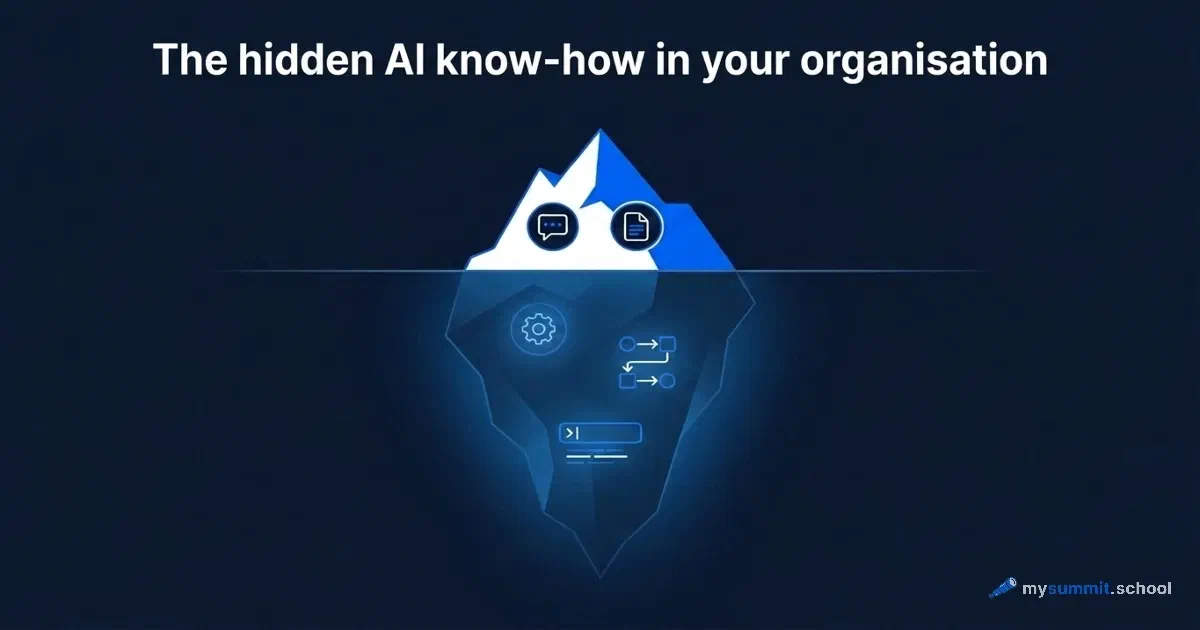
A doctor, 31, uses AI several times a day. He built a prompt template for the tool his hospital approved, and by his own account the results are startling. His colleagues have the same tool and complain that it gives them nothing. He knows his template would fix that.
He still does not share it.
That is the opening case in an HBR study, which asks an awkward question: if AI really does raise productivity, why can’t companies see it? A global survey by KPMG and the University of Melbourne – more than 48,000 respondents – found the answer. 57% of employees admit they hide how they use AI at work.
This is not the familiar shadow-AI story. The issue is not that people reach for tools nobody approved. The issue is that they build methods which save hours, and then keep them.
Greg Shove, chief executive of Section, put it plainly: “There is ROI from AI. It just stays with the employee instead of the organisation.”
Why this is a different problem than it looks
Hidden knowledge is nothing new. Research on organisational silence – why people stay quiet about problems, risks and worries – has been running for decades. AI changes what gets hidden.
People used to stay quiet about problems. Now they stay quiet about solutions.
That difference matters. When someone finds a prompt sequence that turns a three-hour task into twenty minutes, it is not a personal shortcut. It is organisational value wrapped in a personal asset that cannot be split. Productive improvements used to be built into shared systems and processes, where they scaled by default. AI methods do not. They are portable, they get better in private, and they stay private just as easily.
Most companies respond the usual way: write an AI policy, publish a list of approved tools, tighten monitoring. All sensible. The research says it treats the symptom. The cause is trust.
The three calculations an employee makes
Before showing a method, a person runs a quick cost-benefit analysis on disclosure. The authors identify three components.
The first is reputation. A young consultant uses AI just as much as his colleagues and says nothing, because it feels like an admission of incompetence. At another company an analyst shared an AI tool with the team and got this from a senior colleague: “The computer did that, not you.” Organisations announce innovation while local norms punish the appearance of using AI.
The second is workload. One management consultant was blunt about it: “If I automate A and B, they won’t let me focus on C. They’ll load me with D, E and F.” Once efficiency turns into an instruction to do even more, people have a rational motive to hide the fact that they got faster.
The third is replacement. Corporate AI systems log prompts, record iterations and document successful methods. Matthew Call, a professor at Texas A&M’s business school, names the problem directly: knowledge that used to accumulate over years of experience can now be extracted, written down and handed to somebody else. His advice to employees is to use personal tools rather than corporate ones for their most valuable work, so the method stays with them.
The fear is not paranoia, and the statistics back it up. The Stanford AI Index 2026 (in Russian) records productivity gains of 14–26% in fields such as customer support and software development. It also records falling hiring of junior specialists in those same fields. In other words, the places where AI works best are the places where entry-level jobs go first. An employee watching this draws a reasonable conclusion: a documented method is not a contribution to the common good. It is one fewer line on the headcount plan.
When hiding from your employer becomes a sensible career strategy, the organisation has already lost the argument about trust.
All three fears come down to one question: what happens to me when the organisation sees how I work?
What the trust data shows
USC researchers surveyed 604 employees who use AI every day. Almost a third – 30% – said they had deliberately withheld AI knowledge, methods or techniques from colleagues or employers. That is below the 57% in the KPMG survey, and still a lot.
At the same time, 80% of those same people agreed that sharing AI knowledge would improve team tasks, help colleagues and lift team output. They understand the value of sharing. They still do not share.
The strongest predictor of hiding turned out to be the level of organisational trust. Employees in the bottom trust quartile hid AI knowledge in 47% of cases; in the top quartile, 14%. Psychological safety shows a similar pattern: 45% against 17%.
Curiously, neither the existence of an AI policy nor access to approved tools predicted whether people shared. Corporate infrastructure does not work without a cultural foundation. More than that: approved tools strengthened the link between trust and openness where trust was high, and sharpened fear where it was low. A tool that logs your work becomes a threat rather than an opportunity in the hands of a low-trust organisation.
It helps to see where that distrust comes from. The same AI Index 2026 found that 73% of experts expect AI to be good for people’s work, against 23% of the general public. The average employee lives in a very different emotional climate from an AI specialist or a senior manager. In that climate, hiding your methods is an instinct, not calculated sabotage.
A meta-analysis of 104 studies covering around 32,000 employees confirms the general pattern: psychological safety goes with less knowledge hiding, while toxic supervision, job insecurity and a competitive culture go with more.
This matches what we saw in the Microsoft WTI 2026 research (in Russian): organisational factors explain 67% of the variation in AI effectiveness – twice the contribution of individual employee skills. Technology does not perform in a cultural vacuum.
Why experimentation looks like breaking the rules
Amy Edmondson of Harvard Business School separates two kinds of failure: blameworthy deviation, where someone ignores the rules to cut a corner, and praiseworthy exploratory testing, where someone experiments at the edge of the known and produces failures that generate useful learning. The trouble is that organisations routinely mistake the second for the first.
Employees who write their own prompt sequences, build unconventional workflows and iterate outside the official AI policy are the textbook example of the second. React to them as if they were the first, and you punish exactly the behaviour you need.
A Stanford Digital Economy Lab study of 51 enterprise AI deployments found that 77% of the hardest problems were not technological. Among them: winning the trust of sceptical teams.
It is the same picture we examined in why AI pilots die between the demo and the factory floor: the gap between “the technology works” and “people use it” comes down to whether using it is organisationally safe, not to what the tool can do.
Prompt engineering looks simple until you need a reliable result. The distance between “it sometimes works” and “it works every time” is a skill that does not pass from person to person on its own: it has to be built deliberately, and handed over just as deliberately. The open module at mysummit.school gives you 9 real management tasks to test where the gaps in your own AI approach are.
Test your approach to AI on 9 real management tasks. Free, no sign-up.
No payment required • Get notified on launch
What a manager can do
The findings are uncomfortable for managers. None of the fears employees describe is paranoia. Each is a fair reading of how organisations have historically treated personal productivity: they took the gains and shared none of them. A manager who wants people to show how they work with AI has to offer a different deal.
The authors propose five directions.
Remove the ambiguity
Employees burn cognitive effort managing how their AI use will look, instead of doing the work. Stopping that takes a permissive policy rather than a prohibitive one: what is encouraged, what is restricted, and how to act in the grey zones.
This does not require redesigning every process around AI. It requires removing the ambiguity that makes people hide.
Lower the cost of disclosure
Research on knowledge repositories shows that people contribute when the system reduces the effort of codifying knowledge instead of adding to it. Asking an employee to turn their working prompt sequence into a methodology document adds effort. The right format: show it once in a short demo, the company takes on documenting and distributing it, the author keeps the attribution.
And that last part is essential. Disclosure should raise a person’s standing, not wipe it out.
Do not tax efficiency
If an employee knows that a saved hour will immediately fill up with D, E and F, there is no incentive to reveal that they got faster. You need an explicit agreement about what the time they save is for – deep work, development, harder projects, recovery. The rule only holds if the employee sees a personal benefit, and not only a benefit for the company.
The logic is the same as in supplier relationships: partners are more willing to reveal ways to cut costs when they keep part of the saving rather than passing all of it on as a lower price.
Reward multiplication, not productivity
AI productivity leaderboards and one-off bonuses for clever tricks create a competitive climate, and the research shows that this is precisely the climate that increases knowledge hiding between colleagues. You need a different metric: not who uses AI best, but whose method other people adopted.
Concretely: attribution in team results for the methods others took up; protected time for further experiments; transparent feedback on where the contribution was used, what changed and what recognition it earned. That is the distance between handing over your advantage and becoming a recognised multiplier.
An experiment with salespeople – random pairs, structured meetings – found that conversations about what worked and why produced sustained sales growth of more than 15% for at least 20 weeks. Collective incentives on their own produced a short-lived effect. Only combined with a norm of sharing what works did they last.
Get the first thirty seconds right
This is the most important point. It is also the cheapest.
When an employee shows you their AI method, your reaction is the most accurate signal of what the declared culture of openness actually means. A sceptical question, visible disappointment, even a neutral “interesting” with no interest behind it – and the person remembers: disclosure does not pay. The next experiment stays with them.
There is a subtler trap. The well-meaning response: “Great! Now explain it to the whole team.” That turns honesty into unpaid labour. Someone who shares a finding should not become its permanent evangelist. The company takes on distribution, and the person keeps the credit.
In our piece on thinkslop (in Russian) we looked at the other side of the same problem: AI replacing thought instead of sharpening it. Hiding AI knowledge is the mirror image. The collective intelligence is there; the organisation cuts itself off from it, because its culture makes sharing a bad deal.
A good AI result looks convincing. So does a bad one. The open module at mysummit.school exists so you can tell the difference on real management tasks before it costs you time or reputation.
9 practical management tasks in the open module: try AI on real work and find your growth point. Free, no sign-up.
No payment required • Get notified on launch
A warning about corporate tools
One finding deserves attention from anyone rolling out corporate AI right now.
Approved tools log prompts, iterations and successful methods. That is exactly what makes them valuable to the organisation: you can see who discovered what, credit it and spread it. It is also what makes them dangerous in a low-trust environment, because the same data can be used to extract a method, document it and hand it to somebody else.
The data is clear. Where trust is high, approved tools increase open sharing. Where trust is low, they increase hiding. An enterprise AI rollout in a dysfunctional culture will not fix the culture. It will harden the pattern of hiding.
This connects to what Benedict Evans describes as the task–job gap (in Russian): a documented task is easy to hand over, professional judgement is not. When employees sense that a corporate tool is documenting their tasks for transfer, they rationally move their most valuable work onto personal tools.
The paradox worth naming
57% hide their AI use. 80% understand that sharing would help the team. The distance between those two numbers is not a tooling problem or a policy problem. It is the price of distrust, paid in knowledge that never travels.
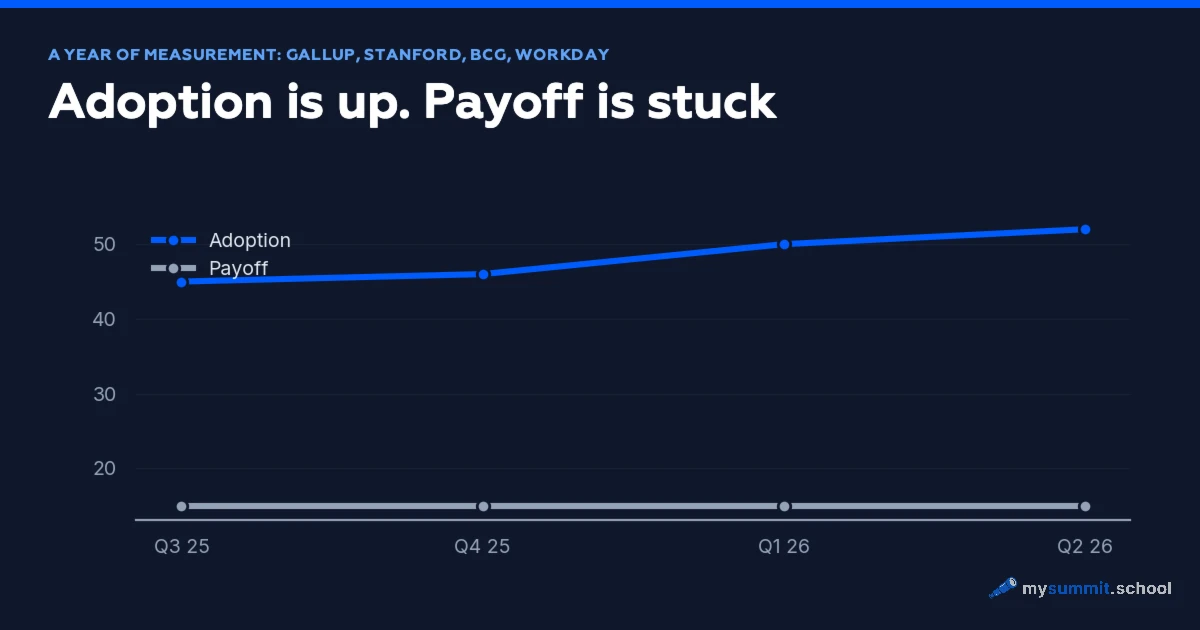
Organisations focused only on whether employees use AI are asking the wrong question. The Stanford AI Index 2026 (in Russian) records 88% AI adoption in companies. But adopting a tool and gaining from it are different things. The real question is whether employees trust the organisation enough to show what they have found.
While the answer is no, the ROI from AI will be distributed across individual careers rather than team results. This is not a conspiracy of employees against the company. It is a sensible response to how companies have historically handled personal efficiency.
It can be changed. But first you have to answer honestly: what happens to the person who shows you their method right now?
From a personal trick to a team skill
The foundation of the course builds a systematic understanding of AI: how to set tasks, verify results and hand methods over so that they work for more than one person. The team management specialisation examines the organisational patterns separately.
Часто задаваемые вопросы
Why do employees hide their AI use at work?
How does trust affect whether employees share their AI findings?
What does it mean that the ROI stays with the employee?
Does a corporate AI policy stop hidden AI use?
What can a manager actually do to get the team sharing AI techniques?
Stanislav Belyaev
Engineering Leader at Microsoft18 years leading engineering teams. Founder of mysummit.school. 700+ graduates at Yandex Practicum and Stratoplan.