
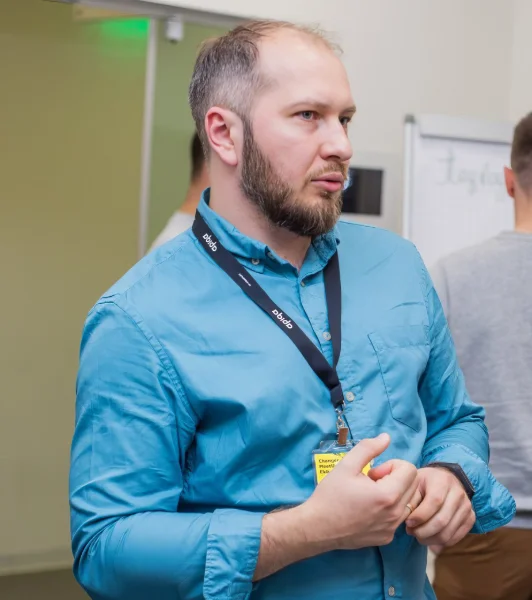
Stanislav Belyaev
Founder of mysummit.school, Engineering Leader at Microsoft
Leads engineering teams at Microsoft and works with AI himself every day. Before that he taught managers at Yandex Practicum and Stratoplan.
Career
Building and scaling engineering teams since 2008 – from startups to enterprises with thousands of developers. At Microsoft, doubled build system productivity for 2,000+ engineers. Previously transformed processes for 600+ IT staff at Tochka Bank, cutting delivery times from weeks to days.
Teaching
Co-author and mentor of the IT Project Manager course at Yandex Practicum – 500+ students over three years. Trainer at Stratoplan with a 9/10 course rating. Three years teaching Project Management in IT at Ural Federal University.
mysummit.school
A platform where managers learn to use AI in practice. Concrete skills: from writing prompts and detecting hallucinations to measuring the ROI of AI adoption. Text-based format with interactive assignments – learn at your own pace.
What graduates say
The most valuable part for me – the course changed how I think. I finally understood how to structure work with AI properly: how to write prompts, where the models have limits, when they can be trusted and when it is better to double-check the result. I spent three days trying to design an AI quest for schoolchildren and kept hitting a dead end. Then I opened the course materials, rebuilt the prompt using the structure I had learned – and within a couple of hours the task was fully solved.
Milan Alkeshev Product Manager | SKO Hub powered by Astana Hub | KazakhstanRead the full review
I want to share my impressions after completing the "Foundation" block of the course "Artificial Intelligence for Managers: from Fundamentals to Practice".
When I signed up, I knew I was using AI very superficially. I would open ChatGPT or Grok for simple tasks now and then, but I wanted to work out how to apply AI deliberately in my work and in project management, instead of just collecting ready-made answers.
The most valuable part for me – the course changed how I think. I finally understood how to structure work with AI properly: how to write prompts, where the models have limits, when they can be trusted and when it is better to double-check the result. The topics of critical thinking, security and MCP stood out in particular. Before the course I had no idea how far AI agents have come today and how they can work with different systems.
What stayed with me most was the practical assignment with the analytical memo. I failed it the first time because I built the prompt wrong. After going through the mistakes I tried again – and it worked. That was the moment I understood that this course is not about grades, it is about the habit of working with AI correctly.
The knowledge paid off almost immediately at work. For example, I spent three days trying to design an AI quest for schoolchildren and kept hitting a dead end. Then I opened the course materials, rebuilt the prompt using the structure I had learned – and within a couple of hours the task was fully solved. After that I started approaching neural networks completely differently.
During a work trip our team visited universities and factories where we talked about real AI adoption. It felt good to realise that thanks to the course I understood the terminology, could hold the conversation and ask genuinely substantive questions. That was when I became certain I had chosen the right training.
I want to say a separate thank you to my mentor Stanislav. Once a week we had a call and worked through the homework and whatever questions had come up along the way. There were times I wanted to put the course aside, but it was his support and one simple rule – give the studying at least 20 minutes a day – that kept me from dropping out and got me to the finish.
After finishing the block I became far more confident using AI at work. I now use it regularly to analyse tasks, prepare reports and look for solutions, but the main thing is that I learned to tell when AI genuinely helps and when the task is better solved without it.
Thank you to the course team for a strong foundation, a large amount of practice, and knowledge that is already helping me in my work. I confidently recommend this course to managers, team leads, and anyone who wants to learn to use AI as a real working tool rather than a box to tick.
Honestly, I expected the course to sell me on AI in every state of matter. In reality half of it is about the errors AI makes and the errors people make interpreting its results. For me that was a genuine revelation. It became clear that the way I used to write my queries, and the way I organised checking them, was a very basic level – going on instinct.
Mikhail Seleznev Project Manager, PMP | Bereke BankRead the full review
I am still in the "Foundation" block. Honestly, I expected the course to sell me on AI in every state of matter. In reality half of it is about the errors AI makes and the errors people make interpreting its results. For me that was a genuine revelation.
It became clear that the way I used to write my queries, and the way I organised checking them, was a very basic level – going on instinct. And that properly, you need to build templates for your queries to get a better result.
This is what I would recommend as onboarding for teams and companies that have decided to take up AI. I judge by my own sysadmins: when they send me the results of working through a problem with GPT, you can see they lack prompting skills and AI skills generally. They are unlikely to dig into it themselves until a deliberate "AI adoption" push reaches them. And I have a feeling that will not happen soon: all the effort goes to the developers alone.
Just finished the "Foundation" module on mysummit.school – a base course on applying AI in your work: prompt engineering, privacy, ethics, copywriting, and more. Learned a working prompt structure that gives much better answers. Started using Personas in queries. Finally understood what Agents are and for which tasks they make sense. A must for anyone already using ChatGPT or just considering it.
Alexey Sokol Head of PMO | Portfolio Director (IPMA-A) | Manufacturing & Engineering
You put the idea in my head that a project manager is not a pair of hands, but part of the team whose job is to find bottlenecks and remove obstacles so people can do their best work. I don't know how my career would have turned out with a different mentor.
Yandex Practicum graduate Project Manager
The 8-week program transformed my career path. I learned to balance features and tech debt, position my skills in the market. Now I apply these frameworks to release planning.
Stepan Mordvinov QA -> Product Management, SPORTSOFT
Very interesting material for me as a team lead – it broadened my understanding of how to communicate with the team at all levels. I immediately started applying everything, especially the tech debt part.
Anzhalika Novikova Team Lead